Native Plants

Plant Database
Search for native plants by scientific name, common name or family. If you are not sure what you are looking for, try the Combination Search or our Recommended Species lists.
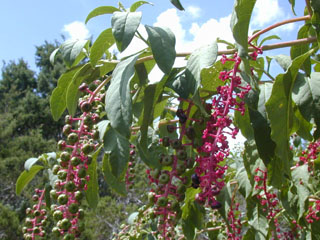
Marcus, Joseph A.
Phytolacca americana
Phytolacca americana L.
American Pokeweed, Great Pokeweed, Pokeweed, Pokeberry, Red Ink Plant, Pigeonberry
Phytolaccaceae (Pokeweed Family)
Synonym(s):
USDA Symbol: PHAM4
USDA Native Status: L48 (N), CAN (N)
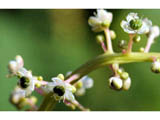
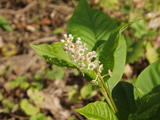
A tall, large-leaved, branching plant with reddish stems and long clusters of small, white flowers.
This is frequently a troublesome weed. Because all parts of the plant are poisonous, its potential ethnobotanical uses are not treated here.

Plant Characteristics
Duration: PerennialHabit: Herb
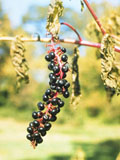
Fruit Type: Berry
Size Notes: Up to about 20 feet tall, often much shorter.
Leaf: Green
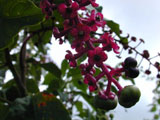
Fruit: Purple
Bloom Information
Bloom Color: White , Pink , PurpleBloom Time: Jan , Feb , Mar , Apr , May , Jun , Jul , Aug , Sep , Oct , Nov , Dec
Bloom Notes: Flowers summer-fall in northern part of range, may flower year-round in southern part of range.
Distribution
USA: AL , AR , AZ , CA , CT , DC , DE , FL , GA , IA , IL , IN , KS , KY , LA , MA , MD , ME , MI , MN , MO , MS , NC , NE , NH , NJ , NY , OH , OK , OR , PA , RI , SC , TN , TX , VA , VT , WI , WVCanada: NB , ON , QC
Native Distribution: Ontario to southern Quebec, New England, and New York; south to Florida; west to Texas and Mexico; north to Minnesota.
Native Habitat: Open woods, damp thickets, clearings, roadsides.
Growing Conditions
Water Use: MediumLight Requirement: Part Shade
Soil Moisture: Moist
CaCO3 Tolerance: High
Conditions Comments: Pokeweed has a perennial root stock, and also reseeds. It proliferates in disturbed areas.
Benefit
Warning: POISONOUS PARTS: All parts, mainly the roots; shoots, leaves, and berries when fresh and in quantity. Highly toxic, may be fatal if eaten. Toxic Principle: Phytolaccatoxin and related triterpene saponins, an alkaloid (phytolaccin), and histamines.Conspicuous Flowers: yes
Attracts: Birds
Deer Resistant: High
Find Seed or Plants
Order seed of this species from Native American Seed and help support the Wildflower Center.
Mr. Smarty Plants says
Plant Identification
September 24, 2008
I have a single stem red vine with purple berries growing on it. It is in a cluster of bushes and gets mostly morning and early afternoon sun. The berries also have small bumps at the stem. I have ...
view the full question and answer
National Wetland Indicator Status
| Region: | AGCP | AK | AW | CB | EMP | GP | HI | MW | NCNE | WMVE |
| Status: | FACU | FAC | FACU | FACU | FACU | FACU | FACU |
From the National Organizations Directory
According to the species list provided by Affiliate Organizations, this plant is on display at the following locations:Lady Bird Johnson Wildflower Center - Austin, TX
Pineywoods Native Plant Center - Nacogdoches, TX
Bibliography
Bibref 1207 - Earth Medicine, Earth Food (1990) Michael A. WeinerBibref 417 - Field Guide to Medicinal Plants and Herbs of Eastern and Central North America (2000) Foster, S. & J. A. Duke
Bibref 1294 - The Midwestern Native Garden: Native Alternatives to Nonnative Flowers and Plants An Illustrated Guide (2011) Adelman, Charlotte and Schwartz, Bernard L.
Search More Titles in Bibliography
Web Reference
Webref 38 - Flora of North America (2019) Missouri Botanical Garden, St. Louis, MO & Harvard University Herbaria, Cambridge, MA.Webref 23 - Southwest Environmental Information Network (2009) SEINet - Arizona Chapter
From the Archive
Wildflower Newsletter 1992 VOL. 9, NO.6 - Architectural Plans for new Facility Taking Shape, Native Plants Provide Local C...Additional resources
USDA: Find Phytolacca americana in USDA PlantsFNA: Find Phytolacca americana in the Flora of North America (if available)
Google: Search Google for Phytolacca americana
Metadata
Record Modified: 2022-10-20Research By: NPC