Native Plants

Plant Database
Search for native plants by scientific name, common name or family. If you are not sure what you are looking for, try the Combination Search or our Recommended Species lists.
Morella californica
Morella californica (Cham.) Wilbur
Pacific Wax Myrtle, California Wax Myrtle, Pacific Bayberry, California Bayberry
Myricaceae (Bayberry Family)
Synonym(s): Myrica californica
USDA Symbol: MOCA6
USDA Native Status: L48 (N), CAN (N)
California Wax Myrtle is a tree-like, densely bushy evergreen shrub with glossy, dark-green, narrow leaves. The 10-25 ft., aromatic shrub has slender, ascending branches. Spring catkins are followed by brown-purple fruit.
Pacific Wax Myrtle is sometimes planted as an ornamental shrub for the showy berries and dense, shiny evergreen foliage. The fruit is eaten in small quantities by myrtle warblers and many other birds. The waxy covering of the fruit apparently is not used; colonists extracted the wax from related Eastern bayberries or Wax myrtles (Morella cerifera) in boiling water and made fragrant-burning candles.
From the Image Gallery
No images of this plant
Plant Characteristics
Duration: PerennialHabit: Shrub
Leaf Retention: Evergreen
Leaf Arrangement: Alternate
Leaf Complexity: Simple
Fruit Type: Drupe
Size Notes: 6-30 feet tall, 10-20 feet wide.
Leaf: Dark Green
Fruit: Purple.
Bloom Information
Bloom Color: White , YellowBloom Time: Apr , May , Jun , Jul
Distribution
USA: CA , OR , WACanada: BC
Native Distribution: Coastal areas from c. CA to WA & Vancouver I., B.C.
Native Habitat: Canyons & moist slopes below 500 ft.
Growing Conditions
Water Use: MediumLight Requirement: Sun , Part Shade
CaCO3 Tolerance: Medium
Soil Description: Moist, well-drained, slightly acid sands or loams.
Conditions Comments: This shrub tolerates beach wind.
Benefit
Use Ornamental: Good for hedges.Use Wildlife: Attracts Eastern Kingbird, Northern Mockingbird, Northern Flicker, Red-bellied Woodpecker, and Wood Thrush (Audubon At Home).
Attracts: Birds , Butterflies
Larval Host: Red-banded Hairstreak
Butterflies and Moths of North America (BAMONA)
|
Banded Hairstreak (Satyrium calanus) 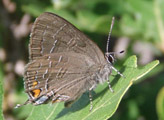 Larval Host |
Red-banded Hairstreak (Calycopis cecrops) 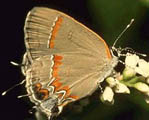 Larval Host |
Propagation
Description: California wax myrtle can be increased by seeds, cuttings, or by layering.Commercially Avail: yes
Find Seed or Plants
View propagation protocol from Native Plants Network.
National Wetland Indicator Status
| Region: | AGCP | AK | AW | CB | EMP | GP | HI | MW | NCNE | WMVE |
| Status: | FACW | FACW |
From the National Organizations Directory
According to the species list provided by Affiliate Organizations, this plant is on display at the following locations:Santa Barbara Botanic Garden - Santa Barbara, CA
Bibliography
Bibref 1186 - Field Guide to Moths of Eastern North America (2005) Covell, C.V., Jr.Bibref 1185 - Field Guide to Western Butterflies (Peterson Field Guides) (1999) Opler, P.A. and A.B. Wright
Bibref 841 - Native Alternatives to Invasive Plants (2006) Burrell, C. C.
Search More Titles in Bibliography
Web Reference
Webref 30 - Calflora (2018) CalfloraWebref 38 - Flora of North America (2019) Missouri Botanical Garden, St. Louis, MO & Harvard University Herbaria, Cambridge, MA.
Webref 23 - Southwest Environmental Information Network (2009) SEINet - Arizona Chapter
Additional resources
USDA: Find Morella californica in USDA PlantsFNA: Find Morella californica in the Flora of North America (if available)
Google: Search Google for Morella californica
Metadata
Record Modified: 2023-04-18Research By: TWC Staff