Native Plants

Plant Database
Search for native plants by scientific name, common name or family. If you are not sure what you are looking for, try the Combination Search or our Recommended Species lists.
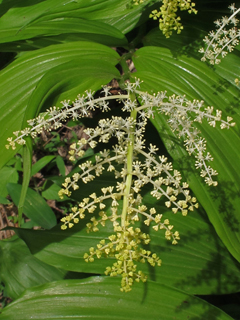
Cressler, Alan
Maianthemum racemosum ssp. racemosum
Maianthemum racemosum (L.) Link ssp. racemosum
Feathery False Lily Of The Valley, False Spikenard, False Solomon's Seal, Solomon's Plume, Smilacina
Liliaceae (Lily Family)
Synonym(s): Convallaria racemosa, Smilacina ciliata, Smilacina flexicaulis, Smilacina racemosa, Smilacina racemosa var. cylindrata, Smilacina racemosa var. lanceolata, Smilacina racemosa var. typica, Vagnera australis, Vagnera racemosa
USDA Symbol: MARAR
USDA Native Status: L48 (N), CAN (N)
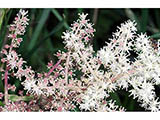
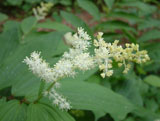
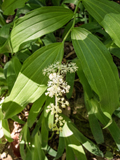
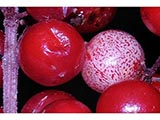
The 1-4 ft., arching, unbranched stems of this widespread perennial bear two rows of elliptic leaves. A many-flowered raceme is at the tip of the stem and is made up of tiny, white flowers. Berries ripen to a pink-red in autumn. Each branched rhizome bears one to several stems. As a landscaping plant, it is most effective when planted in groups of six or more stalks.
The feathery, creamy-white masses of flowers borne at the end of the stem distinguish this species from the true Solomon's seals (Polygonatum spp.), which have pendulous, axillary, bell-like flowers. The rhizome lacks the seal-like pattern of the true Solomon's seals, but exhibits circular stem scars. The usual western form is subspecies amplexicaule, with longer flower clusters and shorter leaves than the eastern subspecies. A smaller species, Star-flowered Solomon's Seal (M. stellatum), found throughout the East except for the coastal states from North Carolina to Texas, has a raceme of larger star-shaped flowers, 1/4" (6 mm) long, leaves clasping stem, and larger berries; at first the berries are striped with blackish red, eventually becoming completely blackish red.
Plant Characteristics
Duration: PerennialHabit: Herb
Leaf Complexity: Simple
Fruit Type: Berry
Size Notes: Arching stems up to about 4 feet long.
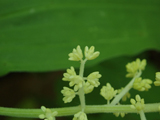
Flower: Flowers in 1 to 4 inch clusters. Individual flowers tiny.
Fruit: Red, in 1 to 4 inch clusters.
Bloom Information
Bloom Color: WhiteBloom Time: Mar , Apr , May , Jun
Distribution
USA: AK , AL , AR , CT , DC , DE , FL , GA , IA , IL , IN , KS , KY , LA , MA , MD , ME , MI , MN , MO , MS , NC , ND , NE , NH , NJ , NM , NY , OH , OK , PA , RI , SC , SD , TN , VA , VT , WI , WVCanada: BC , MB , NB , NS , ON , PE , QC
Native Distribution: N.S. to AK, s. in the east to GA & TX, in the west through mts. to AZ & s. CA
Native Habitat: Woods; clearings; bluffs
Growing Conditions
Water Use: MediumLight Requirement: Part Shade , Shade
Soil Moisture: Moist
Soil pH: Acidic (pH<6.8)
Cold Tolerant: yes
Soil Description: Deep, humus-rich, acid soils.
Conditions Comments: Though it prefers moist, deciduous woods, this plant is also found, in a stunted form, growing in drier, shallower soils or open spaces.
Benefit
Use Ornamental: A good shade plant with late spring blossoms.Use Wildlife: Birds and small mammals eat this plant's berries. Deer browse leaves.
Conspicuous Flowers: yes
Attracts: Birds
Deer Resistant: No
Propagation
Propagation Material: Root Division , SeedsDescription: Divide rhizomes early spring or fall and plant 2 inches deep.
Seed Collection: Approximate collection date in northern U.S.: September
Seed Treatment: If seeds are stored, cold-moist stratification (40 degrees for 3-4 months) is required. A cold-warm-cold treatment has also given good results.
Commercially Avail: yes
Mr. Smarty Plants says
Groundcover to reduce erosion for shady area in New York
May 05, 2009
We live on a lake with gravelly and clay soils, lots of wind and little sun. I am looking for a native ground cover that will help reduce erosion over some of the steep slopes facing south (under shad...
view the full question and answer
From the National Organizations Directory
According to the species list provided by Affiliate Organizations, this plant is on display at the following locations:Mt. Cuba Center - Hockessin, DE
Bibliography
Bibref 928 - 100 easy-to-grow native plants for Canadian gardens (2005) Johnson, L.; A. LeyerleSearch More Titles in Bibliography
Web Reference
Webref 38 - Flora of North America (2019) Missouri Botanical Garden, St. Louis, MO & Harvard University Herbaria, Cambridge, MA.Webref 23 - Southwest Environmental Information Network (2009) SEINet - Arizona Chapter
Additional resources
USDA: Find Maianthemum racemosum ssp. racemosum in USDA PlantsFNA: Find Maianthemum racemosum ssp. racemosum in the Flora of North America (if available)
Google: Search Google for Maianthemum racemosum ssp. racemosum
Metadata
Record Modified: 2023-02-17Research By: TWC Staff