Native Plants

Plant Database
Search for native plants by scientific name, common name or family. If you are not sure what you are looking for, try the Combination Search or our Recommended Species lists.
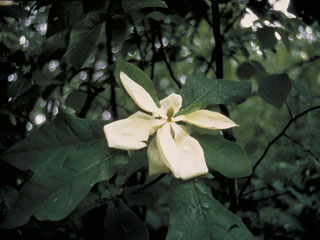
Loughmiller, Campbell and Lynn
Magnolia ashei
Magnolia ashei Weath.
Ashe's Magnolia, Ashe Magnolia, Deciduous Magnolia
Magnoliaceae (Magnolia Family)
Synonym(s): Magnolia macrophylla ssp. ashei, Magnolia macrophylla var. ashei
USDA Symbol: MAAS
USDA Native Status: L48 (N)
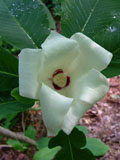
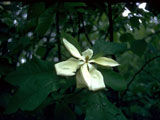
The Ashe magnolia is a small deciduous tree with a broad, round top. It has leaves 2-3 feet long and sometimes a foot wide. They are wider near the tip than at the stem, green on the upper surface and whitish beneath. The blossoms, which grow at the end of stout stems, are fragrant, creamy white, cup-shaped, opening out flat as they mature. Each blossom has 6-8 petals, up to 6 inches long and about half as wide, and pointed at the tip. The pistils form a fleshy, oval, seed-bearing cone which enlarges as it matures, 2-4 inches long and about 2 inches in diameter. The seeds are attached to the cone by slender threads.
This rare species of very local distribution is closely related to Bigleaf Magnolia (Magnolia macrophylla), which is taller and has larger leaves and flowers. Named for its discoverer, William Willard Ashe (1872-1932), pioneer forester of the United States Forest Service.

Plant Characteristics
Duration: PerennialHabit: Tree
Leaf Retention: Deciduous
Leaf Arrangement: Alternate
Leaf Complexity: Simple
Leaf Venation: Pinnate
Leaf Margin: Entire
Breeding System: Flowers Bisexual
Fruit Type: Aggregate , Follicle
Size Notes: Up to about 35 feet tall.
Fruit: Cone-like aggregated follicles.
Bloom Information
Bloom Color: WhiteBloom Time: Mar , Apr , May , Jun
Distribution
USA: FLNative Distribution: FL Panhandle
Native Habitat: Endemic to a few bluffs and bayheads of the FL Panhandle
Growing Conditions
Light Requirement: Part ShadeSoil Description: Rich, acid soils.
Conditions Comments: Horticulturalists hope this plant will provide a large-flowered magnolia with flowers at a height that allows them to be easily seen. Plants flower when very small.
Propagation
Description: Fresh seed sown in fall; stratified seed; semi-hardwood cuttings taken in summerSeed Collection: When ripe, the seeds are bright red, fleshy, oily, soft on the outside and stony on the inside. Gather when ripe. Clean and store in moist sand or sphagnum moss in refrigerator. Cold, moist storage also serves at stratification.
Seed Treatment: Stored seed must be kept moist and cool which will also serve as stratification. Stratify at least 60 days.
Commercially Avail: yes
National Wetland Indicator Status
| Region: | AGCP | AK | AW | CB | EMP | GP | HI | MW | NCNE | WMVE |
| Status: | FACU |
From the National Organizations Directory
According to the species list provided by Affiliate Organizations, this plant is on display at the following locations:Mt. Cuba Center - Hockessin, DE
Bibliography
Bibref 1620 - Gardening with Native Plants of the South (Reprint Edition) (2009) Wasowski, S. with A. WasowskiBibref 248 - Texas Wildflowers: A Field Guide (1984) Loughmiller, C. & L. Loughmiller
Search More Titles in Bibliography
Web Reference
Webref 3 - Flora of North America (2014) Missouri Botanical Garden, St. Louis, MO & Harvard University Herbaria, Cambridge, MA.Additional resources
USDA: Find Magnolia ashei in USDA PlantsFNA: Find Magnolia ashei in the Flora of North America (if available)
Google: Search Google for Magnolia ashei
Metadata
Record Modified: 2022-10-07Research By: TWC Staff