Native Plants

Plant Database
Search for native plants by scientific name, common name or family. If you are not sure what you are looking for, try the Combination Search or our Recommended Species lists.
Wasowski, Sally and Andy
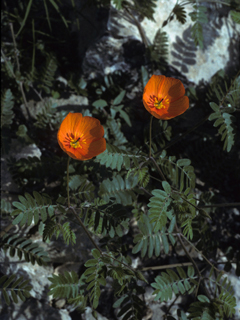
Kallstroemia grandiflora
Kallstroemia grandiflora Torr. ex A. Gray
Arizona Poppy, Desert Poppy, Orange Caltrop, Summer Poppy
Zygophyllaceae (Creosote-Bush Family)
Synonym(s):
USDA Symbol: KAGR
USDA Native Status: L48 (N)
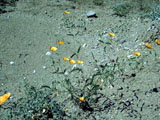
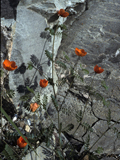
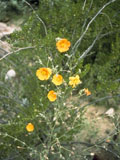
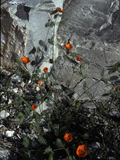
Forming large populations in favorable years, the showy flowers of this annual plant superficially resemble the California poppy. Orange Caltrop grows 2-3 feet tall, sometimes more, and its several branches are quite hairy. It is inclined to spread and is often seen in clumps 2-5 feet across. Leaves are opposite and compound, with 5-10 pairs of leaflets about 1 inch long on each side of the midrib, like the feather of a bird. It is a favorite bird food, especially liked by doves. The flowers, often 2 1/2 inches in diameter, have 5 petals, 5 sepals, and 10 stamens. They are orange in color with dark-vermillion centers.
These are not Poppies, and they are not closely related, but the resemblance is there and large patches provide a display as brilliant and spectacular as those of California Poppies (Eschscholtzia californica). This is one of the most handsome wildflowers in the Southwest, frequent along roadsides. There are several other Kallstroemica species that can be recognized by the opposite, pinnately compound leaves on trailing stems. They have corollas only about 1/2" (1.3 cm) wide. All species are Southwestern. One, Small-flowered Carpetweed (K. parviflora), has orange flowers, and a beak on the fruit that is longer than the round body. Two have yellow flowers and short beaks. On Hairy Carpetweed (K. hirsutissima) sepals do not drop off, and the base of the fruit's beak is bristly-hairy. California Carpetweed (K. californica) has sepals that usually drop off after the flower opens, and has no hairs, or only small ones at the base of the beak.
Plant Characteristics
Duration: AnnualHabit: Herb
Fruit Type: Schizocarp
Size Notes: Up to about 3 feet tall.
Bloom Information
Bloom Color: White , Orange , YellowBloom Time: Jun , Jul , Aug , Sep , Oct
Distribution
USA: AZ , CA , NM , TXNative Distribution: S.e. CA to w. TX, also Mex.
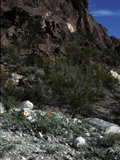
Native Habitat: Sandy deserts, plains & mesas below 5000 ft.
Growing Conditions
Light Requirement: SunSoil Description: Sandy soils.
Conditions Comments: Summer poppy seeds germinate in response to summer rains and complete their life cycle in a few months.
Benefit
Use Wildlife: Seeds are important dove and quail food.Attracts: Birds
Propagation
Description: Seeds may take several years to germinate due to the presence of germination inhibitors that require several season to wash off.Commercially Avail: yes
Find Seed or Plants
Find seed sources for this species at the Native Seed Network.
From the National Organizations Directory
According to the species list provided by Affiliate Organizations, this plant is on display at the following locations:Native Seed Network - Corvallis, OR
Bibliography
Bibref 248 - Texas Wildflowers: A Field Guide (1984) Loughmiller, C. & L. LoughmillerSearch More Titles in Bibliography
Web Reference
Webref 38 - Flora of North America (2019) Missouri Botanical Garden, St. Louis, MO & Harvard University Herbaria, Cambridge, MA.Webref 23 - Southwest Environmental Information Network (2009) SEINet - Arizona Chapter
Additional resources
USDA: Find Kallstroemia grandiflora in USDA PlantsFNA: Find Kallstroemia grandiflora in the Flora of North America (if available)
Google: Search Google for Kallstroemia grandiflora
Metadata
Record Modified: 2023-02-15Research By: TWC Staff