Native Plants

Plant Database
Search for native plants by scientific name, common name or family. If you are not sure what you are looking for, try the Combination Search or our Recommended Species lists.
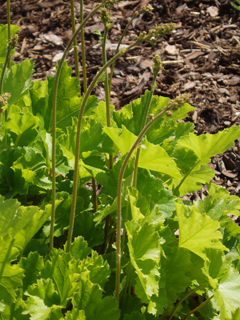
Makin, Julie
Heuchera americana
Heuchera americana L.
American Alumroot, Alumroot
Saxifragaceae (Saxifrage Family)
Synonym(s):
USDA Symbol: HEAM6
USDA Native Status: L48 (N), CAN (N)
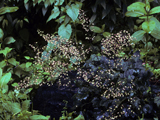
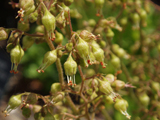
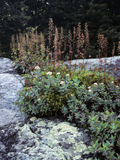
American alumroot's leafless, hairy, sticky flower stalk rises 18-36 in. and surrounds its upper third with loosely grouped, minute, greenish, cup-shaped flowers. A somewhat hairy stalk bearing yellowish-green, bell-shaped, drooping flowers in loose, slender, branching clusters; usually 4-5 flowers on each branch. A clump of attractive basal leaves springs from an underground stem. The leaves are fuzzy, oval, lobed and somewhat evergreen.
Several similar Heuchera species occur in the East, many of which are difficult to distinguish from one another. The genus name honors the 18th-century German physician and botanist Johann von Heucher.


Plant Characteristics
Duration: PerennialHabit: Herb
Inflorescence: Panicle
Fruit Type: Capsule
Size Notes: Usually around 18 inches high, but can grow to 3 feet
Leaf: Deep green. Shades of purple, red, and yellow in fall.
Autumn Foliage: yes
Flower: Flower tiny
Fruit: Dark red
Bloom Information
Bloom Color: Red , Green , Purple , BrownBloom Time: Mar , Apr , May , Jun , Jul , Aug
Bloom Notes: Pale greenish yellow or pale purple, so pale they almost appear white. Delicate and misty looking.
Distribution
USA: AL , AR , CT , DC , DE , GA , IA , IL , IN , KS , KY , LA , MD , MI , MO , MS , NC , NE , NJ , NY , OH , OK , PA , SC , TN , VA , WVCanada: ON
Native Distribution: CT to Ont. & MI, s. to GA & OK; Eastern North America, Zones 5 to 8.
Native Habitat: Rich woods; rock outcrops
Growing Conditions
Water Use: Low , MediumLight Requirement: Part Shade , Shade
Soil Moisture: Dry , Moist
Soil pH: Acidic (pH<6.8)
Soil Description: Well-drained, humus-rich, acid soils, sometimes rocky. Tolerates poor soil, low moisture, and lime.
Conditions Comments: In sunny areas, the leaves take on a bronze cast several months into the growing season.
Benefit
Use Ornamental: Valued as a foliage plant and groundcover in shady Eastern gardens. Also grows well in pots.Interesting Foliage: yes
Propagation
Propagation Material: Root Division , SeedsDescription: Sow seed in spring. Divide root crown in spring or fall.
Seed Collection: Check for mature seeds in dark-brown capsules 3-4 weeks after the plant has flowered. The seeds are black when mature and are smaller than grains of black pepper. Dried seeds may be stored, uncleaned, in sealed, refrigerated containers.
Commercially Avail: yes
Maintenance: The appearance of the plant is enhanced by division of the clump every 3 to 4 years.
Find Seed or Plants
View propagation protocol from Native Plants Network.
National Wetland Indicator Status
| Region: | AGCP | AK | AW | CB | EMP | GP | HI | MW | NCNE | WMVE |
| Status: | FACU | FACU | FACU | FACU | FACU |
From the National Organizations Directory
According to the species list provided by Affiliate Organizations, this plant is on display at the following locations:Native Plant Center at Westchester Community College, The - Valhalla, NY
Delaware Nature Society - Hockessin, DE
Mt. Cuba Center - Hockessin, DE
Bibliography
Bibref 1620 - Gardening with Native Plants of the South (Reprint Edition) (2009) Wasowski, S. with A. WasowskiBibref 1294 - The Midwestern Native Garden: Native Alternatives to Nonnative Flowers and Plants An Illustrated Guide (2011) Adelman, Charlotte and Schwartz, Bernard L.
Search More Titles in Bibliography
Additional resources
USDA: Find Heuchera americana in USDA PlantsFNA: Find Heuchera americana in the Flora of North America (if available)
Google: Search Google for Heuchera americana
Metadata
Record Modified: 2013-09-09Research By: TWC Staff