Native Plants

Plant Database
Search for native plants by scientific name, common name or family. If you are not sure what you are looking for, try the Combination Search or our Recommended Species lists.
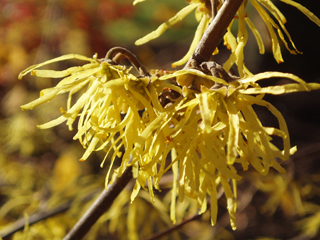
Makin, Julie
Hamamelis virginiana
Hamamelis virginiana L.
Witch-hazel, American Witch-hazel, Common Witch-hazel, Winterbloom, Snapping Hazelnut, Striped Alder, Spotted Alder, Tobacco-wood, Water-witch
Hamamelidaceae (Witch-Hazel Family)
Synonym(s): Hamamelis macrophylla, Hamamelis virginiana var. henryi, Hamamelis virginiana var. macrophylla, Hamamelis virginiana var. parvifolia
USDA Symbol: HAVI4
USDA Native Status: L48 (N), CAN (N)
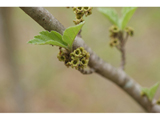
This small tree or tall shrub is often multi-trunked and usually grows 10-15 ft. tall but can reach 35 ft. in height. The large, crooked, spreading branches form an irregular, open crown. The floral display of witch hazel is unique. Its fragrant, yellow flowers with strap-like, crumpled petals appear in the fall, persisting for some time after leaf drop. Lettuce-green, deciduous leaves maintain a rich consistency into fall when they turn brilliant gold. Bark is smooth and gray.
The aromatic extract of leaves, twigs, and bark is used in mildly astringent lotions and toilet water. A myth of witchcraft held that a forked branch of Witch-hazel could be used to locate underground water. The foliage and fruits slightly resemble those of the shrub hazel (Corylus). Upon drying, the contracting capsule can eject its small seed as far as 30' (9 m).
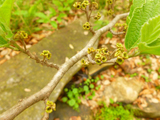
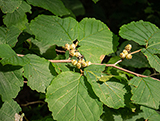

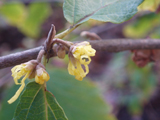
Plant Characteristics
Duration: PerennialHabit: Tree
Leaf Retention: Deciduous
Leaf Arrangement: Alternate
Leaf Complexity: Simple
Fruit Type: Capsule
Size Notes: Up to about 35 feet tall, often much shorter.
Leaf: Green
Autumn Foliage: yes
Flower: Flowers 1 inch long
Fruit: Brown
Bloom Information
Bloom Color: Orange , Yellow , Green , BrownBloom Time: Sep , Oct , Nov , Dec
Distribution
USA: AL , AR , CT , DC , DE , FL , GA , IA , IL , IN , KY , LA , MA , MD , ME , MI , MN , MO , MS , NC , NH , NJ , NY , OH , OK , PA , RI , SC , TN , TX , VA , VT , WI , WVCanada: NB , NS , ON , PE , QC
Native Distribution: Que. & N.S. to n. MI & s.e. MN, s. to FL & TX. In TX, limited mostly to the moist southeast, with disjunct populations far away in a couple of counties in central TX
Native Habitat: Moist woods, thickets, bottomlands
Growing Conditions
Water Use: MediumLight Requirement: Part Shade , Shade
Soil Moisture: Dry , Moist
Soil pH: Acidic (pH<6.8)
CaCO3 Tolerance: Low
Soil Description: Rich, well-drained soil. Sandy, Sandy Loam, Medium Loam, Clay Loam, Clay, Acid-based, Calcareous
Conditions Comments: The long-lived witch hazel performs best on moister sites. It tolerates wet soils, pollution, shade, and poor soil. Avoid extremely dry situations. Full sun forms fuller, more symmetrical plants. Closely related is H. macrophylla, which is smaller in all characteristics as compared to H. virginiana, with less showy flowers. H. macrophylla occurs from SC to FL, w. to AR & TX.
Benefit
Use Ornamental: Fall conspicuous, Understory tree, Blooms ornamental, AromaticUse Wildlife: Birds eat the fruits (small brown capsules). Browsed by deer and beaver. Seeds-granivorous birds, Seeds-Small mammals
Use Food: First Nations used witch-hazel leaves for tea. (Athenic)
Use Medicinal: Commercial witch-hazel, an astringent liniment, is an alcohol extract of witch- hazel bark.
Witch-hazel oil has been used in medicines, eye-washes, after shave lotions and salves for soothing insect bites, burns and poison ivy rashes. (Kershaw)
Conspicuous Flowers: yes
Fragrant Flowers: yes
Interesting Foliage: yes
Fragrant Foliage: yes
Attracts: Birds
Propagation
Description: Seeds sown immediately after collection will be exposed to a period of warm temperatures to complete after-ripening. Pretreated seed must be double-stratified seed. Witch hazel can be layered from new wood.Seed Collection: Pick fruits from late August to September (nearly a year after flowering) before they completely dry and snap open. Put closed capsules in a paper bag and, as they dry, the seeds will pop out. Seeds can be stored in sealed, refrigerated containers or directly stratified over winter in moist sand and peat at 41 degrees.
Seed Treatment: Stratify at 86 degrees for 60 days followed by 41 degrees for 90 days.
Commercially Avail: yes
Find Seed or Plants
View propagation protocol from Native Plants Network.
Mr. Smarty Plants says
Aging non-native weeping willow in Ohio
June 11, 2008
We had a weeping willow now for about 15 years and it was doing fine until this summer. It has new branches sort of but a lot of the older ones are dying. There are leaves of course and they are sti...
view the full question and answer
National Wetland Indicator Status
| Region: | AGCP | AK | AW | CB | EMP | GP | HI | MW | NCNE | WMVE |
| Status: | FACU | FACU | FACU | FAC | FACU | FACU | FACU |
From the National Organizations Directory
According to the species list provided by Affiliate Organizations, this plant is on display at the following locations:Lady Bird Johnson Wildflower Center - Austin, TX
Texas Discovery Gardens - Dallas, TX
Delaware Nature Society - Hockessin, DE
Crosby Arboretum - Picayune, MS
Longwood Gardens - Kennett Square, PA
First United Methodist Church of Jefferson City - Jefferson City, TN
Mt. Cuba Center - Hockessin, DE
Bibliography
Bibref 1620 - Gardening with Native Plants of the South (Reprint Edition) (2009) Wasowski, S. with A. WasowskiBibref 841 - Native Alternatives to Invasive Plants (2006) Burrell, C. C.
Bibref 318 - Native Texas Plants: Landscaping Region by Region (2002) Wasowski, S. & A. Wasowski
Bibref 286 - Wildflowers of the Texas Hill Country (1989) Enquist, M.
Search More Titles in Bibliography
Web Reference
Webref 38 - Flora of North America (2019) Missouri Botanical Garden, St. Louis, MO & Harvard University Herbaria, Cambridge, MA.Webref 23 - Southwest Environmental Information Network (2009) SEINet - Arizona Chapter
Additional resources
USDA: Find Hamamelis virginiana in USDA PlantsFNA: Find Hamamelis virginiana in the Flora of North America (if available)
Google: Search Google for Hamamelis virginiana
Metadata
Record Modified: 2022-10-18Research By: TWC Staff