Native Plants

Plant Database
Search for native plants by scientific name, common name or family. If you are not sure what you are looking for, try the Combination Search or our Recommended Species lists.
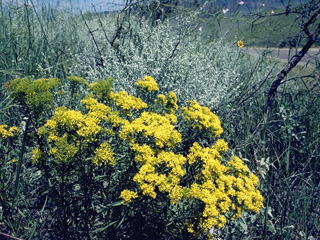
Loughmiller, Campbell and Lynn
Gutierrezia sarothrae
Gutierrezia sarothrae (Pursh) Britton & Rusby
Broom Snakeweed, Kindlingweed, Matchbrush, Texas Snakeweed, Broomweed, Turpentine Weed, Matchweed
Asteraceae (Aster Family)
Synonym(s): Gutierrezia diversifolia, Gutierrezia lepidota, Gutierrezia linearifolia, Gutierrezia linearis, Gutierrezia linoides, Gutierrezia longipappa, Gutierrezia pomariensis, Gutierrezia sarothrae var. pomariensis, Gutierrezia tenuis, Solidago sarothrae, Xanthocephalum sarothrae, Xanthocephalum sarothrae var. pomariense, Xanthocephalum tenue
USDA Symbol: GUSA2
USDA Native Status: L48 (N), CAN (N)
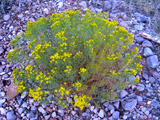
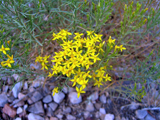
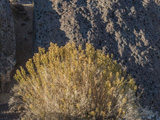
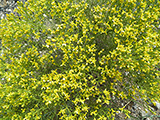
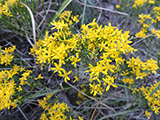
Kindlingweed or Broom Snakeweed is a 1-3 ft. sub-shrub with many slender, branching stems. Tiny, yellow flowers cluster in tufts at ends of branches. Foliage is yellow-green and thread-like. Lower leaves are often shed by the time of flowering. Stems are mostly of the same height, producing a yellow-domed, fan-shaped plant when in flower. Many slender green branches form a round shrublet with hundreds of tiny yellow flower heads in loose clusters.
A very similar species, Little-head Snakeweed (G. microcephala), which may grow in the same area, has 1-3 ray flowers and 1-3 disc flowers. As with many aromatic plants, this species was used medicinally, occasionally as a treatment for snakebite; hence the name Snakeweed. Bundled, dried stems made primitive brooms, hence Broom. It has also been called Matchweed and Matchbush, in reference to the match-like flower heads. This plant poses serious problems as a range weed. More frequent under improper range management, it now covers thousands of square miles of once good grassland.
Plant Characteristics
Duration: PerennialHabit: Herb , Subshrub
Size Notes: Up to about 3 feet tall, often shorter.
Leaf: Green
Flower: Flowers 1/4 inch
Fruit: Fruit is a cypsela (pl. cypselae). Though technically incorrect, the fruit is often referred to as an achene.
Bloom Information
Bloom Color: YellowBloom Time: Jan , Jul , Aug , Sep , Oct , Nov , Dec
Distribution
USA: AZ , CA , CO , ID , KS , MN , MT , ND , NE , NM , NV , NY , OK , OR , SD , TX , UT , WA , WYCanada: AB , MB , NT , SK
Native Distribution: Sask. to extreme s.e. WA, s. to w. TX & CA; also n. Mex.
Native Habitat: Dry, open, calcareous mesas, plains & disturbed areas
Growing Conditions
Water Use: MediumLight Requirement: Part Shade
Soil Moisture: Dry
CaCO3 Tolerance: Medium
Soil Description: Rocky or gravelly soils. Caliche type, Limestone-based, Sandy, Sandy Loam, Medium Loam, Clay Loam Clay
Conditions Comments: Better color and less aggressive than annual broomweeds. Responds well to poor, dry soils. Generally considered a weed and indicator of poor management in range areas.
Benefit
Use Ornamental: Rock gardens, Showy, Perennial gardenUse Wildlife: It is generally shunned by wildlife. Nectar-insects, Nectar-Bees, Nectar-Butterflies, Cover, Seeds-Granivorous birds. This plant is a poor grazing fodder, and the new spring growth may be toxic to animals. Since it tends to increase with overgrazing, its abundance often indicates overused rangeland. (Niering)
Conspicuous Flowers: yes
Propagation
Propagation Material: SeedsDescription: Propagate by seed or cuttings. Woody stem or herbaceous tip cuttings should be placed in vermiculite or sand under intermittent mist.
Seed Treatment: No pretreatment is necessary.
Find Seed or Plants
Find seed sources for this species at the Native Seed Network.
From the National Organizations Directory
According to the species list provided by Affiliate Organizations, this plant is on display at the following locations:Lady Bird Johnson Wildflower Center - Austin, TX
Santa Barbara Botanic Garden - Santa Barbara, CA
Native Seed Network - Corvallis, OR
Bibliography
Bibref 318 - Native Texas Plants: Landscaping Region by Region (2002) Wasowski, S. & A. WasowskiBibref 291 - Texas Wildscapes: Gardening for Wildlife (1999) Damude, N. & K.C. Bender
Search More Titles in Bibliography
Web Reference
Webref 38 - Flora of North America (2019) Missouri Botanical Garden, St. Louis, MO & Harvard University Herbaria, Cambridge, MA.Additional resources
USDA: Find Gutierrezia sarothrae in USDA PlantsFNA: Find Gutierrezia sarothrae in the Flora of North America (if available)
Google: Search Google for Gutierrezia sarothrae
Metadata
Record Modified: 2022-12-27Research By: TWC Staff