Native Plants

Plant Database
Search for native plants by scientific name, common name or family. If you are not sure what you are looking for, try the Combination Search or our Recommended Species lists.
Lytle, Melody
Forestiera pubescens var. pubescens
Forestiera pubescens Nutt. var. pubescens
Stretchberry, Elbowbush, Stretch-berry, Downy Forestiera, Desert Olive, Elbow-bush
Oleaceae (Olive Family)
Synonym(s): Forestiera acuminata var. parviflora, Forestiera neomexicana, Forestiera neomexicana var. arizonica, Forestiera pubescens ssp. neomexicana, Forestiera pubescens var. neomexicana, Forestiera sphaerocarpa
USDA Symbol: FOPUP
USDA Native Status: L48 (N)
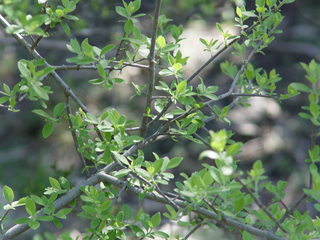
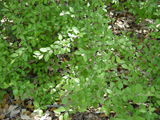
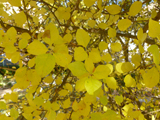
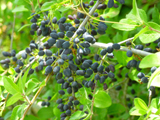
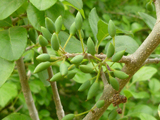
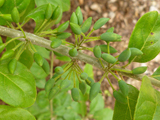
Desert Olive is a multi-branched, deciduous shrub, 4-9 ft. tall, with smooth, gray bark; arched branches; spiny branchlets, and light-green leaves. Flowers are inconspicuous but fragrant. Tiny, blue fruits occur in clusters on the female plants. This is a thicket-forming, deciduous shrub.
This drought-tolerant plant is well-suited for use as a spreading background plant or ground cover where grass won't grow. It is widely adaptable – tolerating dry or moist soil, sun or shade.
Plant Characteristics
Duration: PerennialHabit: Shrub
Leaf Retention: Deciduous
Leaf Shape: Linear
Breeding System: Dioecious
Fruit Type: Drupe
Size Notes: 5-10 feet tall.
Leaf: Gray-green, pubescent on both surfaces.
Flower: Sepals in fours or sometimes fives and reduced. Stamens yellow with no petals
Fruit: Black, Blue.
Bloom Information
Bloom Color: YellowBloom Time: Feb , Mar , Apr
Distribution
USA: AZ , CA , CO , NM , NV , OK , TX , UTNative Distribution: CO, UT & CA, s. to w. Tex. & n. Mex.
Native Habitat: Thickets, Prairie, Plains, Meadows, Pastures, Savannas, Woodlands' edge, Opening
Growing Conditions
Water Use: MediumLight Requirement: Sun , Part Shade
Soil Moisture: Dry
Soil Description: Poor, well-drained soils.
Benefit
Use Ornamental: Nice gray-green foliage.Use Wildlife: The plant provides valuable browse and fruit for wildlife and the early blooms are an important source of food for bees. Nectar-insects, Nectar-bees, Nectar-butterflies, Browse, Fruit-birds, Fruit-mammals
Conspicuous Flowers: yes
Interesting Foliage: yes
Attracts: Birds , Butterflies
Larval Host: Hairstreaks
Nectar Source: yes
Propagation
Description: Germinates from untreated seed planted in late March to early April. Roots easily from softwood and semi-hardwood cuttings. Transplanting is easy because of shallow, easily dug roots.Seed Collection: Harvest fruit when it has turned dark purple in late summer. Air dry seeds with or without pulp. Store in ventilated bags or containers in cool, dry place.
Seed Treatment: No pretreatment is necessary, although one month stratification may improve results.
Commercially Avail: yes
From the National Organizations Directory
According to the species list provided by Affiliate Organizations, this plant is on display at the following locations:Lady Bird Johnson Wildflower Center - Austin, TX
Wildflower Center Seed Bank
LBJWC-204 Collected 2008-05-12 in Travis County by Lady Bird Johnson Wildflower CenterBibliography
Bibref 293 - Manual of the Vascular Plants of Texas (1979) Correll, D. S. & M. C. JohnstonBibref 841 - Native Alternatives to Invasive Plants (2006) Burrell, C. C.
Bibref 318 - Native Texas Plants: Landscaping Region by Region (2002) Wasowski, S. & A. Wasowski
Bibref 291 - Texas Wildscapes: Gardening for Wildlife (1999) Damude, N. & K.C. Bender
Bibref 297 - Trees of Central Texas (1984) Vines, Robert A.
Search More Titles in Bibliography
Web Reference
Webref 23 - Southwest Environmental Information Network (2009) SEINet - Arizona ChapterAdditional resources
USDA: Find Forestiera pubescens var. pubescens in USDA PlantsFNA: Find Forestiera pubescens var. pubescens in the Flora of North America (if available)
Google: Search Google for Forestiera pubescens var. pubescens
Metadata
Record Modified: 2023-04-19Research By: TMH