Native Plants

Plant Database
Search for native plants by scientific name, common name or family. If you are not sure what you are looking for, try the Combination Search or our Recommended Species lists.
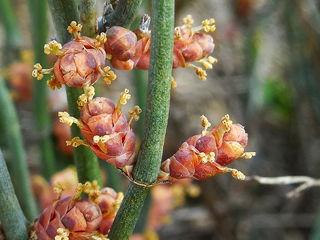
Nugent, Louis R
Ephedra antisyphilitica
Ephedra antisyphilitica Berl. ex C.A. Mey.
Mormon Tea, Joint-fir, Clapweed, Popote
Ephedraceae (Mormon-Tea Family)
Synonym(s): Ephedra antisyphilitica var. brachycarpa
USDA Symbol: EPAN
USDA Native Status: L48 (N)
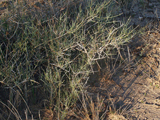
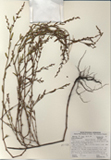
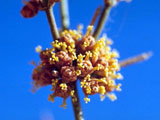
An upright or spreading shrub found on limestone hillsides, on bluffs, and in gravelly or stony upland soils. Jointed branches green to yellowish or grayish green, with a light orange to yellow or tan band encircling the stem below the leaves. Leaves minute, scalelike at the joints. Reproductive structures in small cones, 1/4 to 1/2 inch long, emerging from the joints. Not to be confused with either Horsetail or Scouring-rush, genus Equisetum, which are herbaceous.

Plant Characteristics
Duration: PerennialHabit: Shrub
Leaf Complexity: Simple
Breeding System: Flowers Unisexual , Dioecious
Fruit Type: Cone
Size Notes: Up to about 3 feet tall.
Bloom Information
Bloom Color: Red , GreenBloom Time: Feb , Mar , Apr
Bloom Notes: Reproductive structures consist of pollen and seed cones. Bloom color refers to cones. Bloom time refers to coning period.
Distribution
USA: OK , TXNative Habitat: Prairie, Plains, Meadows, Pastures, Savannas, Canyons, Ditches, Ravines, Depressions
Growing Conditions
Water Use: LowLight Requirement: Part Shade
Soil Moisture: Dry
Cold Tolerant: yes
Heat Tolerant: yes
Soil Description: Rocky Gravelly, Caliche type, Sandy, Sandy Loam, Medium Loam, Clay Loam Clay
Conditions Comments: This plant is a gnetophyte and has neither flowers nor leaves, and is easily overcome by other, more hardy species. The green stem of the plant grows and branches from nodes. Instead of flowers the plant developes cones which produce spores. Do not overwater. Protect from rabbit and deer.
From the National Organizations Directory
According to the species list provided by Affiliate Organizations, this plant is on display at the following locations:Lady Bird Johnson Wildflower Center - Austin, TX
NPSOT - Austin Chapter - Austin, TX
Bibliography
Bibref 355 - Landscaping with Native Plants of Texas and the Southwest (1991) Miller, G. O.Bibref 354 - Native & Naturalized Woody Plants of Austin & the Hill Country (1981) Lynch, D.
Bibref 318 - Native Texas Plants: Landscaping Region by Region (2002) Wasowski, S. & A. Wasowski
Bibref 291 - Texas Wildscapes: Gardening for Wildlife (1999) Damude, N. & K.C. Bender
Bibref 286 - Wildflowers of the Texas Hill Country (1989) Enquist, M.
Search More Titles in Bibliography
Web Reference
Webref 38 - Flora of North America (2019) Missouri Botanical Garden, St. Louis, MO & Harvard University Herbaria, Cambridge, MA.Webref 23 - Southwest Environmental Information Network (2009) SEINet - Arizona Chapter
Additional resources
USDA: Find Ephedra antisyphilitica in USDA PlantsFNA: Find Ephedra antisyphilitica in the Flora of North America (if available)
Google: Search Google for Ephedra antisyphilitica
Metadata
Record Modified: 2023-02-07Research By: NPC