Native Plants

Plant Database
Search for native plants by scientific name, common name or family. If you are not sure what you are looking for, try the Combination Search or our Recommended Species lists.
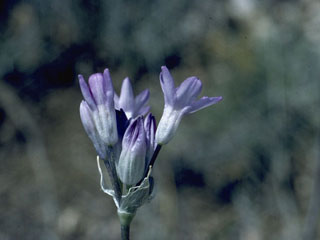
Flaigg, Norman G.
Dichelostemma capitatum ssp. pauciflorum
Dichelostemma capitatum (Benth.) Alph. Wood ssp. pauciflorum (Torr.) G. Keator
Little Bluedicks, Little Blue Dicks, Covena, Grass Nuts, Desert Hyacinth, Few-flowered Covena, Hahd, Papago Lily, Purplehead, Wild Hyacinth
Liliaceae (Lily Family)
Synonym(s): Brodiaea pulchella var. pauciflora, Dichelostemma pulchellum var. pauciflorum
USDA Symbol: DICAP
USDA Native Status: L48 (N)
Terrestrial, perennial forb. Plant grows from a corm producing few, narrow leaves and naked flower scapes. Usually 2-5 flowers borne in conspicuously bracted umbels. Flowers blue-violet, short-tubular, campanulate with six perianth lobes.
This range of this subspecies of Dichelostemma capitatum extends farther east and south than that of D. capitatum ssp. capitatum reaching New Mexico and Baja California. The bracts of this taxon are generally whitish with purple streaks.

Plant Characteristics
Duration: PerennialHabit: Herb
Root Type: Tuberous
Leaf Retention: Deciduous
Leaf Complexity: Simple
Leaf Shape: Linear
Leaf Venation: Parallel
Leaf Pubescence: Glabrous
Leaf Margin: Entire
Leaf Apex: Acute
Leaf Texture: Smooth
Breeding System: Flowers Bisexual
Inflorescence: Terminal , Umbel
Fruit Type: Capsule
Size Notes: Flowering stem 12-30".
Leaf: Green
Flower: Petals 6
Fruit: Black
Bloom Information
Bloom Color: Blue , Purple , VioletBloom Time: Jan , Feb , Mar , Apr , May , Jun , Jul , Aug , Sep
Distribution
USA: AZ , CA , NM , NV , UTNative Distribution: Southern California, southern Nevada, southern Utah, Arizona, western New Mexico, Baja California.
Native Habitat: Rocky, sandy or gravelly soil on mesas, arroyos, canyons, ridges and mountains.
Growing Conditions
Water Use: LowLight Requirement: Sun
Soil Moisture: Dry
Drought Tolerance: High
Heat Tolerant: yes
Soil Description: This species grows in a wide variety of soil conditions including sandy, gravelly, rocky, loamy, silty, cindery, rocky clay and clay soils.
Conditions Comments: Prefers sandy, rocky soils on mesas, buttes and exposed hillsides in the desert Southwest.
Benefit
Use Ornamental: Interesting in a xeric garden bed.Use Food: Native Americans harvested and ate the corms.
Conspicuous Flowers: yes
Fragrant Flowers: yes
Propagation
Propagation Material: Root Division , SeedsDescription: May be propagated by corm offsets or seeds.
Seed Collection: Seed should be collected when black and fully ripe.
Bibliography
Bibref 261 - Arizona Flora (1960) Kearney, T. H. & R. H. PeeblesBibref 7 - Jepson Manual: Higher Plants of California (1993) Hickman, J.C. (ed.)
Search More Titles in Bibliography
Additional resources
USDA: Find Dichelostemma capitatum ssp. pauciflorum in USDA PlantsFNA: Find Dichelostemma capitatum ssp. pauciflorum in the Flora of North America (if available)
Google: Search Google for Dichelostemma capitatum ssp. pauciflorum
Metadata
Record Modified: 2022-08-17Research By: Joseph A. Marcus