Native Plants

Plant Database
Search for native plants by scientific name, common name or family. If you are not sure what you are looking for, try the Combination Search or our Recommended Species lists.
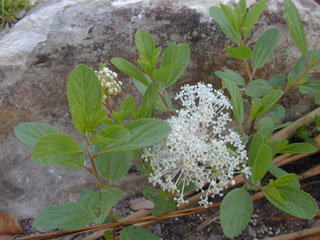
Marcus, Joseph A.
Ceanothus herbaceus
Ceanothus herbaceus Raf.
Prairie Redroot, Smaller Redroot, Small Redroot, Inland Ceanothus, Fuzzy Ceanothus, Jersey Tea, Redroot
Rhamnaceae (Buckthorn Family)
Synonym(s): Ceanothus herbaceus var. pubescens, Ceanothus ovatus, Ceanothus ovatus var. pubescens, Ceanothus pubescens
USDA Symbol: CEHE
USDA Native Status: L48 (N), CAN (N)
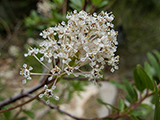
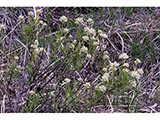
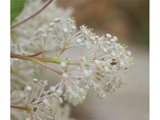
This species grows 2-3 ft. tall with a thick rootstock and dense foliage. Leaves as much as 2 1/2 inches long and 1 inch wide, may be as small as 1 inch by 1/4 inch, with prominent, yellowish veins on the lower side. Margins finely serrate. Less woody than C. americanus, with narrow, glossier leaves and shorter flower clusters. Flowers small, white, in dense, rounded clusters 1/2 to 3/4 inch wide, at the ends of leafy twigs, opening from March to July. Fruit a rounded, dark brown, 3 lobed capsule, about 3/16 inch in diameter, with a saucerlike support. Fall color is insignificant.
This genus can fix nitrogen from the atmosphere.

Plant Characteristics
Duration: PerennialHabit: Shrub
Leaf Retention: Deciduous
Leaf Complexity: Simple
Fruit Type: Capsule
Size Notes: Up to about 3 feet tall.
Bloom Information
Bloom Color: White , BlueBloom Time: Mar , Apr , May , Jun , Jul , Aug
Distribution
USA: AR , CO , DC , IA , IL , IN , KS , KY , LA , MA , MI , MN , MO , MT , ND , NE , NJ , NM , NY , OH , OK , SD , TX , VA , VT , WI , WV , WYCanada: ON
Native Distribution: VT, Que., MN & Powder River, Co., MT, s. to n.w. IN, LA & TX
Native Habitat: Rocky, open, wooded hillsides; roadsides. Little Bluestem prairies; Rocky woods; Limestone escarpment. In drier, more alkaline habitat than Ceanothus americanus.
Growing Conditions
Water Use: LowLight Requirement: Sun
Soil Moisture: Dry
Soil pH: Alkaline (pH>7.2)
Drought Tolerance: High
Soil Description: Well-drained clays, sandy loams, or limey soils, calcareous preferred. Often found growing in cracks in limestone outcrops.
Conditions Comments: Prefers more alkaline and dry sites than Ceanothus americanus.
Benefit
Conspicuous Flowers: yesAttracts: Birds , Butterflies
Nectar Source: yes
Deer Resistant: High
Value to Beneficial Insects
Special Value to Native BeesSupports Conservation Biological Control
This information was provided by the Pollinator Program at The Xerces Society for Invertebrate Conservation.
Butterflies and Moths of North America (BAMONA)
|
Mottled Duskywing (Erynnis martialis) 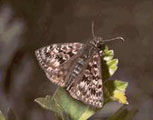 Larval Host |
Propagation
Propagation Material: Seeds , Semi-hardwood Cuttings , Softwood CuttingsSeed Collection: Collect seeds in late summer and early fall. Because dry capsules disperse their seed abruptly with a sudden ejection, it may be necessary to tie cloth bags around the clusters of capsules to catch the seeds.
Seed Treatment: Scarification may be necessary and can be accomplished by soaking the seeds in hot water (180-200 degrees). Soak in cooling water 24 hours. Stratify all seeds for 60-90 days at 41 degrees.
Commercially Avail: yes
From the National Organizations Directory
According to the species list provided by Affiliate Organizations, this plant is on display at the following locations:Lady Bird Johnson Wildflower Center - Austin, TX
Bibliography
Bibref 1186 - Field Guide to Moths of Eastern North America (2005) Covell, C.V., Jr.Bibref 1185 - Field Guide to Western Butterflies (Peterson Field Guides) (1999) Opler, P.A. and A.B. Wright
Bibref 946 - Gardening with Prairie Plants: How to Create Beautiful Native Landscapes (2002) Wasowski, Sally
Bibref 354 - Native & Naturalized Woody Plants of Austin & the Hill Country (1981) Lynch, D.
Bibref 318 - Native Texas Plants: Landscaping Region by Region (2002) Wasowski, S. & A. Wasowski
Bibref 286 - Wildflowers of the Texas Hill Country (1989) Enquist, M.
Search More Titles in Bibliography
Web Reference
Webref 38 - Flora of North America (2019) Missouri Botanical Garden, St. Louis, MO & Harvard University Herbaria, Cambridge, MA.Webref 23 - Southwest Environmental Information Network (2009) SEINet - Arizona Chapter
Additional resources
USDA: Find Ceanothus herbaceus in USDA PlantsFNA: Find Ceanothus herbaceus in the Flora of North America (if available)
Google: Search Google for Ceanothus herbaceus
Metadata
Record Modified: 2022-12-02Research By: NPC