Native Plants

Plant Database
Search for native plants by scientific name, common name or family. If you are not sure what you are looking for, try the Combination Search or our Recommended Species lists.
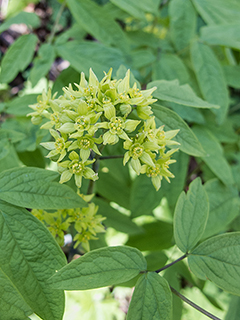
Brundage, Stephanie
Caulophyllum thalictroides
Caulophyllum thalictroides (L.) Michx.
Blue Cohosh, Squaw-root, Papoose-root, Caulophylle Faux-pigamon
Berberidaceae (Barberry Family)
Synonym(s):
USDA Symbol: CATH2
USDA Native Status: L48 (N), CAN (N)
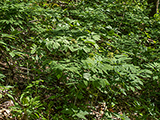
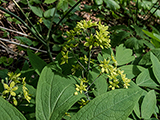
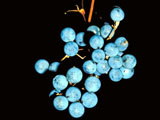
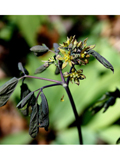
Spreading and bushy when mature, blue cohosh is a large, many-stemmed perennial, 1-3 ft. tall. Thrice-compound leaves with lobed leaflets are purplish in spring. Inconspicuous, purplish-brown to yellow-green flowers in a loosely branched cluster. Clusters of flowers are followed by conspicuous, bright-blue berries.
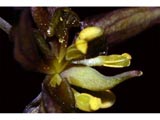
The six stamens and central pistil of this early spring flower mature at different times, assuring cross-pollination. The petals bear fleshy nectar glands that are visited by early solitary bees. The ovary is eventually ruptured by the developing seeds within it; the seeds are thus exposed, an unusual condition among flowering plants. The seeds have reportedly been used as a coffee substitute, but may also be toxic. The foliage resembles meadow rues (Thalictrum), hence the species name.
Plant Characteristics
Duration: PerennialHabit: Herb
Breeding System: Flowers Bisexual
Fruit Type: Berry
Size Notes: Up to about 3 feet tall.
Leaf: Green
Fruit: Blue
Bloom Information
Bloom Color: Yellow , Green , BrownBloom Time: Apr , May
Distribution
USA: AL , AR , CT , DE , GA , IA , IL , IN , KS , KY , MA , MD , ME , MI , MN , MO , NC , ND , NE , NH , NJ , NY , OH , OK , PA , RI , SC , SD , TN , VA , VT , WI , WVCanada: NB , NS , ON
Native Distribution: N.B. to s.e. Man., s. to New England, SC mts., TN & AR
Native Habitat: Deciduous & mixed woods
Growing Conditions
Water Use: MediumLight Requirement: Shade
Soil Moisture: Moist
CaCO3 Tolerance: Low
Soil Description: Rich, moist, well-drained soils
Conditions Comments: A heavy wintercoat of mixed leaves should be left on plant in the spring.
Benefit
Warning: The berries, roots and leaves of this plant may cause skin irritation if touched, and the raw berries may be poisonous to children if ingested. POISONOUS PARTS: Raw seeds, roots. Low toxicity if ingested. Symptoms include vomiting and diarrhea. Toxic Principle: Alkaloid and saponins. (Poisonous Plants of N.C.)Conspicuous Flowers: yes
Propagation
Seed Treatment: Scarifing seeds by nicking the seed coat will hasten germination.Commercially Avail: yes
Find Seed or Plants
View propagation protocol from Native Plants Network.
From the National Organizations Directory
According to the species list provided by Affiliate Organizations, this plant is on display at the following locations:Delaware Nature Society - Hockessin, DE
Mt. Cuba Center - Hockessin, DE
Bibliography
Bibref 1294 - The Midwestern Native Garden: Native Alternatives to Nonnative Flowers and Plants An Illustrated Guide (2011) Adelman, Charlotte and Schwartz, Bernard L.Search More Titles in Bibliography
Web Reference
Webref 38 - Flora of North America (2019) Missouri Botanical Garden, St. Louis, MO & Harvard University Herbaria, Cambridge, MA.Webref 23 - Southwest Environmental Information Network (2009) SEINet - Arizona Chapter
Additional resources
USDA: Find Caulophyllum thalictroides in USDA PlantsFNA: Find Caulophyllum thalictroides in the Flora of North America (if available)
Google: Search Google for Caulophyllum thalictroides
Metadata
Record Modified: 2023-01-31Research By: TWC Staff