Native Plants

Plant Database
Search for native plants by scientific name, common name or family. If you are not sure what you are looking for, try the Combination Search or our Recommended Species lists.
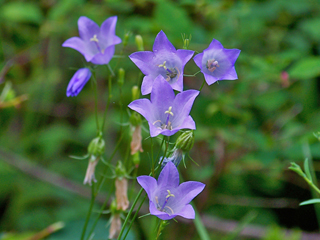
Glase, Terry
Campanula rotundifolia
Campanula rotundifolia L.
Bluebell Bellflower, Bluebell Of Scotland, Bluebell, Harebell, Witches' Thimble
Campanulaceae (Bellflower Family)
Synonym(s): Campanula alaskana, Campanula dubia, Campanula gieseckiana, Campanula gieseckiana ssp. groenlandica, Campanula gieseckiana var. arctica, Campanula groenlandica, Campanula heterodoxa, Campanula intercedens, Campanula petiolata, Campanula rotundifolia ssp. groenlandica, Campanula rotundifolia ssp. intercedens, Campanula rotundifolia var. alaskana, Campanula rotundifolia var. alpina, Campanula rotundifolia var. arctica, Campanula rotundifolia var. intercedens, Campanula rotundifolia var. lancifolia, Campanula rotundifolia var. petiolata, Campanula rotundifolia var. velutina, Campanula sacajaweana
USDA Symbol: CARO2
USDA Native Status: L48 (N), AK (N), CAN (N), GL (N), SPM (N)
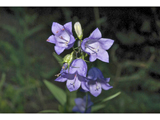
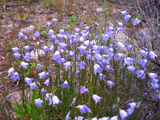
A delicate perennial with graceful, slender stems, usually in clusters, rising in height from 4-15 in. The stems can be weak so that the entire plant bends over. Its rounded, basal leaves wither early while the narrow, stem leaves remain. Blue-violet bell-shaped flowers hang singly or in clusters along the top parts of nodding, thread-like, mostly unbranched stems that grow in small patches. The nodding, bell-shaped, lavender flowers are borne in loose clusters at stem tips.
The genus name, from the Latin campana ("bell"), means "little bell." The name Harebell may allude to an association with witches, who were believed able to transform themselves into hares, portents of bad luck when they crossed a person's path. In Scotland, another old name for this plant was Witches' Thimble. The characteristics of this perennial vary considerably, depending on habitat conditions. Among other common species are the Southern Harebell (C. divaricata), with wider leaves and smaller, white or pale lavender flowers, typical of wet, grassy meadows. The common garden Bellflower (C. rapunculoides), which is native to western Eurasia and frequently escapes from cultivation, has flowers usually borne on one side of the stems and lanceolate or heart-shaped leaves.

Plant Characteristics
Duration: PerennialHabit: Herb
Fruit Type: Capsule
Size Notes: Up to about 15 inches tall.
Bloom Information
Bloom Color: Blue , PurpleBloom Time: Jun , Jul , Aug , Sep
Distribution
USA: AK , AZ , CA , CO , CT , IA , ID , IL , IN , MA , MD , ME , MI , MN , MO , MT , NC , ND , NE , NH , NJ , NM , NY , OH , OR , PA , SD , TN , TX , UT , VA , VT , WA , WI , WV , WYCanada: AB , BC , MB , NB , NL , NS , ON , QC , SK
Native Distribution: Temperate Eurasia and North America, from Europe east to Siberia and Canada, s. to MD, n. IN, n.e. IA, NE & n. CA; also s. in mts. to TX & northeastern Mex.
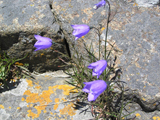
Native Habitat: Moist, rocky, mt. slopes; dry meadows & prairies; open woods; limey cliffs; beaches
Growing Conditions
Light Requirement: Sun , Part Shade , ShadeSoil Moisture: Dry
Soil Description: Sandy, well-drained soils.
Conditions Comments: Harebell is easily cultured and does well in a variety of sites including rock gardens. Flowers are long lasting.
Benefit
Use Wildlife: HummingbirdsConspicuous Flowers: yes
Attracts: Hummingbirds
Propagation
Description: For best results, seeds should be sown inside and not covered after sowing. They should be bottom-watered. These seedlings will germinate quickly but will not flower until the second year. Root cuttings or stem cuttings stuck in damp sand are other propagation methods useful for this species.Seed Collection: Approximate collection date in northern U.S.: late Jul. through mid Sep.
Seed Treatment: No treatment. Seeds may need light for good germination.
Commercially Avail: yes
Find Seed or Plants
Find seed sources for this species at the Native Seed Network.
View propagation protocol from Native Plants Network.
Mr. Smarty Plants says
Native flowers for Door County, Wisconsin
September 02, 2009
We recently were required to put in a new septic system on our vacation property in Door County, WI. This left us with a clearing on our wooded lot where the septic field is now located. The installer...
view the full question and answer
Native plants of dune erosion control in Michigan
May 30, 2008
We care for Lake Michigan dune near our home in New Buffalo and would like to provide erosion control with native species that will also enhance the beauty of the dune with long lasting flowers. The ...
view the full question and answer
Identification of plant with bell-shaped flowers
January 03, 2008
Dear Mr. Smarty Plants,
I am in need of a plant name to purchase. It is absolutely beautiful. The plant has light green leaves, the flowers that bloom look like bells (of course they hang upside down...
view the full question and answer
Native wildflowers for Northern Indiana
May 08, 2007
I had the wonderful opportunity to visit the Lady Bird Johnson Wildflower Center
on Saturday April 21. What a beautiful place. I thoroughly enjoyed my visit. I was
wondering how I could find out w...
view the full question and answer
National Wetland Indicator Status
| Region: | AGCP | AK | AW | CB | EMP | GP | HI | MW | NCNE | WMVE |
| Status: | FACU | UPL | FACU | FACU | FAC | FACU | FACU | FACU |
From the National Organizations Directory
According to the species list provided by Affiliate Organizations, this plant is on display at the following locations:Native Seed Network - Corvallis, OR
Bibliography
Bibref 946 - Gardening with Prairie Plants: How to Create Beautiful Native Landscapes (2002) Wasowski, SallyBibref 841 - Native Alternatives to Invasive Plants (2006) Burrell, C. C.
Search More Titles in Bibliography
From the Archive
Wildflower Newsletter 1989 VOL. 6, NO.3 - Butterfly Gardens, Director\'s Report, Proper Care Gives Staying Power to Cut Fl...Additional resources
USDA: Find Campanula rotundifolia in USDA PlantsFNA: Find Campanula rotundifolia in the Flora of North America (if available)
Google: Search Google for Campanula rotundifolia
Metadata
Record Modified: 2015-12-14Research By: TWC Staff