Native Plants

Plant Database
Search for native plants by scientific name, common name or family. If you are not sure what you are looking for, try the Combination Search or our Recommended Species lists.
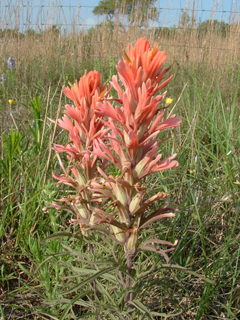
Carr, Bill
Castilleja purpurea var. lindheimeri
Castilleja purpurea (Nutt.) G. Don var. lindheimeri (A. Gray) Shinners
Lindheimer's Paintbrush, Lindheimer's Prairie Paintbrush, Lindheimer's Indian Paintbrush, Prairie Paintbrush
Scrophulariaceae (Figwort Family)
Synonym(s): Castilleja mearnsii, Castilleja williamsii
USDA Symbol: CAPUL
USDA Native Status: L48 (N)
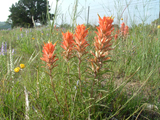
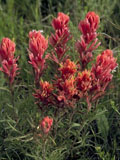
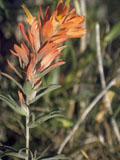
Castilleja purpurea var. lindheimeri shares most of the characteristics of its species, C. purpurea, but is distinguished by floral bracts in a range of oranges and reds. It is more often found in clay soils than varieties citrina and purpurea. This perennial paintbrush ranges from the Blackland prairies of north-central Texas south to the Rio Grande plains in calcareous gravels, sands, and clays. A prairie plant adapted to its environment by part-parasitizing grass roots.
This variety is named after Ferdinand Jacob Lindheimer (1801-1879) who is often called the Father of Texas Botany because of his work as the first permanent-resident plant collector in Texas. In 1834 Lindheimer immigrated to the United States as a political refugee. He spent from 1843-1852 collecting specimens in Texas. In 1844 he settled in New Braunfels, Texas, and was granted land on the banks of the Comal River, where he continued his plant collecting and attempted to establish a botanical garden. He shared his findings with many others who shared his interest in botany, including Ferdinand von Roemer and Adolph Scheele. Lindheimer is credited with the discovery of several hundred plant species. In addition his name is used to designate forty-eight species and subspecies of plants. He is buried in New Braunfels. His house, on Comal Street in New Braunfels, is now a museum.
Plant Characteristics
Duration: PerennialHabit: Herb
Leaf Retention: Deciduous
Leaf Arrangement: Alternate
Leaf Complexity: Simple
Leaf Shape: Lanceolate , Linear
Leaf Pubescence: Villose
Leaf Margin: Entire
Breeding System: Flowers Unisexual , Monoecious
Inflorescence: Spike
Fruit Type: Capsule
Size Notes: Usually 6-9 inches tall but can be twice that.
Leaf: Green to grey-green
Flower: Spikes to 6 inches long. Individual flowers within bracts 25-40 mm
Bloom Information
Bloom Color: Red , OrangeBloom Time: Mar , Apr , May
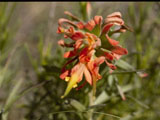
Bloom Notes: Usually blooms in May. Color ranges from red to orange to peach.
Distribution
USA: TXNative Distribution: North-central Texas to south Texas
Native Habitat: Calcareous grasslands of clay, gravel, or sandy soils
Growing Conditions
Water Use: LowLight Requirement: Sun
Soil Moisture: Dry
Soil pH: Alkaline (pH>7.2)
Drought Tolerance: High
Heat Tolerant: yes
Soil Description: Calcareous clays, sands, and gravels.
Conditions Comments: Does best when in association with prairie grasses, as it semi-parasitizes their roots.
Benefit
Use Ornamental: Orange-bracted grasslands perennial for calcareous, especially clay, soils in its Texas range.Use Wildlife: Attracts insect pollinators.
Conspicuous Flowers: yes
Nectar Source: yes
Propagation
Propagation Material: SeedsCommercially Avail: yes
Maintenance: Plant prairie grasses nearby if plant appears to be in decline.
From the National Organizations Directory
According to the species list provided by Affiliate Organizations, this plant is on display at the following locations:Lady Bird Johnson Wildflower Center - Austin, TX
Herbarium Specimen(s)
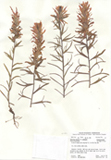
NPSOT 0791 Collected Apr 27, 1994 in Bexar County by Mike FoxNPSOT 0793 Collected Apr 27, 1994 in Bexar County by Mike Fox
NPSOT 0760 Collected Apr 24, 1994 in Comal County by Mary Beth White
Bibliography
Bibref 293 - Manual of the Vascular Plants of Texas (1979) Correll, D. S. & M. C. JohnstonBibref 318 - Native Texas Plants: Landscaping Region by Region (2002) Wasowski, S. & A. Wasowski
Bibref 281 - Shinners & Mahler's Illustrated Flora of North Central Texas (1999) Diggs, G. M.; B. L. Lipscomb; B. O'Kennon; W. F...
Bibref 286 - Wildflowers of the Texas Hill Country (1989) Enquist, M.
Search More Titles in Bibliography
Additional resources
USDA: Find Castilleja purpurea var. lindheimeri in USDA PlantsFNA: Find Castilleja purpurea var. lindheimeri in the Flora of North America (if available)
Google: Search Google for Castilleja purpurea var. lindheimeri
Metadata
Record Modified: 2019-04-10Research By: TWC Staff, GDG