Native Plants

Plant Database
Search for native plants by scientific name, common name or family. If you are not sure what you are looking for, try the Combination Search or our Recommended Species lists.
Vick, Albert F. W.
Carya ovata
Carya ovata (Mill.) K. Koch
Shagbark Hickory, Carolina Hickory, Scalybark Hickory, Upland Hickory, Shellbark Hickory
Juglandaceae (Walnut Family)
Synonym(s): Carya ovata var. fraxinifolia, Carya ovata var. nuttallii, Carya ovata var. pubescens, Hicoria alba, Hicoria borealis, Hicoria ovata
USDA Symbol: CAOV2
USDA Native Status: L48 (N), CAN (N)
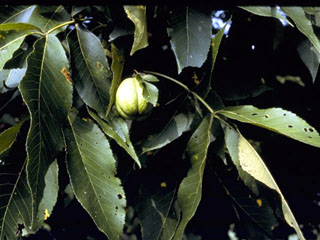
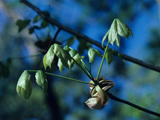
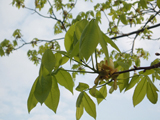
This is the hickory with bark that peels in long, tough curls off the straigt trunk. It is a large tree growing 60-80 ft., and sometimes reaching 150 ft. in height. The tree maintains its central stem high into the narrow, oblong crown. The bright, yellow-green, pinnately-compound leaves become golden in early fall, eventually drying to a warm bronze. The thick-shelled hickory nuts are edible.
Wild trees and improved cultivated varieties produce commercial hickory nuts. Carolina Hickory (var. australis (Ashe) Little), a variety found in southeastern mountains, has small lance-shaped leaflets and small nuts. The name "hickory" is from pawcohiccora, an Algonquian word for the oily food removed from pounded kernels steeped in boiling water. This sweet hickory milk was used in cooking corn cakes and hominy. Pioneers made a yellow dye from the inner bark. The nickname "Old Hickory" was given by his backwoods militia to General Andrew Jackson (afterwards our seventh President) because he was "tough as hickory."


Plant Characteristics
Duration: PerennialHabit: Tree
Leaf Retention: Deciduous
Leaf Complexity: Pinnate
Breeding System: Flowers Unisexual , Monoecious
Fruit Type: Nut
Size Notes: Up to about 150 feet tall. Often much shorter.
Leaf: Green
Autumn Foliage: yes
Fruit: Green, Red, Brown
Bloom Information
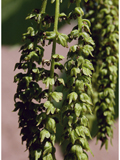
Bloom Color: Green , BrownBloom Time: Mar , Apr , May , Jun
Distribution
USA: AL , AR , CT , DC , DE , GA , IA , IL , IN , KS , KY , LA , MA , MD , ME , MI , MN , MO , MS , NC , ND , NE , NH , NJ , NY , OH , OK , PA , RI , SC , TN , TX , VA , VT , WI , WVCanada: ON , QC
Native Distribution: S.w. ME to c. MI & s.e. MN, s. to c. GA, e. TX, e. KS & s.e. NE, south to Michoacán and Veracruz in east-central Mexico
Native Habitat: Shaded woods, Stream, river banks, Swamps, Flood plains, bottomland
Growing Conditions
Water Use: MediumLight Requirement: Sun , Part Shade , Shade
Soil Moisture: Dry , Moist
Soil pH: Acidic (pH<6.8)
CaCO3 Tolerance: Medium
Soil Description: Well-drained, fertile soils. Sandy, Sandy Loam, Medium Loam, Clay Loam, Clay.
Conditions Comments: Tough to transplant, because of a large taproot, and slow to grow. Sensitive to disturbance once established. Undisturbed trees are fairly disease resistant. Shadbark creates considerable litter from bark plate, leafstalk and nut husks. The similar but larger shellbark hickory, Carya laciniosa, is a bottomland species with a more central distribution. It is faster growing.
Benefit
Use Ornamental: Long-living, Shade tree, AttractiveUse Wildlife: Squirrels and birds relish the seeds and catkins. Fruit-birds, Fruit-mammals, Nesting site, Cover, Substrate-insectivorous birds
Use Food: Fruits-nutrition
Use Other: Shagbark hickory is a very strong and hard wood that was used to make spokes for wooden wheels used on carriages and carts. (Hosie)
The inner bark produces a yellow dye, which was patented in the 18th century. (Kershaw)
The fuel value of Shagbark is higher than that of any other North American wood except Locust. A cord of Hickory is almost the equivalent in thermal units of a ton of anthracite, and even today costs less. (Peattie)
Interesting Foliage: yes
Fragrant Foliage: yes
Attracts: Birds
Propagation
Description: Most easily grown from fresh seed sown immediately after collection or stratified and sown in spring. Sow in permanent location as even small seedlings have a taproot too large to move. Increase by hardwood cuttings is usually successful.Seed Collection: Collect nuts from September to November. Husks usually dry and split open by themselves when the nuts are mature. Persistent husks can be removed with a corn sheller.
Seed Treatment: Embyro dormancy can be overcome by moist stratification at 33-40 degrees for 30-150 days. Older seeds require less stratification.
Commercially Avail: yes
Find Seed or Plants
View propagation protocol from Native Plants Network.
Mr. Smarty Plants says
Edible Plants for North Georgia
January 10, 2010
We are planning a forest food garden in the hollers of the N GA Mountains.
Which edible fruit, nut, berry, herb and creepers would be best for this reddish, clay-like soil? The food garden is in...
view the full question and answer
Aging non-native weeping willow in Ohio
June 11, 2008
We had a weeping willow now for about 15 years and it was doing fine until this summer. It has new branches sort of but a lot of the older ones are dying. There are leaves of course and they are sti...
view the full question and answer
National Wetland Indicator Status
| Region: | AGCP | AK | AW | CB | EMP | GP | HI | MW | NCNE | WMVE |
| Status: | FACU | FACU | FACU | FACU | FACU |
From the National Organizations Directory
According to the species list provided by Affiliate Organizations, this plant is on display at the following locations:Pineywoods Native Plant Center - Nacogdoches, TX
Mt. Cuba Center - Hockessin, DE
Bibliography
Bibref 298 - Field Guide to Texas Trees (1999) Simpson, B.J.Bibref 1620 - Gardening with Native Plants of the South (Reprint Edition) (2009) Wasowski, S. with A. Wasowski
Bibref 400 - Natural History of Trees of Eastern & Central North America (1991) Peattie, D.C. & P. H. Landacre
Bibref 291 - Texas Wildscapes: Gardening for Wildlife (1999) Damude, N. & K.C. Bender
Search More Titles in Bibliography
Web Reference
Webref 3 - Flora of North America (2014) Missouri Botanical Garden, St. Louis, MO & Harvard University Herbaria, Cambridge, MA.Additional resources
USDA: Find Carya ovata in USDA PlantsFNA: Find Carya ovata in the Flora of North America (if available)
Google: Search Google for Carya ovata
Metadata
Record Modified: 2022-09-20Research By: TWC Staff