Native Plants

Plant Database
Search for native plants by scientific name, common name or family. If you are not sure what you are looking for, try the Combination Search or our Recommended Species lists.
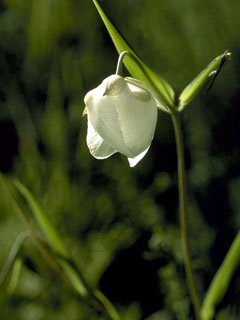
Pisapia, Robert J.
Calochortus albus
Calochortus albus Douglas ex Benth.
White Fairy-lantern, Fairy-lantern, White Fairy Lantern
Liliaceae (Lily Family)
Synonym(s): Calochortus albus var. rubellus
USDA Symbol: CAAL2
USDA Native Status: L48 (N)
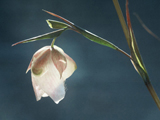
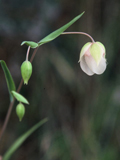
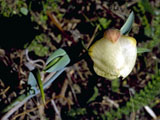
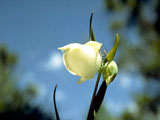
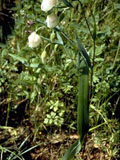
From corms, the slender, branched stems of this woodland perennial reach 8-30 in. in height. Leaves are grass-like. Petals of the nodding, white flowers (those from the coast ranges are often tinged with pink and green) are overlapped to form a closed globe. Egg-shaped, white flowers hanging in an open branched cluster. Seed pods are broad, flat and pendent.
The several Calochortus species with egg-shaped flowers are generally called globe lilies, whereas those with more open flowers are known as mariposa lilies and star tulips. Other common names of this species include White Fairy Lantern, Snowdrops, Indian Bells, and Satin Bells. Rose Globe Lily (C. amoenus), with deep pink flowers, grows on the western slopes of the Sierra Nevada in California's San Joaquin Valley.
Plant Characteristics
Duration: PerennialHabit: Herb
Leaf Complexity: Simple
Fruit Type: Capsule
Size Notes: Up to about 30 inches tall.
Bloom Information
Bloom Color: White , PinkBloom Time: Mar , Apr , May , Jun , Jul
Distribution
USA: CANative Distribution: N. Sierra foothills & s. Coast Ranges
Native Habitat: Shaded, rocky woods or brush, below 5000 ft.
Growing Conditions
Light Requirement: Part ShadeSoil Moisture: Dry
Soil Description: Well-drained, rocky soils.
Conditions Comments: Var. rubellus, native from the Santa Cruz to Santa Lucia Mts., has rosy sepals and deep pink petals. All Calochortus spp. are extremely difficult in cultivation. Flowering bulbs must be raised from seed for any success and bulbs must be kept completely dry from mid-summer to late fall. Needs protection from gophers and moles.
Benefit
Use Wildlife: All species are preferred browse.Use Food: Bulbs consumed by indigenous peoples.
Conspicuous Flowers: yes
Propagation
Description: Plant seed in late autumn in pots, flats or outdoor seed beds. Corms reach maturity in 3-5 years.Seed Treatment: No treatment.
Commercially Avail: yes
Find Seed or Plants
Find seed sources for this species at the Native Seed Network.
From the National Organizations Directory
According to the species list provided by Affiliate Organizations, this plant is on display at the following locations:Native Seed Network - Corvallis, OR
Bibliography
Bibref 1218 - Tending the Wild: Native American Knowledge and the Management of California's Natural Resources (2006) Anderson, M. KatSearch More Titles in Bibliography
Web Reference
Webref 30 - Calflora (2018) CalfloraWebref 38 - Flora of North America (2019) Missouri Botanical Garden, St. Louis, MO & Harvard University Herbaria, Cambridge, MA.
Webref 23 - Southwest Environmental Information Network (2009) SEINet - Arizona Chapter
Additional resources
USDA: Find Calochortus albus in USDA PlantsFNA: Find Calochortus albus in the Flora of North America (if available)
Google: Search Google for Calochortus albus
Metadata
Record Modified: 2022-12-19Research By: TWC Staff