Native Plants

Plant Database
Search for native plants by scientific name, common name or family. If you are not sure what you are looking for, try the Combination Search or our Recommended Species lists.
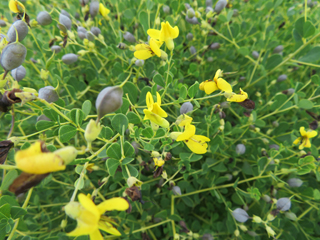
Muller, Thomas L.
Baptisia tinctoria
Baptisia tinctoria (L.) R. Br.
Horseflyweed, Yellow Wild Indigo
Fabaceae (Pea Family)
Synonym(s): Baptisia gibbesii, Baptisia tinctoria var. crebra, Baptisia tinctoria var. projecta
USDA Symbol: BATI
USDA Native Status: L48 (N), CAN (N)
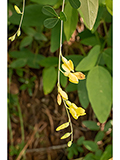
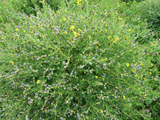
Smooth, bushy perennial with numerous few-flowered, elongated terminal clusters of yellow pea-like flowers.
Widely distributed, Wild Indigo often increases in burnt fields. Some 15 other species are found in eastern North America, including numerous yellow species farther south and some white or creamy ones. Blue False Indigo (B.australis), which has upright racemes of blue flowers and sap that turns purple when exposed to air, has escaped from cultivation northward to New York and Vermont. The genus name, from the Greek baptizein ("to dye"), refers to the fact that some species are used as an inferior substitute for true indigo dye.


Plant Characteristics
Duration: PerennialHabit: Herb
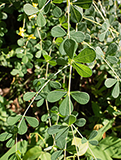
Leaf Arrangement: Alternate
Fruit Type: Legume
Leaf: Gray-Green
Bloom Information
Bloom Color: YellowBloom Time: May , Jun , Jul , Aug , Sep
Distribution
USA: CT , DC , DE , GA , IA , IL , IN , KY , MA , MD , ME , MI , MN , NC , NH , NJ , NY , OH , PA , RI , SC , TN , VA , VT , WI , WVCanada: ON
Native Distribution: Across southeastern Canada; from New England south to Florida; west to Louisiana; north to Minnesota.
Native Habitat: dry open woods and clearings, sandy acidic soil
Growing Conditions
Water Use: LowLight Requirement: Sun
Soil Moisture: Dry
CaCO3 Tolerance: High
Soil Description: Loam, Sand
Benefit
Use Medicinal: Root tea used as emetic and purgative, cold tea to stop vomiting. Poultice of the root was used for toothaches, to allay inflammation; wash used for cuts, wounds, bruises and sprains. (Foster & Duke) Root steeped in water used as antiseptic wash for wounds (Weiner)Warning: This plant is poisonous if ingested, although no fatalities have been recorded. Low toxicity if ingested. Symptoms include nausea, vomiting, diarrhea. Toxic Principle: Baptisin and cytisine.
Conspicuous Flowers: yes
Attracts: Butterflies
Value to Beneficial Insects
Special Value to Native BeesSpecial Value to Bumble Bees
This information was provided by the Pollinator Program at The Xerces Society for Invertebrate Conservation.
Butterflies and Moths of North America (BAMONA)
|
Frosted Elfin (Callophrys irus) 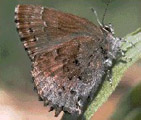 Larval Host |
Wild Indigo Duskywing (Erynnis baptisiae) 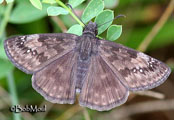 Larval Host |
Find Seed or Plants
Find seed sources for this species at the Native Seed Network.
View propagation protocol from Native Plants Network.
From the National Organizations Directory
According to the species list provided by Affiliate Organizations, this plant is on display at the following locations:Natural Biodiversity - Johnstown, PA
Native Seed Network - Corvallis, OR
Mt. Cuba Center - Hockessin, DE
Bibliography
Bibref 1207 - Earth Medicine, Earth Food (1990) Michael A. WeinerBibref 417 - Field Guide to Medicinal Plants and Herbs of Eastern and Central North America (2000) Foster, S. & J. A. Duke
Bibref 1186 - Field Guide to Moths of Eastern North America (2005) Covell, C.V., Jr.
Bibref 1185 - Field Guide to Western Butterflies (Peterson Field Guides) (1999) Opler, P.A. and A.B. Wright
Bibref 841 - Native Alternatives to Invasive Plants (2006) Burrell, C. C.
Bibref 1294 - The Midwestern Native Garden: Native Alternatives to Nonnative Flowers and Plants An Illustrated Guide (2011) Adelman, Charlotte and Schwartz, Bernard L.
Search More Titles in Bibliography
Additional resources
USDA: Find Baptisia tinctoria in USDA PlantsFNA: Find Baptisia tinctoria in the Flora of North America (if available)
Google: Search Google for Baptisia tinctoria
Metadata
Record Modified: 2021-01-28Research By: TWC Staff