Native Plants

Plant Database
Search for native plants by scientific name, common name or family. If you are not sure what you are looking for, try the Combination Search or our Recommended Species lists.
Williams, Pam
Asclepias asperula
Asclepias asperula (Decne.) Woodson
Antelope-horns, Spider Milkweed, Green-flowered Milkweed, Spider Antelope-horns, Antelope Horns
Asclepiadaceae (Milkweed Family)
Synonym(s):
USDA Symbol: ASAS
USDA Native Status: L48 (N)
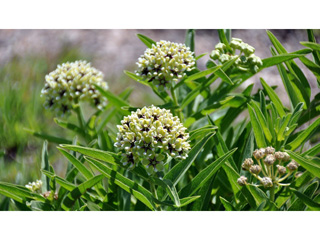
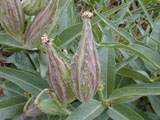
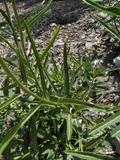
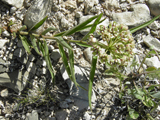
Asclepias asperula is a clump-forming, 1-2 ft. perennial with an upright or sprawling habit. Stems are densely covered with minute hairs. The leaves are 4-8 inches long, narrow, and irregularly grouped. The long, thick, narrow leaves are often folded lengthwise. As the green seed follicles grow in length and begin to curve, they are said to resemble antelope horns, thus one of its vernacular names.
Milkweed species are the food source for Monarch butterfly caterpillars.

Plant Characteristics
Duration: PerennialHabit: Herb
Root Type: Tap
Leaf Arrangement: Alternate , Opposite
Leaf Complexity: Simple
Leaf Shape: Lanceolate
Leaf Venation: Pinnate
Leaf Margin: Entire
Leaf Apex: Acute
Leaf Base: Truncate
Breeding System: Flowers Bisexual
Fruit Type: Follicle
Size Notes: Plant 1-2 ft tall. Follicles 4-13 cm long, 1-2.5 cm in diameter.
Leaf: Green
Bloom Information
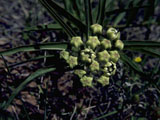
Bloom Color: White , GreenBloom Time: Mar , Apr , May , Jun , Jul , Aug , Sep , Oct
Bloom Notes: Flowers heavily in spring, sporadically summer through fall.
Distribution
USA: AZ , CA , CO , ID , KS , NE , NM , NV , OK , TX , UTNative Distribution: C. Kansas to Texas and Mexico, west to s. Idaho and se. California.
Native Habitat: Meadows, along roadsides, Blackland Prairie to Edwards Plateau. Well-drained caliche, loam, sand, clay.
Growing Conditions
Water Use: MediumLight Requirement: Sun
Soil Moisture: Dry , Moist
Soil Description: Prefers rocky or sandy soils of prairies, pastures, plains, hillsides, brushlands, and woodlands.
Conditions Comments: The Antelope-horns have interesting and robust flower heads. The common name is derived from the curved form of the seed pods. Antelope-horns will inevitably have aphids. The insects are not a problem unless the plant looks sick; at that point an effective treatment is to spray the plant and aphids with soapy water. Another possible treatment is to support the plant part with your hand and blast it with high-pressure water.
Benefit
Use Ornamental: Antelope-horns spreads out along the ground and grows 8 to 24 inches in height.Use Wildlife: This plant is attractive to bees, butterflies and/or birds. This species of milkweed attracts huge bees as pollinators.
Warning: This plant is reported to be toxic to animals, and like other plants in the genus Asclepias is probably also poisonous to humans. The sap of some causes skin irritation in humans. Sensitivity to a toxin varies with a person’s age, weight, physical condition, and individual susceptibility. Children are most vulnerable because of their curiosity and small size. Toxicity can vary in a plant according to season, the plant’s different parts, and its stage of growth; and plants can absorb toxic substances, such as herbicides, pesticides, and pollutants from the water, air, and soil.
Conspicuous Flowers: yes
Attracts: Butterflies
Larval Host: Monarchs, Queens
Deer Resistant: High
Value to Beneficial Insects
Special Value to Native BeesSpecial Value to Bumble Bees
Special Value to Honey Bees
Supports Conservation Biological Control
This information was provided by the Pollinator Program at The Xerces Society for Invertebrate Conservation.
Butterflies and Moths of North America (BAMONA)
|
Monarch (Danaus plexippus) 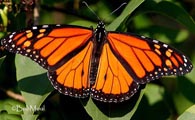 Larval Host |
Queen (Danaus gilippus) 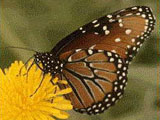 Larval Host |
Propagation
Propagation Material: Root Cuttings , SeedsDescription: Root cuttings can be taken in fall or early spring. Seeds may be sown outside in late fall or the following spring. Germination of spring-planted seeds is enhanced by cool moist stratification.
Seed Collection: Collect seed in June.
Seed Treatment: Soak seed overnight in water. Cold moist stratification of seed for 30 days resulted in over 80 % germination. Seed can be stratified up to 3 months at 40 degrees. Germinates best in warmer part of the year.
Commercially Avail: yes
Find Seed or Plants
Order seed of this species from Native American Seed and help support the Wildflower Center.
Mr. Smarty Plants says
Medicinal plants at the Wildflower Center
April 19, 2006
What kinds of medicinal plants do you have at the Wildflower Center?
view the full question and answer
Sources for seed of Utah native Asclepias labriformis
January 08, 2006
Hi there,
I am looking for seeds of the plant "Asclepias labriformis" which is
native to Utah.
Can you help me to find seeds from this plant?
view the full question and answer
From the National Organizations Directory
According to the species list provided by Affiliate Organizations, this plant is on display at the following locations:Fredericksburg Nature Center - Fredericksburg, TX
Lady Bird Johnson Wildflower Center - Austin, TX
NPSOT - Austin Chapter - Austin, TX
Jacob's Well Natural Area - Wimberley, TX
NPSOT - Williamson County Chapter - Georgetown, TX
Wildflower Center Seed Bank
LBJWC-1717 Collected 2015-06-11 in Burnet County by LBJWCLBJWC-1760 Collected 2015-06-25 in Bandera County by Lady Bird Johnson Wildflower Center
LBJWC-1718 Collected 2015-06-11 in Burnet County by LBJWC
LBJWC-1741 Collected 2015-06-18 in Burnet County by LBJWC
LBJWC-1728 Collected 2015-07-06 in Hill County by Lady Bird Johnson Wildflower Center
LBJWC-1747 Collected 0000-00-00 in Williamson County by LBJWC
LBJWC-1719 Collected 2015-06-11 in Travis County by Lady Bird Johnson Wildflower Center
Bibliography
Bibref 1186 - Field Guide to Moths of Eastern North America (2005) Covell, C.V., Jr.Bibref 1185 - Field Guide to Western Butterflies (Peterson Field Guides) (1999) Opler, P.A. and A.B. Wright
Bibref 946 - Gardening with Prairie Plants: How to Create Beautiful Native Landscapes (2002) Wasowski, Sally
Bibref 765 - McMillen's Texas Gardening: Wildflowers (1998) Howard, D.
Bibref 281 - Shinners & Mahler's Illustrated Flora of North Central Texas (1999) Diggs, G. M.; B. L. Lipscomb; B. O'Kennon; W. F...
Bibref 248 - Texas Wildflowers: A Field Guide (1984) Loughmiller, C. & L. Loughmiller
Bibref 328 - Wildflowers of Texas (2003) Ajilvsgi, Geyata.
Bibref 286 - Wildflowers of the Texas Hill Country (1989) Enquist, M.
Search More Titles in Bibliography
Additional resources
USDA: Find Asclepias asperula in USDA PlantsFNA: Find Asclepias asperula in the Flora of North America (if available)
Google: Search Google for Asclepias asperula
Metadata
Record Modified: 2023-01-10Research By: TWC Staff, RLU