Native Plants

Plant Database
Search for native plants by scientific name, common name or family. If you are not sure what you are looking for, try the Combination Search or our Recommended Species lists.
Bransford, W.D. and Dolphia
Arisaema triphyllum
Arisaema triphyllum (L.) Schott
Jack In The Pulpit, Indian Jack In The Pulpit, Jack-in-the-pulpit
Araceae (Arum Family)
Synonym(s):
USDA Symbol: ARTR
USDA Native Status: L48 (N), CAN (N)
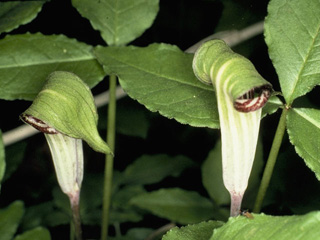
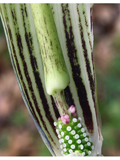
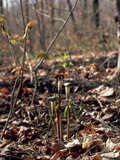
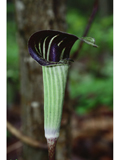
One to two large, glossy leaves, divided into three leaflets, rise on their own stems up to about 2 feet tall. The intriguing blossom of this woodland perennial occurs on a separate stalk at the same height as the leaves. It is a large, cylindrical, hooded flower, green in color with brown stripes. Distinctive "Jack-in-the-Pulpit" formation grows beneath large leaves. A cluster of bright red berries appears in late summer.
Some authorities recognize one species, and others three, based on minor differences in leaves, spathe, and size.


Plant Characteristics
Duration: PerennialHabit: Herb
Root Type: Tap
Fruit Type: Berry
Size Notes: Up to about 2 feet tall.
Leaf: Green
Fruit: Red
Bloom Information
Bloom Color: Green , Purple , BrownBloom Time: Mar , Apr , May , Jun
Distribution
USA: AL , AR , CT , DC , DE , FL , GA , IA , IL , IN , KS , KY , LA , MA , MD , ME , MI , MN , MO , MS , NC , ND , NE , NH , NJ , NY , OH , OK , PA , RI , SC , SD , TN , TX , VA , VT , WI , WVCanada: MB , NB , NS , ON , PE , QC
Native Distribution: N.S. to Man. & e. ND, s. to FL, e. TX & e. KS
Native Habitat: Forest, Woodland, Swamp, Marsh
Growing Conditions
Water Use: HighLight Requirement: Sun , Shade
Soil Moisture: Moist , Wet
CaCO3 Tolerance: Medium
Soil Description: Humus-rich, moist soils.
Conditions Comments: Jack-in-the-pulpit is an excellent woodsgarden plant, very easy to cultivate and requiring very little care. It thrives under a variety of conditions, but grows most vigorously in moist, shady, seasonally wet locations. A heavy, leafy wintercover should be left in place.
Benefit
Use Wildlife: Birds and mammals eat the berries of this plant.Warning: Containing needle-like calcium oxalate crystals and perhaps other acrid substances, the berries, foliage, and roots of this plant will cause painful irritation of the mouth and throat if ingested. The roots can cause blisters on skin if touched.
Conspicuous Flowers: yes
Interesting Foliage: yes
Attracts: Birds
Propagation
Description: Propagate by root division or seed. Seeds may be sown outside in late fall, 3/4 " deep, or the following spring with or without cold treatment. Seeds should not be allowed to dry out. The seeds may not germinate for up to two years. Cormlets can be separated from the parent corm in fall.Seed Collection: Collect fruits in fall when the berries are red. Approximate collection date for northern U.S.: Late Aug. & Sep.
Seed Treatment: Remove the small brown seed from the pulp. Stratify stored seeds by placing them in moist sphagmun moss and refrigerating 60 days before planting.
Commercially Avail: yes
Find Seed or Plants
View propagation protocol from Native Plants Network.
Mr. Smarty Plants says
Plant identification, green and tube-like
September 18, 2008
LOOKING FOR NAME OF A GREEN TUBE-LIKE PLANT (SHAPED LIKE A CALLA LILY). THE VEINS ARE VISIBLE. MAYBE IN CLUSTER
view the full question and answer
Native wildflowers for Northern Indiana
May 08, 2007
I had the wonderful opportunity to visit the Lady Bird Johnson Wildflower Center
on Saturday April 21. What a beautiful place. I thoroughly enjoyed my visit. I was
wondering how I could find out w...
view the full question and answer
Plants for shade native to New York
June 13, 2006
I am gradually trying to convert my garden to all natives. I am working in a shaded area under a maple tree. Are there any varieties of epimediums/barrenwort or hellebores that are native to the nor...
view the full question and answer
Native perennials for moist shade in Missouri
January 16, 2005
I live near Adrian, Mo (s of KC by an hour). I currently have a small hillside that is covered by trees and shaded all day and also seems to hold moisture really well. The hill seems to grow a littl...
view the full question and answer
National Wetland Indicator Status
| Region: | AGCP | AK | AW | CB | EMP | GP | HI | MW | NCNE | WMVE |
| Status: | FACW | FACW | FAC | FACW | FAC |
From the National Organizations Directory
According to the species list provided by Affiliate Organizations, this plant is on display at the following locations:Pineywoods Native Plant Center - Nacogdoches, TX
Delaware Nature Society - Hockessin, DE
Natural Biodiversity - Johnstown, PA
Mt. Cuba Center - Hockessin, DE
Bibliography
Bibref 928 - 100 easy-to-grow native plants for Canadian gardens (2005) Johnson, L.; A. LeyerleBibref 1620 - Gardening with Native Plants of the South (Reprint Edition) (2009) Wasowski, S. with A. Wasowski
Bibref 841 - Native Alternatives to Invasive Plants (2006) Burrell, C. C.
Bibref 1294 - The Midwestern Native Garden: Native Alternatives to Nonnative Flowers and Plants An Illustrated Guide (2011) Adelman, Charlotte and Schwartz, Bernard L.
Search More Titles in Bibliography
Research Literature
Reslit 184 - Effects of Alliaria petiolata (Garlic Mustard; Brassicaceae) on Mycorrhizal Colonization and Community Structure in Three Herbaceous Plants in a Mixed Deciduous Forest (2008) D. J. BurkeReslit 466 - The response of understory herbaceous plants to nitrogen fertilization in forests of different land-use history (2009) J. M. Fraterrigo, S. M. Pearson and M. G. Turner
Reslit 451 - Use of common forest forbs to measure browsing pressure by white-tailed deer (Odocoileus virginianus Zimmerman) in Virginia, USA (2001) J. D. Fletcher, W. J. McShea, L. A. Shipley and D....
Reslit 556 - Changes in hardwood forest understory plant communities in response to European earthworm invasions (2006) C. M. Hale, L. E. Frelich and P. B. Reich
Reslit 593 - Nonconsumptive effects of a generalist ungulate herbivore drive decline of unpalatable forest herbs (2010) C. D. Heckel, N. A. Bourg, W. J. McShea and S. Kal...
Reslit 658 - Photosynthetic induction dynamics to sunflecks of four deciduous forest understory herbs with different phenologies (2002) J. C. Hull
Reslit 827 - Effects of forest age and disturbance on population persistence in the understory herb, Arisaema triphyllum (Araceae) (2004) M. T. Levine and I. C. Feller
Reslit 1195 - Considering herbivory, reproduction, and gender when monitoring plants: A case study of Jack-in-the-pulpit (Arisaema triphyllum [L.] Schott) (2000) S. Ruhren and S. N. Handel
Reslit 1435 - Gender-related differences in gas exchange rates in the gender-switching species Arisaema triphyllum (Araceae) (2001) P. Vitt
Reslit 1467 - A field test of herbaceous plant indicators of deer browsing intensity in mesic hardwood forests of Indiana, USA (2001) C. R. Webster, M. A. Jenkins and G. R. Parker
This information was provided by the Florida WIldflower Foundation.
Search More Titles in Research Literature
Additional resources
USDA: Find Arisaema triphyllum in USDA PlantsFNA: Find Arisaema triphyllum in the Flora of North America (if available)
Google: Search Google for Arisaema triphyllum
Metadata
Record Modified: 2021-10-06Research By: TWC Staff