Native Plants

Plant Database
Search for native plants by scientific name, common name or family. If you are not sure what you are looking for, try the Combination Search or our Recommended Species lists.
Marcus, Joseph A.
Anisacanthus quadrifidus var. wrightii
Anisacanthus quadrifidus (Vahl) Nees var. wrightii (Torr.) Henrickson
Flame Acanthus, Hummingbird Bush, Wright's Desert Honeysuckle, Wright Acanthus, Mexican Flame, Wright's Mexican Flame
Acanthaceae (Acanthus Family)
Synonym(s): Anisacanthus wrightii, Drejera wrightii
USDA Symbol: ANQUW
USDA Native Status: L48 (N)
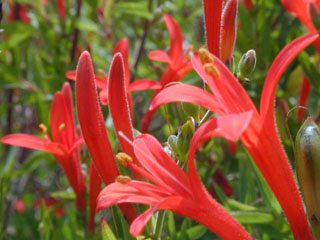
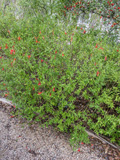
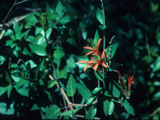
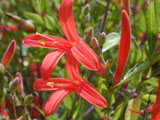
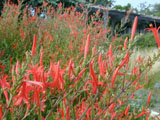
Native from west and south-central Texas into adjacent northern Mexico, Anisacanthus quadrifidus var. wrightii is a spreading, 3 to 5 ft. deciduous shrub with exfoliating bark; red-orange, tubular flowers; and light-green, lanceolate leaves.
Its brilliant summer-to-fall blooms, cheerful green foliage, pale bark, and ability to attract hummingbirds have made it increasingly popular in landscapes. Though found in the wild mostly in rocky, calcareous soils, it is adaptable both to the heavy soils of Houston and to the drying, confined conditions of pots. It is drought-tolerant and can survive low temperatures as far north as Dallas, though only the roots will survive the winters there and the whole plant will reemerge each year like a perennial from the ground. Though the attractive branches are somewhat brittle, it takes well to shearing and can make a dense, low hedge. As with other xeric plants within its range, rain will trigger a flush of blooms, covering the plant in fiery orange. Under favorable conditions, it will seed out readily.
The species name of this plant is for Charles Wright, 1811-1885, world-wide botanical collector who collected extensively in Texas (1837-1852), Cuba, and his native Connecticut.
The Acanthus family includes trees, shrubs and herbs. Stems are square; leaves are generally without teeth or lobes, and are opposite. The flowers are 2-lipped and almost radially symmetrical. There are 2–4 stamens; when 4, they are in unequal pairs.

Plant Characteristics
Duration: PerennialHabit: Shrub
Root Type: Fibrous
Leaf Retention: Deciduous
Leaf Arrangement: Opposite
Leaf Complexity: Simple
Leaf Shape: Lanceolate
Leaf Venation: Pinnate
Leaf Pubescence: Glabrous
Leaf Margin: Entire
Leaf Apex: Acute
Leaf Base: Rounded
Leaf Texture: Smooth
Breeding System: Flowers Bisexual
Fruit Type: Capsule
Size Notes: Normally no more than 3 ft tall but can reach 5 ft.
Leaf: Dull light green
Flower: Flowers 3-4 cm long
Fruit: Brown capsules, black seeds 15 mm
Bloom Information
Bloom Color: Red , OrangeBloom Time: Jun , Jul , Aug , Sep , Oct , Nov
Distribution
USA: TXNative Distribution: The northernmost variety of its species, Anisacanthus quadrifidus var. wrightii ranges from south-central Texas (the southern Edwards Plateau) and west Texas into northern Mexico. Its species, Anisacanthus quadrifidus, continues south to Oaxaca in southern Mexico.
Native Habitat: Rocky banks and floodplains of streams, shrublands (matorral), and grasslands
Growing Conditions
Water Use: LowLight Requirement: Sun , Part Shade
Soil Moisture: Dry , Moist
Drought Tolerance: High
Cold Tolerant: yes
Heat Tolerant: yes
Soil Description: Well-drained sand, loam, clay, caliche, limestone. Adapts to a wide variety of soils, from rocky slopes to open areas.
Conditions Comments: This drought- and cold-tolerant shrub will adapt to a variety of soils and does well in patio pots. It blooms best in full sun but will tolerate light shade. As with many other xeric plants, rain triggers blooms.
Benefit
Use Ornamental: A showy shrub with ornamental blooms for perennial gardens and other planned landscapesUse Wildlife: Flowers attract hummingbirds and butterflies.
Conspicuous Flowers: yes
Interesting Foliage: yes
Attracts: Butterflies , Hummingbirds
Larval Host: Janais Patch, Texan Crescentspot
Nectar Source: yes
Deer Resistant: High
Butterflies and Moths of North America (BAMONA)
|
Texan Crescent (Anthanassa texana) 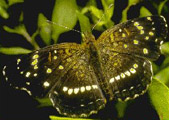 Larval Host |
Propagation
Propagation Material: Seeds , Softwood CuttingsDescription: The easiest method of propagation is to take cuttings from the current season’s growth. Cut a 4 – 6 inch branch just below a node. Remove lower leaves and root in flats or small pots. Rooting hormone increases rooting percentage but is not necessary. Seeds can be planted in flats, or outside after the danger of frost has past. Sowing indoors allows for a sturdier plant to withstand mid-summer’s heat. Plant seeds 1/3 – 1/2 inch deep in a well-drained soil mix. Keep soil moist but not saturated.
Seed Collection: As soon as capsules begin to dry and turn brown but before they split open. Air dry and store in a cool, dry place for one season, or store in the refrigerator for longer periods of time.
Seed Treatment: Best sown fresh
Commercially Avail: yes
Maintenance: Pruning in winter encourages more blooms and a compact shape. Where it dies to the ground in the winter (meaning leaves won't resprout from the branches but the whole plant regrows from the ground each year, in the manner of a perennial), cut back to the ground before spring.
Mr. Smarty Plants says
Small shrub to plant in Austin Texas
March 11, 2009
Hi..
I live in Southwest Austin and I am looking for a shrub that I can plant against the back of my house, which faces the north. I want something native, fairly low maintenance and not too large,...
view the full question and answer
List of native perennial Texas flowers
March 13, 2006
Good day, I am searching for a list of native Texas flowers (preferably perennials) for a flower garden.
Thank you.
view the full question and answer
From the National Organizations Directory
According to the species list provided by Affiliate Organizations, this plant is on display at the following locations:Naval Air Station Kingsville - Kingsville, TX
Fredericksburg Nature Center - Fredericksburg, TX
Lady Bird Johnson Wildflower Center - Austin, TX
Sibley Nature Center - Midland, TX
Brackenridge Field Laboratory - Austin, TX
NPSOT - Native Plant Society of Texas - Fredericksburg, TX
NPSOT - Fredericksburg Chapter - Fredericksburg, TX
NPSOT - Austin Chapter - Austin, TX
National Butterfly Center - Mission, TX
NPSOT - Williamson County Chapter - Georgetown, TX
Bibliography
Bibref 1186 - Field Guide to Moths of Eastern North America (2005) Covell, C.V., Jr.Bibref 1185 - Field Guide to Western Butterflies (Peterson Field Guides) (1999) Opler, P.A. and A.B. Wright
Bibref 481 - How to Grow Native Plants of Texas and the Southwest: Revised and Updated Edition (2001) Nokes, J.
Bibref 318 - Native Texas Plants: Landscaping Region by Region (2002) Wasowski, S. & A. Wasowski
Search More Titles in Bibliography
Web Reference
Webref 23 - Southwest Environmental Information Network (2009) SEINet - Arizona ChapterWebref 1 - Texas Native Shrubs (2002) Texas A&M University Agriculture Program and Leslie Finical, Dallas Arboretum
Additional resources
USDA: Find Anisacanthus quadrifidus var. wrightii in USDA PlantsFNA: Find Anisacanthus quadrifidus var. wrightii in the Flora of North America (if available)
Google: Search Google for Anisacanthus quadrifidus var. wrightii
Metadata
Record Modified: 2023-06-08Research By: TWC Staff, MWJ, JSC, GDG