Native Plants

Plant Database
Search for native plants by scientific name, common name or family. If you are not sure what you are looking for, try the Combination Search or our Recommended Species lists.
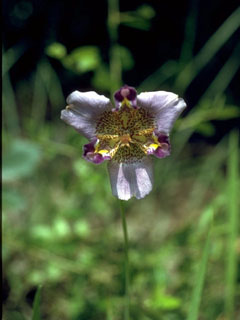
Loughmiller, Campbell and Lynn
Alophia drummondii
Alophia drummondii (Graham) R.C. Foster
Propeller Flower, Purple Pleat-leaf, Pinewoods Lily, Prairie Iris, Pleatleaf Iris
Iridaceae (Iris Family)
Synonym(s): Cypella drummondii, Eustylis purpurea, Herbertia drummondii, Nemastylis purpurea, Tigridia purpurea
USDA Symbol: ALDR2
USDA Native Status: L48 (N)
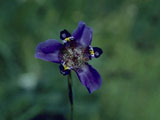
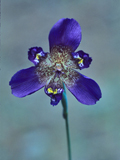
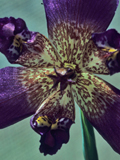
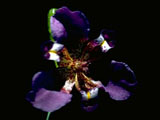
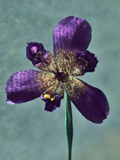
Growing from a tunicated bulb, the Prairie Iris is 1-2 feet tall and is usually unbranched. It has leaves 1 1/2-2 feet long by 1 inch wide. Most of them grow from the base and are conspicuously veined, clasp the stem directly at the base, and are folded (pleated) for most of their length. The flowers grow in a cluster at the end of the stem and open one at a time for several days in succession. They are cup-shaped to flat. The 3 outer tepals are spreading, about 1 1/2 inches wide, light to deep purple; the 3 inner tepals are dwarfed, cupped or crimped, and usually a deeper purple. The inner portion of the tepals is yellowish, spotted with reddish-brown.
A member of the iris family (family Iridaceae) which consists of herbs growing from rhizomes, bulbs, or corms, with narrow basal leaves and showy clusters at the tips of long stalks. There are about 60 genera and 1,500 species, distributed in temperate and tropical regions. Among them, Iris, Freesia, Gladiolus, Bugle Lily, and Montbretia are popular ornamentals. Saffron dye is obtained from Crocus, and "essence of violets," used in perfumes, is extracted from the rhizomes of Iris.
The species name of this plant is named for Thomas Drummond, (ca. 1790-1835), naturalist, born in Scotland, around 1790. In 1830 he made a trip to America to collect specimens from the western and southern United States. In March, 1833, he arrived at Velasco, Texas to begin his collecting work in that area. He spent twenty-one months working the area between Galveston Island and the Edwards Plateau, especially along the Brazos, Colorado, and Guadalupe rivers. His collections were the first made in Texas that were extensively distributed among the museums and scientific institutions of the world. He collected 750 species of plants and 150 specimens of birds. Drummond had hoped to make a complete botanical survey of Texas, but he died in Havana, Cuba, in 1835, while making a collecting tour of that island.
Plant Characteristics
Duration: PerennialHabit: Herb
Fruit Type: Capsule
Size Notes: Up to about 2 feet tall.
Flower: Flowers 2 inches
Bloom Information
Bloom Color: Yellow , Blue , PurpleBloom Time: Mar , Apr , May , Jun , Jul , Aug , Sep
Distribution
USA: AR , LA , MS , OK , TXNative Distribution: Southwestern Arkansas and southeastern Oklahoma south through much of Louisiana and eastern and coastal Texas to Mexico. Separate populations in northern South America (Bolivia and Guyana).
Native Habitat: Prairie, Plains, Meadows, Pastures, Savannas. Tends to grow in verge habitats, the partly shaded edges of forests where trees meet grasslands.
Growing Conditions
Water Use: LowLight Requirement: Part Shade
Soil Moisture: Dry
Soil Description: Sandy, Sandy Loam, Medium Loam, Clay Loam, Clay. Sand preferred.
Benefit
Conspicuous Flowers: yesNational Wetland Indicator Status
| Region: | AGCP | AK | AW | CB | EMP | GP | HI | MW | NCNE | WMVE |
| Status: | FACU | FACU | FACU |
Bibliography
Bibref 765 - McMillen's Texas Gardening: Wildflowers (1998) Howard, D.Bibref 318 - Native Texas Plants: Landscaping Region by Region (2002) Wasowski, S. & A. Wasowski
Bibref 248 - Texas Wildflowers: A Field Guide (1984) Loughmiller, C. & L. Loughmiller
Bibref 328 - Wildflowers of Texas (2003) Ajilvsgi, Geyata.
Search More Titles in Bibliography
Web Reference
Webref 38 - Flora of North America (2019) Missouri Botanical Garden, St. Louis, MO & Harvard University Herbaria, Cambridge, MA.Webref 23 - Southwest Environmental Information Network (2009) SEINet - Arizona Chapter
Additional resources
USDA: Find Alophia drummondii in USDA PlantsFNA: Find Alophia drummondii in the Flora of North America (if available)
Google: Search Google for Alophia drummondii
Metadata
Record Modified: 2023-04-06Research By: TWC Staff