Native Plants

Plant Database
Search for native plants by scientific name, common name or family. If you are not sure what you are looking for, try the Combination Search or our Recommended Species lists.
Makin, Julie
Aesculus glabra
Aesculus glabra Willd.
Ohio Buckeye, Texas Buckeye, Fetid Buckeye, Horse Chestnut
Hippocastanaceae (Horse-Chestnut Family)
Synonym(s):
USDA Symbol: AEGL
USDA Native Status: L48 (N), CAN (N)
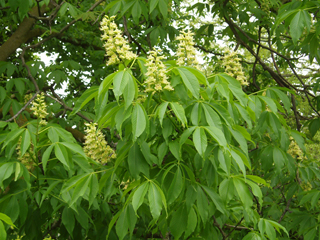
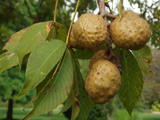
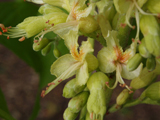
Ohio Buckeye, a medium-sized, canopy tree, 50-75 ft. tall, is often used as an ornamental because of its interesting fruit and bright orange fall foliage. Branches bend toward the ground then arch back up, creating a rounded outline. Dense, attractive, deciduous foliage is palmately compound and the showy, erect blossom clusters are held at the ends of the twigs. The tree’s fruit is encased in a spiny, splitting husk (capsule). Twigs and leaves often have a slightly unpleasant odor when crushed.
The state tree of Ohio, the Buckeye State. Pioneers carried a buckeye seed in their pockets to ward off rheumatism. The seeds and young foliage are poisonous, and the toxic bark was formerly used medicinally. Sometimes planted as an ornamental for the showy autumn foliage. The wood is used for furniture, boxes, flooring, and musical instruments. Caution: All parts of this tree are poisonous if taken internally. Keep away from livestock; seeds and fruits are attractive to children and are dangerous.
Plant Characteristics
Duration: PerennialHabit: Tree
Leaf Retention: Deciduous
Leaf Arrangement: Opposite
Leaf Complexity: Palmate
Leaf Margin: Serrate
Fruit Type: Capsule
Size Notes: Up to about 75 feet tall, often shorter.
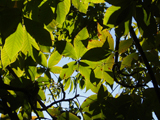
Leaf: Green above, pale below.
Autumn Foliage: yes
Bloom Information
Bloom Color: Yellow , Green , BrownBloom Time: Mar , Apr , May
Distribution
USA: AL , AR , GA , IA , IL , IN , KS , KY , ME , MI , MN , MO , MS , NE , NH , NJ , NY , OH , OK , PA , TN , TX , WI , WV , WYCanada: ON
Native Distribution: W. PA to extreme s.e. NE, s. to GA & TX
Native Habitat: Rich, moist stream banks & bottomlands
Growing Conditions
Water Use: MediumLight Requirement: Sun , Part Shade , Shade
Soil Moisture: Moist
Soil pH: Acidic (pH<6.8)
CaCO3 Tolerance: Medium
Soil Description: Rich, moist, well-drained soils.
Conditions Comments: It can be difficult to grow grass under Ohio buckeye because of the dense foliage. It is one of the first trees to leaf out in the spring and lose its foliage in fall. In hot, droughty situations, leaf blotch, leaf scorch and a variety of other pysiological and pest problems can be serious. In moist habitats, disease and insects are not a problem. Ohio buckeye is escaping into New York.
Benefit
Use Wildlife: Squirrels eat seeds. Hummingbirds are attracted to the flowers.Warning: All parts of this tree are poisonous if taken internally. Keep away from livestock; seeds and fruits are attractive to children and are dangerous. May be Fatal if Eaten! Symptoms include muscle weakness and paralysis, dilated pupils, vomiting, diarrhea, depression, paralysis, and stupor. Toxic Principle: Glycoside aesculin, saponin aescin, possibly alkaloids.
Conspicuous Flowers: yes
Interesting Foliage: yes
Propagation
Description: Sow seeds in fall.Seed Collection: Seeds dry and shrivel quickly.
Seed Treatment: Moist-stratify for 120 days at 41 degrees.
Commercially Avail: yes
Find Seed or Plants
View propagation protocol from Native Plants Network.
Mr. Smarty Plants says
How to propagate Texas red buckeye (Aesculus sp.) from seeds
May 01, 2007
I have a Texas Red Buckeye that is doing very well. How do I propagate from the seeds that come off of that tree? Thanks,
view the full question and answer
National Wetland Indicator Status
| Region: | AGCP | AK | AW | CB | EMP | GP | HI | MW | NCNE | WMVE |
| Status: | FACU | FACU | FAC | FAC | FAC |
From the National Organizations Directory
According to the species list provided by Affiliate Organizations, this plant is on display at the following locations:Natural Biodiversity - Johnstown, PA
Mt. Cuba Center - Hockessin, DE
Bibliography
Bibref 902 - Ex situ plant conservation : supporting species survival in the wild (2004) Guerrant, E. O.; K. Havens; M. MaunderBibref 1620 - Gardening with Native Plants of the South (Reprint Edition) (2009) Wasowski, S. with A. Wasowski
Search More Titles in Bibliography
Web Reference
Webref 23 - Southwest Environmental Information Network (2009) SEINet - Arizona ChapterAdditional resources
USDA: Find Aesculus glabra in USDA PlantsFNA: Find Aesculus glabra in the Flora of North America (if available)
Google: Search Google for Aesculus glabra
Metadata
Record Modified: 2023-04-05Research By: TWC Staff