Native Plants

Plant Database
Search for native plants by scientific name, common name or family. If you are not sure what you are looking for, try the Combination Search or our Recommended Species lists.
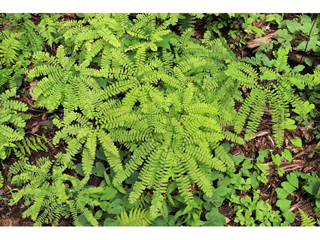
Cressler, Alan
Adiantum pedatum
Adiantum pedatum L.
Northern Maidenhair Fern, Maidenhair Fern
Pteridaceae (Maidenhair Fern Family)
Synonym(s):
USDA Symbol: ADPE
USDA Native Status: L48 (N), CAN (N)
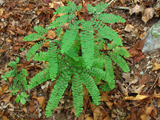
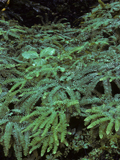
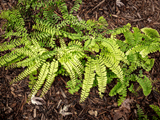
Northern maidenhair’s delicate, 8-30 in. fronds, with dark, shiny stems, spread their pinnae horizontally in a nearly perfect circle. This graceful, fan-like pattern is unique among native ferns. The fronds arise from a creeping rootstock in clusters. Burgundy red fiddleheads appear in early spring. The roots are wiry and black, colonizing in favorable sites.
This fern is quite easy to grow if it is provided with the right conditions. Western plants are sometimes treated as a separate variety or subspecies, A. pedatum var. or ssp. aleuticum, but eastern and western plants look very much alike.


Plant Characteristics
Duration: PerennialHabit: Fern
Leaf Retention: Deciduous
Size Notes: Fronds up to about 30 inches long.
Leaf: Dark Green
Bloom Information
Bloom Color: Not ApplicableBloom Time: Jun , Jul , Aug , Sep , Oct , Nov
Bloom Notes: Not a flowering plant. Reproduces by spores. Bloom time refers to sporulating period.
Distribution
USA: AL , AR , CT , DC , DE , GA , IA , IL , IN , KS , KY , LA , MA , MD , ME , MI , MN , MO , MS , NC , NE , NH , NJ , NY , OH , OK , PA , RI , SC , SD , TN , VA , VT , WI , WVCanada: NB , NS , ON , QC
Native Distribution: Que., Ont. & AK, s. to GA, OK, & c. CA. North America Zones 4 to 8.
Native Habitat: Moist, cool, rich woods & shaded areas, especially northern exposures, with neither little nor too much moisture. Rocky seeps and springs especially.
Growing Conditions
Water Use: MediumLight Requirement: Part Shade , Shade
Soil Moisture: Moist
Soil pH: Circumneutral (pH 6.8-7.2)
CaCO3 Tolerance: Low
Drought Tolerance: Low
Soil Description: Rich, moist, well-drained soils, mostly acidic but can tolerate some lime.
Conditions Comments: Likes moist but not wet sites. Will not survive drying out. Keep evenly moist year-round.
Benefit
Use Ornamental: Uniquely delicate, light green foliage, black stems, and red fiddleheads for areas with the right conditionsUse Wildlife: Provides shelter for toads and lizards.
Use Medicinal: Indigenous peoples made a tea from the leaves to treat respiratory conditions such as coughing and consumption.
Use Other: Shiny, dark stems used in basketry.
Interesting Foliage: yes
Propagation
Propagation Material: Root DivisionDescription: Easily propagated by rhizome division in early spring or late fall or from spores. Easiest to divide roots during fiddlehead stage.
Seed Collection: Spores mature in late summer and fall.
Seed Treatment: Tap spores into sterile potting mix, mist and keep covered with a clear plastic lid.
Commercially Avail: yes
Maintenance: Keep evenly moist throughout the year but not soggy.
Mr. Smarty Plants says
Possible ground covers under pine trees in Illinois
April 18, 2006
Have pine trees in front of house. No luck with the lawn around them....was told it's because of ground acidity. Any tips on how to get a lawn to grow there? If not, can you suggest some ground cover...
view the full question and answer
National Wetland Indicator Status
| Region: | AGCP | AK | AW | CB | EMP | GP | HI | MW | NCNE | WMVE |
| Status: | FACU | FAC | FAC | FACU | FACU | FAC |
From the National Organizations Directory
According to the species list provided by Affiliate Organizations, this plant is on display at the following locations:Delaware Nature Society - Hockessin, DE
Natural Biodiversity - Johnstown, PA
Mt. Cuba Center - Hockessin, DE
Bibliography
Bibref 928 - 100 easy-to-grow native plants for Canadian gardens (2005) Johnson, L.; A. LeyerleBibref 1620 - Gardening with Native Plants of the South (Reprint Edition) (2009) Wasowski, S. with A. Wasowski
Bibref 1231 - Guide To the Ferns of Grey and Bruce Counties, Ontario (1999) Owen Sound Field Naturalists
Bibref 1294 - The Midwestern Native Garden: Native Alternatives to Nonnative Flowers and Plants An Illustrated Guide (2011) Adelman, Charlotte and Schwartz, Bernard L.
Search More Titles in Bibliography
Web Reference
Webref 38 - Flora of North America (2019) Missouri Botanical Garden, St. Louis, MO & Harvard University Herbaria, Cambridge, MA.Additional resources
USDA: Find Adiantum pedatum in USDA PlantsFNA: Find Adiantum pedatum in the Flora of North America (if available)
Google: Search Google for Adiantum pedatum
Metadata
Record Modified: 2022-10-31Research By: TWC Staff