Native Plants

Plant Database
Search for native plants by scientific name, common name or family. If you are not sure what you are looking for, try the Combination Search or our Recommended Species lists.
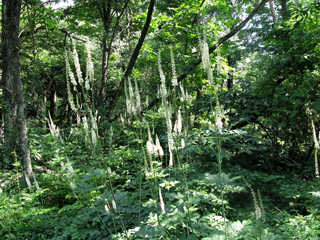
Muller, Thomas L.
Actaea racemosa var. racemosa
Actaea racemosa L. var. racemosa
Black Cohosh, Black Bugbane, Bugbane, Black Snakeroot, Fairy Candles
Ranunculaceae (Buttercup Family)
Synonym(s): Cimicifuga racemosa
USDA Symbol: ACRAR
USDA Native Status: L48 (N), CAN (N)
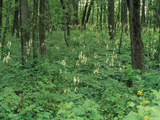
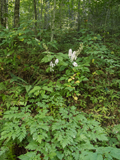
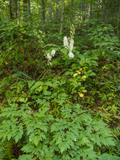
A large, bush-like plant with compound, toothed leaves and long "candles" of tiny, white, fuzzy flowers.
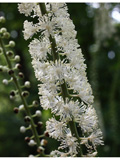

Plant Characteristics
Duration: PerennialHabit: Herb
Fruit Type: Follicle
Size Notes: Up to about 8 feet tall.
Flower: Flowers in 6 to 24 inch spikes.
Fruit: Tan.
Bloom Information
Bloom Color: WhiteBloom Time: May , Jun , Jul , Aug , Sep
Bloom Notes: Blooms for 2 to 3 weeks, beginning in May near the coast and in June in the mountains.
Distribution
USA: AL , AR , CT , DC , DE , GA , IA , IL , IN , KY , MA , MD , ME , MI , MO , MS , NC , NJ , NY , OH , PA , SC , TN , VA , WVCanada: ON , QC
Native Distribution: W. MA to s. Ont. & WI, s. to GA & n. AR; escaped in n. & e. New England; Coastal plain to 4000 ft in mountains. Zones 5 to 7
Native Habitat: Rich woods & woodland openings
Growing Conditions
Water Use: MediumLight Requirement: Part Shade , Shade
Soil Moisture: Moist
Soil pH: Acidic (pH<6.8)
Cold Tolerant: yes
Soil Description: Moderately acid, humus-rich loam. Can grow in acid over lime.
Conditions Comments: Best light is an hour or 2 of morning sun.
Benefit
Use Ornamental: White summer flowers for shady spots.Use Medicinal: The bad odour of this plant is repellent to bugs, which accounts for the common and genus name. The root was used in the 1800s to treat various conditions, ranging from snakebite and lung inflammations, to the pains of childbirth. (Niering)
Conspicuous Flowers: yes
Attracts: Butterflies
Larval Host: Spring Azure
Butterflies and Moths of North America (BAMONA)
|
Spring Azure (Celastrina "ladon" ) 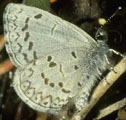 Larval Host |
Propagation
Propagation Material: Root Division , SeedsDescription: Propagate by division in spring or fall or plant seeds outside in fall. Seedlings take one or two years to germinate; three or four years to flower.
Seed Collection: Approximate collection date in northern U.S.: mid Sep. to late Oct.
Commercially Avail: yes
From the National Organizations Directory
According to the species list provided by Affiliate Organizations, this plant is on display at the following locations:Native Plant Center at Westchester Community College, The - Valhalla, NY
Delaware Nature Society - Hockessin, DE
Natural Biodiversity - Johnstown, PA
Mt. Cuba Center - Hockessin, DE
Bibliography
Bibref 928 - 100 easy-to-grow native plants for Canadian gardens (2005) Johnson, L.; A. LeyerleBibref 1186 - Field Guide to Moths of Eastern North America (2005) Covell, C.V., Jr.
Bibref 1185 - Field Guide to Western Butterflies (Peterson Field Guides) (1999) Opler, P.A. and A.B. Wright
Bibref 1620 - Gardening with Native Plants of the South (Reprint Edition) (2009) Wasowski, S. with A. Wasowski
Bibref 1294 - The Midwestern Native Garden: Native Alternatives to Nonnative Flowers and Plants An Illustrated Guide (2011) Adelman, Charlotte and Schwartz, Bernard L.
Search More Titles in Bibliography
Web Reference
Webref 38 - Flora of North America (2019) Missouri Botanical Garden, St. Louis, MO & Harvard University Herbaria, Cambridge, MA.Webref 23 - Southwest Environmental Information Network (2009) SEINet - Arizona Chapter
From the Archive
Wildflower Newsletter 1994 VOL. 11, NO.6 - Wildflower Center Featured Non-Profit in Neiman Marcus Christmas Book, Dana Leav...Additional resources
USDA: Find Actaea racemosa var. racemosa in USDA PlantsFNA: Find Actaea racemosa var. racemosa in the Flora of North America (if available)
Google: Search Google for Actaea racemosa var. racemosa
Metadata
Record Modified: 2023-05-03Research By: TWC Staff