Native Plants
Q. Who is Mr. Smarty Plants?
A: There are those who suspect Wildflower Center volunteers are the culpable and capable culprits. Yet, others think staff members play some, albeit small, role. You can torture us with your plant questions, but we will never reveal the Green Guru's secret identity.
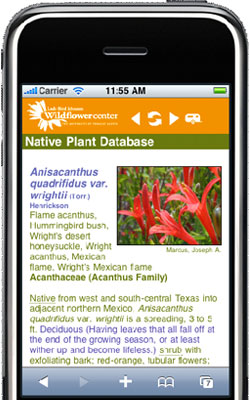
Did you know you can access the Native Plant Information Network with your web-enabled smartphone?

Ask Mr. Smarty Plants
Ask Mr. Smarty Plants is a free service provided by the staff and volunteers at the Lady Bird Johnson Wildflower Center.

rate this answer

Thursday - August 23, 2007
From: PARADISE, TX
Region: Southwest
Topic: Compost and Mulch, Grasses or Grass-like
Title: Encouraging native grasses to flourish
Answered by: Nan Hampton and Joe Marcus
QUESTION:
We have been trying to restore the yard around the house with native grasses and forbs for the last two years. The soil is clay and nothing seems to grow. We have distributed 5 truck loads of mulch, planted little bluestem, planted side oats grama and all is so slow to grow. Any suggestions of another grass that we might try to use on the grounds adjacent to the yard. The rest of the property is covered with native trees. Husband is getting "antsy" as all looks rather unkempt and even ugly because the grasses are so sparse and keeping out the Johnson grass, ragweed, bermuda (where did that come from?) is not so easy for us old farts!ANSWER:
Although it doesn't sound as if you are trying to establish a turf lawn, Mr. Smarty Plants is going to recommend an article, "Native Lawns", from our How to Articles. This article features Bouteloua dactyloides (buffalograss), a grass you didn't mention in your question. If your area gets full sun, buffalo grass would be ideal because it loves the sun, doesn't require much water, and doesn't grow tall. I am supposing that you sowed seeds for your other grasses. You can do this for the buffalo grass, too, but you can also buy sod. Sod is more expensive than seeds, but you can separate the sod into "plugs" to plant so that you can cover a greater area. Combining seeds and plugs should give you nice coverage. although you can sow grass seeds in late summer, spring is really the best time. Sod or plugs can be planted anytime.
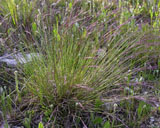
Another shorter grass that you might consider is Bouteloua gracilis (blue grama). Another attractive shorter grass that does well in our area is Aristida purpurea (purple threeawn).
Native American Seed in Junction also has a good article, Planting tips for Native Grasses, that might be helpful.
Depending on how your five truckloads of mulch were used, they could have been either helpful or a hindrance to developing your landscape. If you were trying to improve your soil, then compost or good topsoil -- not mulch -- mixed into the clay would improve the soil. Mulch should be used only as a surface cover to help retain moisture and control some weeds.
Johnson grass and ragweeds are denizens of disturbed soils. Once other vegetation is well-established and the soil is no longer being disturbed, Johnson grass and ragweed tend to disappear. Bermudagrass is another story. It will grow persistently wherever it gets enough light. The trick to eradicating Bermudagrass is to be even more persistent in removing it. It will not be a simple process.
More Compost and Mulch Questions
Native plants for under a pine tree in Vevay IN
June 29, 2009 - At our office we have a very nice garden however, in the front we have a large pine tree. We cannot get anything to take root & live there. Do you have any suggestions for a native shrub or perennia...
view the full question and answer
Necessary sun exposure for Eves Necklace
November 12, 2008 - How little sun can the tree Eve's Necklace receive and still be happy and healthy? I have an intended spot that gets about 3, maybe 4 hours, some of that will be hot afternoon sun in the summer.
Th...
view the full question and answer
Problem With Vegetable Garden Soil
June 09, 2013 - We live in Liberty Hill on 25 acres and we are working to restore native grasses and plants. We are ardent supporters of the Wildflower center. I say this because my question is not "typical" of wh...
view the full question and answer
Area under live oaks from Austin
October 08, 2012 - We have many live oaks in our mostly shaded half acre. While I have tried to plant mostly native plants, often beneath them, the plants are showered with leathery leaves, acorns and sap, while oak sp...
view the full question and answer
Failure to bloom of lantanas in San Antonio
July 22, 2010 - Mr. Smarty Plants,
We have lantanas in our front yard. This summer the leaves have turned white and they die to a brown color all the while the leaves are "crispy". At the beginning of the season...
view the full question and answer
| Support the Wildflower Center by Donating Online or Becoming a Member today. |