Native Plants

Plant Database
Search for native plants by scientific name, common name or family. If you are not sure what you are looking for, try the Combination Search or our Recommended Species lists.
Salix lucida
Salix lucida Muhl.
Shining Willow
Salicaceae (Willow Family)
Synonym(s):
USDA Symbol: SALU
USDA Native Status: L48 (N), AK (N), CAN (N), SPM (N)
A broad shrub, shining willow grows 12-20 ft. tall, with a pyramidal form. Upright, spreading, fine-textured branches occur from a short trunk. Bark is smooth and reddish-brown. Shining willow’s finest characteristic is its smooth, glossy leaves that simmer in the sun. Fall color is a fairly insignificant yellow. Spring branches are densely flowered with green catkins.
From the Image Gallery
No images of this plant
Plant Characteristics
Duration: PerennialHabit: Shrub
Leaf Retention: Deciduous
Leaf Arrangement: Alternate
Leaf Complexity: Simple
Fruit Type: Capsule
Size Notes: Up to about 20 feet tall.
Leaf: Yellow-Green
Fruit: Brown
Bloom Information
Bloom Color: YellowBloom Time: Apr , May , Jun , Jul
Distribution
USA: AK , AZ , CA , CO , CT , DE , IA , ID , IL , IN , KS , MA , MD , ME , MI , MN , MT , ND , NH , NJ , NM , NV , NY , OH , OR , PA , RI , SD , UT , VA , VT , WA , WI , WV , WYCanada: AB , MB , NB , NL , NS , NT , ON , PE , QC , SK , YT
Native Distribution: Lab. to n. Man., s. to VA, OH, n. IL & n. ND; also Black Hills & extreme e. CO
Native Habitat: Steam & swamp banks; fens; beaches; met meadows; mud flats
Growing Conditions
Water Use: HighLight Requirement: Sun , Part Shade , Shade
Soil Moisture: Moist , Wet
Soil pH: Circumneutral (pH 6.8-7.2)
CaCO3 Tolerance: Medium
Soil Description: Any poorly drained, wet soil.
Conditions Comments: Willows are brittle, with aggressive roots that exploit the moisture found in drains and sewers. They are fast-growing, short-lived, and prone to disease and insect damage. Disperses seed as a fluff seen in June
Benefit
Use Wildlife: Very popular, especially early in the season, with birds and small mammals.Attracts: Butterflies
Larval Host: Mourning Cloak, Acadian Hairsteaks, Admirals
Value to Beneficial Insects
Special Value to Native BeesThis information was provided by the Pollinator Program at The Xerces Society for Invertebrate Conservation.
Butterflies and Moths of North America (BAMONA)
|
Mourning Cloak (Nymphalis antiopa) 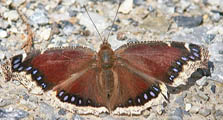 Larval Host |
Find Seed or Plants
Find seed sources for this species at the Native Seed Network.
National Wetland Indicator Status
| Region: | AGCP | AK | AW | CB | EMP | GP | HI | MW | NCNE | WMVE |
| Status: | FACW | FACW | FACW | FACW | FACW | FACW |
From the National Organizations Directory
According to the species list provided by Affiliate Organizations, this plant is on display at the following locations:Native Seed Network - Corvallis, OR
Bibliography
Bibref 1186 - Field Guide to Moths of Eastern North America (2005) Covell, C.V., Jr.Bibref 1185 - Field Guide to Western Butterflies (Peterson Field Guides) (1999) Opler, P.A. and A.B. Wright
Search More Titles in Bibliography
Web Reference
Webref 38 - Flora of North America (2019) Missouri Botanical Garden, St. Louis, MO & Harvard University Herbaria, Cambridge, MA.Webref 23 - Southwest Environmental Information Network (2009) SEINet - Arizona Chapter
Additional resources
USDA: Find Salix lucida in USDA PlantsFNA: Find Salix lucida in the Flora of North America (if available)
Google: Search Google for Salix lucida
Metadata
Record Modified: 2023-05-16Research By: TWC Staff