Native Plants

Q. Who is Mr. Smarty Plants?
A: There are those who suspect Wildflower Center volunteers are the culpable and capable culprits. Yet, others think staff members play some, albeit small, role. You can torture us with your plant questions, but we will never reveal the Green Guru's secret identity.

Did you know you can access the Native Plant Information Network with your web-enabled smartphone?

Ask Mr. Smarty Plants
Ask Mr. Smarty Plants is a free service provided by the staff and volunteers at the Lady Bird Johnson Wildflower Center.

rate this answer

Wednesday - September 04, 2013
From: St. Paul, MN
Region: Midwest
Topic: Erosion Control, Grasses or Grass-like, Herbs/Forbs, Vines
Title: Riverbank Plants for Minnesota
Answered by: Larry Larson
QUESTION:
I would like to stablize a steep riverbank slope along the Upper Mississippi in St. Cloud MN. The slopes are almost 1:1. We are using an open cell concrete matt in which we are going to plant native grasses, forbes and vines. We would like to use plants native to the riverbluffs in the region. Any ideas? Thanks for your help.ANSWER:
As you are using the open cell concrete mat to stabilize the slope, we don’t necessarily need to recommend the usual stabilization of the slope with plants that form clumps and/or have extended root systems. Of course, this is still a useful aspect for your application
Mr Smarty Plants makes recommendations out of the Wildflower Centers “Recommended Species” lists, this time the one for Minnesota.
There turns out to be plenty of native plants [130] that might be found in the “Wet or Moist” soil of a riverbank. So I further restricted the plants listed here to ones that are shorter and/or are perennial; happily, many of these also have extended root systems that will further stabilize the ground. You may want to consider:
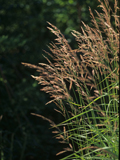
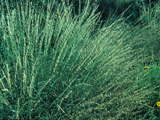
Grasses or Grasslike [11 candidates]: Calamagrostis canadensis (Bluejoint), Carex stipata (Awlfruit sedge), Spartina pectinata (Prairie cordgrass), Allium canadense (Meadow garlic), Andropogon gerardii (Big bluestem), Bouteloua curtipendula (Sideoats grama),
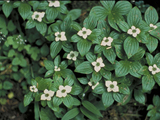
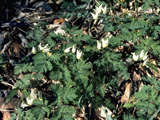
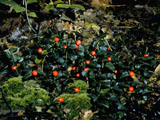
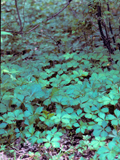
Forbs [64 candidates]: Asarum canadense (Canadian wild ginger), Cornus canadensis (Bunchberry dogwood), Dicentra cucullaria (Dutchman's breeches), Hydrophyllum virginianum (Eastern waterleaf), Mitchella repens (Partridgeberry),
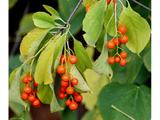
Vines : Celastrus scandens (American bittersweet), Parthenocissus quinquefolia (Virginia creeper)
This is just a sampling of the native plants available that should be successfull. As there are many possibilities, you may want to review the plant records of these suggestions and/or go back to the restricted list of Recommended Species for Minnesota and make a selection based more on your knowledge of the riverbank and its characteristics.
From the Image Gallery

More Erosion Control Questions
Low growing erosion control plants for lakeside in Washington Township NJ
May 12, 2013 - I live on a small lake in Northern NJ and have installed beautiful Boulders along the water to help stop erosion. Now I want to add plants along the property but would like low growing, soil retentio...
view the full question and answer
Raingarden Plants for Brownsville, TX
March 14, 2014 - I'm a Landscape Architect in South Texas and I'm implementing raingardens and vegetated swales in my projects. What native plants could be used in these gardens/water runways. They would need to res...
view the full question and answer
Erosion control in Ohio
April 23, 2014 - We live on the north side of the Maumee River in Toledo, OH. We are looking to plant something low (3' max) that will stabilize the very steep hill leading down to the river, preventing erosion. Wo...
view the full question and answer
Erosion control on partially shaded slope
November 27, 2010 - Mr. Smarty Plants,
I live in Atlanta, GA. My house is on a hill, and I am beginning to have erosion at my backyard porch (concrete slab, on the corners especially). The soil is mainly red clay, a...
view the full question and answer
Salt tolerant plants for shade on tidal inlet in NY
August 11, 2013 - Are there any salt water tolerant grasses or forbs with deep roots that grow in shade? I live on a tidal inlet/canal on Long Island NY. The southern bank has cedars and oaks but the soil is eroding ...
view the full question and answer
| Support the Wildflower Center by Donating Online or Becoming a Member today. |