Native Plants

Q. Who is Mr. Smarty Plants?
A: There are those who suspect Wildflower Center volunteers are the culpable and capable culprits. Yet, others think staff members play some, albeit small, role. You can torture us with your plant questions, but we will never reveal the Green Guru's secret identity.

Did you know you can access the Native Plant Information Network with your web-enabled smartphone?

Ask Mr. Smarty Plants
Ask Mr. Smarty Plants is a free service provided by the staff and volunteers at the Lady Bird Johnson Wildflower Center.

rate this answer

Friday - August 09, 2013
From: Butler, PA
Region: Mid-Atlantic
Topic: Soils, Privacy Screening, Shrubs
Title: Privacy screen shrubs for Butler PA
Answered by: Barbara Medford
QUESTION:
Here is what I want in a bush: native to Western Pa.(Southern Butler County), appropriate for a horse pasture,fast growing, not too aggressive (I will mow around it regularly and can prune occasionally) not hugely wide but at least 12 ft tall at maturity . There are 2 areas where I could plant bushes (I want them for privacy) they both have clay soil one is wet most of the time the other is neither wet nor dry it depends on the weather.I need something that is not too fussy .I have been considering the smooth alder. Is that a good choice? Do you have any other suggestions? Thanks!ANSWER:
When we searched our Native Plant Database, we did not find a plant with the common name "smooth alder." However, when we searched the Internet on that name, we found that common name listed as Alnus serrulata (Hazel alder), which is native to Pennsylvania; in fact, this USDA Plant Profile Map shows that it grows in many counties in Pennsylvania, including Butler County. If you follow that plant link to our webpage on the plant you will learn it grows from 12 to 20 ft. tall and has these growing conditions:
"Growing Conditions
Water Use: High
Light Requirement: Sun , Part Shade , Shade
Soil Moisture: Moist , Wet
Soil pH: Circumneutral (pH 6.8-7.2)
CaCO3 Tolerance: Low
Soil Description: Wet, fine sandy loams, peats & mucks.
Conditions Comments: Physiological problems are rare, however the wood is weak and breakage is common. Very flood tolerant. Alders fix nitrogen and thus serve as nutrient-giving pioneers in reclamation projects.
This does not mention that it tolerates clay soils, perhaps that is what they mean when they say "peats and mucks," not soil characteristics we are familiar with. We did find this short portion of a scientific paper on peat and muck, but we are still not sure what we learned. From Plants for a Future, we finally found this paragraph saying the alder did well in clay soil:
"Suitable for medium (loamy) and heavy (clay) soils and can grow in heavy clay and nutritionally poor soils. Suitable pH: acid, neutral and basic (alkaline) soils." It would seem that this would be an appropriate choice for your purposes.
So, lets go back to our Native Plant Database, and see what else can find in shrubs native to Pennsylvania that would also do well there. Scroll down that page to Combination Search. On the right-hand side of the page is a list of specifications for the desired plant. Select Pennsylvania, "shrub" for Habit,"moist" for Soil Moisture and a size range of 6 to 12 ft. in Height. You did not indicate the amount of sun you got so we left that attribute blank. Also, on Leaf Retention, we selectd "evergreen" since you indicated you needed a privacy screen; sometimes when we ask for "evergreen," we get few choices or none, but it's always worth a try. Well, we got two:
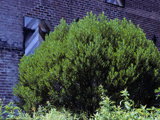
Ilex glabra (Inkberry) - sandy to peaty (there's that word again) acid soil, native to Butler County
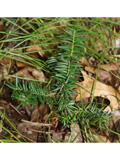
Taxus canadensis (Canada yew) - needs moist sands or sandy loams, native to Butler Co.
We then tried "semi-evergreen" for leaf retention and got nothing, but when we asked for "deciduous" there were 43 listed, from which we chose these, all native to Butler Co.:
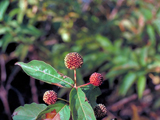
Cephalanthus occidentalis (Common buttonbush) - clay soil
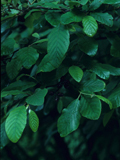
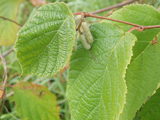
Corylus americana (American hazelnut)
Cornus sericea (Redosier dogwood) - moist well-drained soils, which clays are not
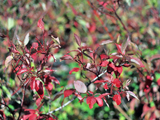
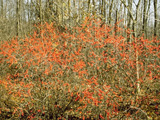
Ilex verticillata (Common winterberry) - clay soils
Alnus serrulata (Hazel alder) also on this list, soils discussed above
Obviously, none of these are ideal, but you can go back to the database, running different searches, maybe asking for a taller height range, etc.
From the Image Gallery
More Shrubs Questions
Need shrubs to form a barrier fence to exclude large dogs in Huntsvile, TX.
August 26, 2009 - I'm seeking shrubs to form a barrier fence to strongly discourage free-roaming large dogs from entering a property in Huntsville, Texas. The site is currently just a grass yard basking in full sun, g...
view the full question and answer
Plants for shelter for butterflies
July 04, 2010 - I understand that butterflies need certain plants for food, but are there specific plants that butterflies prefer to use as shelter in central Texas?
view the full question and answer
Shrubs for planting under hollies in DC
April 01, 2011 - I would like shrub suggestions for planting under holly trees. I live in Washington, DC and have 2 very well-established large holly trees (2 story tall trees) in the front of our house, facing north...
view the full question and answer
Plants that will grow on the Connecticut coast
June 08, 2010 - I live on the coast in Connecticut and have a hard time growing plants here. I live about 1/2 mile from the beach and find that my soil is very rocky. The only plants that have done well in my yard ...
view the full question and answer
Propagation of poinsettias in water from Houston
September 06, 2013 - Pointsettias - we have a broken branch that is thriving in a jar of water with new leaves and additional small branches. When we plant the stem in dirt and even a muck, the growth starts to wither.
...
view the full question and answer
| Support the Wildflower Center by Donating Online or Becoming a Member today. |