Native Plants

Q. Who is Mr. Smarty Plants?
A: There are those who suspect Wildflower Center volunteers are the culpable and capable culprits. Yet, others think staff members play some, albeit small, role. You can torture us with your plant questions, but we will never reveal the Green Guru's secret identity.

Did you know you can access the Native Plant Information Network with your web-enabled smartphone?

Ask Mr. Smarty Plants
Ask Mr. Smarty Plants is a free service provided by the staff and volunteers at the Lady Bird Johnson Wildflower Center.

rate this answer

Tuesday - June 11, 2013
From: Newburyport, MA
Region: Northeast
Topic: Diseases and Disorders, Shrubs
Title: Bottlebrush buckeye not leafing out from Newburyport MA
Answered by: Barbara Medford
QUESTION:
We have a bottlebrush buckeye bush that has grown and blossomed for 16 years. This spring the bush failed to produce any leaves and there are no buds in anticipation of leaves. There are a few smaller undergrowth stems that do have leaves. Is there anyway to save this bush? If it needs to be removed, can the smaller stems be saved?ANSWER:
Here is a very recent Mr. Smarty Plants question on this same plant from Pennsylvania. According to this USDA Plant Profile Map, Aesculus parviflora (Bottlebrush buckeye) does not grow naturally in Massachusetts at all, much less in Essex County in the far northeastern tip of the state. However, since it has been growing there for years, it has obviously adapted. We have another previous answer on bottlebrush, this is Callistemon ssp. but this link is from the Australian Native Plants Society, and the plant would not be in our Native Plant Database or our area of expertise.
However, whichever one it is, we would advise that you first give it the thumbnail test -starting at the topmost branch, use your thumbnail to scratch off a very thin layer of the outer bark. If there is a thin layer of green under that outer layer, that shrub is alive. If not, keep working your way down the shrub until you find green, which may not be until you get to the lower stems. If that is the case, you can trim off the upper branches, and begin to treat the lower branches as the whole bush. Water carefully, as needed, but DON'T FERTILIZE! Fertilizing already stressed plants to put on new growth just stresses the plant more.
Note that the pictures from our Image Gallery below are of the native Aesculus parviflora (Bottlebrush buckeye). Here are pictures of the non-native Callistemon.
From the Image Gallery

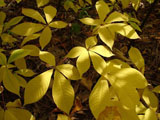
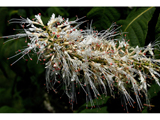
More Shrubs Questions
Florida shrub with tiny green pumpkin-like fruit
July 23, 2008 - I live in Central Florida and have a fast-growing shrub with long stems. The leaves are similar to sassafras and from a distance the red flowers resemble those of a geranium. It has pods that look l...
view the full question and answer
Pruning cherry laurel in January in Austin
January 07, 2011 - Do trust I checked Q&A first. Can Cherry Laurel shrubs be pruned earlier than late winter in Austin? I foolishly planted 12 native Cherry Laurel standards on our suburban property line 5 years ago. I ...
view the full question and answer
Fruit crops to grow in Tennessee mountains
May 27, 2013 - My property has a lot of rock formations throughout it and has hundreds of cedars where it is not pasture. I am wanting to grow fruit trees and berry bushes but don't know what can grow in this e...
view the full question and answer
Is cenizo (Leucophyllum frutescens) edible?
December 21, 2012 - I found a post here about cenizo leaves being used for tea, but I'm wondering if the leaves of the cenizo are edible? I have found many recipes for 'brown butter sage' leaves (sauteed often with on...
view the full question and answer
Correcting overgrown Savannah holly in Goldsboro NC
April 24, 2010 - I have an overgrown Savannah Holly. How do I go about correcting?
view the full question and answer
| Support the Wildflower Center by Donating Online or Becoming a Member today. |