Native Plants

Q. Who is Mr. Smarty Plants?
A: There are those who suspect Wildflower Center volunteers are the culpable and capable culprits. Yet, others think staff members play some, albeit small, role. You can torture us with your plant questions, but we will never reveal the Green Guru's secret identity.

Did you know you can access the Native Plant Information Network with your web-enabled smartphone?

Ask Mr. Smarty Plants
Ask Mr. Smarty Plants is a free service provided by the staff and volunteers at the Lady Bird Johnson Wildflower Center.

rate this answer

Wednesday - May 29, 2013
From: Livermore, CA
Region: California
Topic: Pruning, Shrubs
Title: Pruning of tree poppy from Livermore CA
Answered by: Barbara Medford
QUESTION:
We have a Dendromecon rigida which has been in place for about 10 years and is doing fine. But the older growth gets dry, brown and crinkly, while the newer growth is bright and lush. I would like to keep it looking good, but I'm afraid of pruning off too much of the unsightly old growth for fear of overdoing it, so I have been tending to leave much of the old growth in place. Any advice about how aggressively this plant can, or should, be pruned?ANSWER:
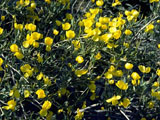
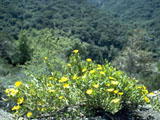
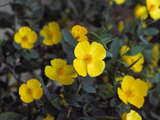
There are two members of the Dendromecon genus native to California. Both appear to be endemic to California; that is, growing nowhere else in North America. One is Dendromecon rigida (Tree poppy) (USDA Plant Profile), native to quite a big area of California, including Alameda County, and Dendromecon harfordii (Harford's tree poppy) (USDA Plant Profile) native to Santa Barbara County and the Channel Islands. Both are members of the Papaveraceae (poppy) family.
We mention this similarity in these plants because we found these pruning instructions for Dendromecon harfordii (Harford's tree poppy) which we think would be applicable to Dendromecon rigida (Tree poppy):
"Regarding pruning, I like tipping the plant back lightly but if it gets too big it can be treated more harshly taking half or more of the plant off around November or December. It re-sprouts generously and if those branches are immediately tipped back again it forms a more dense and floriferous plant the next year."
From the Image Gallery
More Shrubs Questions
Flowering and evergreen shrubs for landscape in Indiana
May 29, 2010 - I live in Southern Indiana and we are getting ready to redesign our front landscape. Currently, we have some yews and other shrubs that are unruly and require a lot of pruning and care. My husband hat...
view the full question and answer
Pruning Wax Myrtle trees & bushes
February 28, 2016 - When is the best time of year to prune Wax Myrtle trees & bushes.
view the full question and answer
Milky Substance on Salvia greggii
June 26, 2015 - The Salvia greggii that I have in the front yard has a milky substance on it ... and the plants are not doing well. Is this some kind of fungi or disease? What can I do to "cure" it? Thank you! Lia...
view the full question and answer
Draought-tolerant screening shrub for Shasta County, California
July 08, 2015 - It has been suggested to me that I plant phodocarpus 'maki' along my fence for needed privacy due to it's dimensions. I need something that does not grow too wide. I would not be pruning them as I ...
view the full question and answer
Need a good plant for Clayton, NC.
August 23, 2012 - What would be a good plant for Clayton,NC for this time of year. I would like for it to come back every year so I don't have to replant. I have several full sun areas that I need to cover in the fron...
view the full question and answer
| Support the Wildflower Center by Donating Online or Becoming a Member today. |