Native Plants

Q. Who is Mr. Smarty Plants?
A: There are those who suspect Wildflower Center volunteers are the culpable and capable culprits. Yet, others think staff members play some, albeit small, role. You can torture us with your plant questions, but we will never reveal the Green Guru's secret identity.

Did you know you can access the Native Plant Information Network with your web-enabled smartphone?

Ask Mr. Smarty Plants
Ask Mr. Smarty Plants is a free service provided by the staff and volunteers at the Lady Bird Johnson Wildflower Center.

rate this answer

Thursday - May 30, 2013
From: Irvine , CA
Region: California
Topic: Pruning, Shrubs
Title: Getting a senna to fill out from Irvine CA
Answered by: Barbara Medford
QUESTION:
I have a Senna of some kind, started from a seed by a friend. I got it as a small,six in high) seedling. After two years it is now blooming beautifully, but is a single thin stem 4 feet tall with very few short side branches. It is bending over and very spindly. How can I prune it to get a full bush or a branching tree shape, anything but a tall, thin, bent over whip?ANSWER:
There are two members of the Senna genus native to California. One is Senna armata (Desert senna) which is native right next to Orange County (USDA Plant Profile Map) and Senna obtusifolia (Java-bean), native relatively near Orange County (USDA Plant Profile Map).
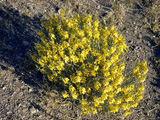
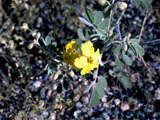
We did a lot of looking trying to find out about the senna plant, considered a subshrub. Our Native Plant Database webpages on the two native to California as well as the rest native to North America yielded very little information except that it was often considered a weedy pest. It is a member of the Fabaceae (bean) family. Here are some photos of Senna armata (Desert senna) from CalPhoto. If they are accurate, you should have a lot of flower-bearing stems instead of only one. However, two years is not a very long time for a shrub to mature.
The nearest we could find to a description of a plant is from Wikipedia:
"Senna armata is a species of flowering plant in the legume family known by the common names spiny senna and desert senna. It is native to the desert regions around the intersection of Nevada, Arizona, eastern California and northern Baja California, where it grows in sandy and rocky habitat, such as arroyos. It is a shrub growing up to a meter tall, its grooved, branching stems often narrowing to thorns at their tips. The spiny branches are coated in tubular hairs which help protect it from hot desert air. The spine-tipped leaves are each made up of two to four pairs of small leaflets. The leaves are ephemeral, dropping soon after emerging, leaving the shrub naked most of the time. Flowers occur singly or in small clusters in leaf axils. They are fragrant and showy, with five petals in shades of yellow to salmon pink, each measuring roughly a centimeter long. The fruit is a legume pod up to 4 centimeters long."
Just at a guess, with no better information, we would say your plant may simply not be mature yet. It is a desert plant, so it needs little water, no fertilizer and lots of sun. Any of those not observed, especially the fertilizer, can inhibit the blooming. One last note -almost any plant grows more quickly from root cuttings or division than from seeds.
We would suggest pruning back any dead growth or wilted flowers. Plants all need to bloom in order to reproduce theselves, so if the plant is in a good place for it to grow, it should be inspired to put on more blooms.
From the Image Gallery
More Pruning Questions
Pruning buttonbush from Pottsville PA
December 10, 2013 - In a formally planted park, a small area has become swampy. I have choosen to plant it with wet tolerant native plants. I would appreciate any suggestions on pruning the buttonbush [Cephalanthus occ...
view the full question and answer
Will catalpa roots damage a nearby swimming pool?
July 13, 2013 - Will a catalpa tree cause problems to my swimming pool? It is 8 feet away and I cut all the branches off every fall. It then grows back to about 6 feet in diameter an makes a great garden feature but ...
view the full question and answer
Pruning the leaves of Sago Palm.
March 10, 2010 - Is it a cardinal sin to remove all the sago palm branches? This winter they were so badly scorched by the cold that hardly a frond went unaffected. So I cut them all off as I needed to get around the...
view the full question and answer
Trimming a rock rose in Richardson TX
March 11, 2009 - I have a Rock Rose (Pavonia lasiopetala)in my garden. I cannot find any information on how to trim or whether I should trim this plant. If so when? Mine is pretty much growing all over the place and...
view the full question and answer
Pruning native Senna lindheimeriana
September 28, 2008 - I asked a question about pruning a Texas Senna tree. The Texas Senna I have is either a S. wislizenii or a S.lindheimeriana. It is a beautiful tree that I purchased at a Texas Native Plant nursery. ...
view the full question and answer
| Support the Wildflower Center by Donating Online or Becoming a Member today. |