Native Plants

Q. Who is Mr. Smarty Plants?
A: There are those who suspect Wildflower Center volunteers are the culpable and capable culprits. Yet, others think staff members play some, albeit small, role. You can torture us with your plant questions, but we will never reveal the Green Guru's secret identity.

Did you know you can access the Native Plant Information Network with your web-enabled smartphone?

Ask Mr. Smarty Plants
Ask Mr. Smarty Plants is a free service provided by the staff and volunteers at the Lady Bird Johnson Wildflower Center.

rate this answer

Saturday - April 06, 2013
From: Laughlin, NV
Region: Southwest
Topic: Trees
Title: Trees for property in Nevada
Answered by: Nan Hampton
QUESTION:
Mr. Smarty Plants: I would like to plant trees in between Crepe Myrtles than put up a fence along the paved road. The temperature ranges from 27'F to 130'F. It is a full sun all day and I will install a drip system. The rest of the front yard has various kinds of cacti: Ocotillos, Chollas, pink beavertails or pink prickly pears, barrel cacti, Mexican Bird of Paradise, etc. as well as a septic system. What would you recommend?ANSWER:
You didn't say what size tree you were interested in so I am suggesting several native trees of various sizes that are known to grow in Clark County, Nevada and would fit in well with the other plants in your yard.
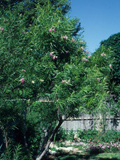
Chilopsis linearis (Desert willow) grows to 15-40 feet, is heat, drought and cold tolerant and produces exotic-looking flowers. Here are more photos and information from University of Arizona Pima County Cooperative Extension.
Cercocarpus ledifolius (Curl-leaf mountain mahogany) is evergreen and grows to 10-20 feet. Here are photos and more information from Las Pilitas Nursery in California and CalPhotos from the University of California-Berkeley.
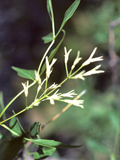
Fraxinus cuspidata (Fragrant ash) grows to 20 feet, has fragrant flowers and is cold hardy to 5 to 10 degrees F and tolerates heat well. Here are more photos and more information from Aggie Horticulture.
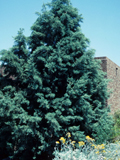
Hesperocyparis arizonica (Arizona cypress) is evergreen and grows to 30-40 feet. Here is more information from Virginia Tech.
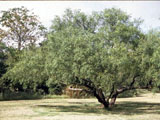
Prosopis glandulosa (Honey mesquite) grows to 30 feet and is well-adapted to hot, dry conditions and improves the soil by fixing nitrogen. Here is more information from the US Forest Service and Winrock International.
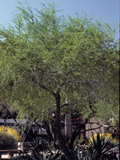
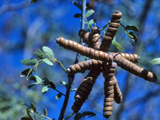
Prosopis pubescens (Screwbean mesquite) grows to 30 feet, does well in heat and hardy down to ~15° F. Here is more information from University of Arizona Pima County Cooperative Extension.
You can search for more possibilites on the Nevada Recommended page that list commercially available plants native to Nevada that are suitable for landscaping. You can use the NARROW YOUR SEARCH option to limit the search to "Tree" under the General Appearance category.
From the Image Gallery

More Trees Questions
Care for indoor Lemon Cypress
November 30, 2008 - How do I care for an indoor Lemon Cypress tree?
view the full question and answer
Desert Willow size question from Austin, TX
June 12, 2015 - Dear MSP, I have a desert willow named Edith. We got her from the CoA a couple of years ago for recycling our Chirstmas tree. She's doing well except her three little trunks are teeny-tiny. We wan...
view the full question and answer
Evergreen low litter tree for Surprise AZ
March 19, 2010 - Looking for a shade tree about 10-15 ft max with low litter and green all year round/full sun.
view the full question and answer
Foundation plants unlikely to provide good shade for rattlesnakes in TX
August 28, 2011 - I would like to plant native grass around my new home in the country near Mason, TX. My concerns are the rattlesnakes that are common here, and if they could "hide" in the native grasses since they ...
view the full question and answer
Growing Loblolly Pine in Salado, Texas
March 09, 2016 - I would like to plant a loblolly pine in Salado, Texas. Will these grow well here?
view the full question and answer
| Support the Wildflower Center by Donating Online or Becoming a Member today. |