Native Plants
Q. Who is Mr. Smarty Plants?
A: There are those who suspect Wildflower Center volunteers are the culpable and capable culprits. Yet, others think staff members play some, albeit small, role. You can torture us with your plant questions, but we will never reveal the Green Guru's secret identity.
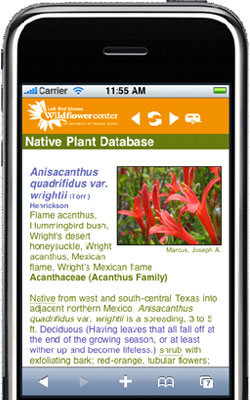
Did you know you can access the Native Plant Information Network with your web-enabled smartphone?
Ask Mr. Smarty Plants
Ask Mr. Smarty Plants is a free service provided by the staff and volunteers at the Lady Bird Johnson Wildflower Center.

rate this answer

Tuesday - March 05, 2013
From: Belleair, FL
Region: Select Region
Topic: Plant Lists, Container Gardens, Shrubs
Title: Hot Sunny Planter Suggestions for Florida
Answered by: Anne Van Nest
QUESTION:
We have a large, raised, concrete planter (about 15' L x 2' W) separating us from our condo neighbor in Clearwater, FL. We would like suggestions for shrubs that tolerate full sun and hot conditions!ANSWER:
Think of the space as two layers – the taller shrub layer and a groundcover or trailing plant layer that will cascade over the edge of the planter. Your planter can include excellent native plants for both these layers. You can also have several different plants in the planter that have attractive flowering, foliage, or fruiting features during different times of the year.
The first place to go to find a list of potential plants is our Native Plant Database. Use the Combination Search feature instead of Recommended Species. This will provide a bigger selection with much more choice to narrow down. The volunteers and staff at the Wildflower Center who maintain the database have partners in different regions to help with these recommended species lists based on what is easy to access in local nurseries.
Under Combination Search, select the following categories: Florida, Habit (shrub), and Duration – Perennial. You can narrow down this search further by indicating light requirement (sun), blooming time, soil moisture (dry) and height specifics (0-1 ft or 1-3 ft).
Follow each plant link to our webpage for that plant to learn its growing conditions, bloom time, etc. At the bottom of each plant webpage, under Additional Resources, there is a link to the USDA webpage for that plant. Take a look there for more specific details about suitability before you put them on your final planting list. Think about including plants that have interest during a variety of seasons and that have more than one attractive feature (flower, fruit, foliage, bark, etc.) so you can get more benefits out of fewer plants.
The full sun and dry list of native shrubs that are 1-3 ft tall include Zamia pumila (Florida arrowroot), Verbena halei (slender verbena), Rosa carolina (Carolina rose), Lantana involucrata (button sage), Clinopodium coccineum (red savory), and Acacia angustissima (prairie acacia).
The same search (full sun, 1-3 ft tall shrubs) but with moist soil conditions resulted in three suggestions: Batis maritima (seaside saltwort), Desmanthus illinoensis (bundleflower), and Rosa carolinia (Carolina rose).
Best wishes with your planter planning.
From the Image Gallery


More Shrubs Questions
Plant identification
June 12, 2014 - We live in Magnolia TX and have a shrub we can't identify.
It's evergreen and
has waxy leaves with a serrated edge that are about an inch in length.
They have pink flowers and
they grow to ab...
view the full question and answer
Sumacs under live oaks dying in Austin
August 08, 2010 - Converted my yard to native plants last fall. All of the fragrant and evergreen sumacs are dying off one by one - they have never thrived. I ensure they get a good soaking at least once a week. I w...
view the full question and answer
Companion Plants for Rhododendron periclymenoides
February 24, 2015 - Could you identify companion plants that work well with the pink azalea (Rhododendron periclymenoides)?
view the full question and answer
Possumhaw losing leaves in Liberty Hill, TX.
July 11, 2011 - I have two female possumhaw trees and one of them is losing its leaves. I planted both of them in February and they were doing very well, getting green and full. What's happening?
view the full question and answer
Native Texas Hill Country nitrogen-fixing plants
June 07, 2006 - Please help me find a listing of native (TX Hill Country) nitrogen-fixing plants.
view the full question and answer
| Support the Wildflower Center by Donating Online or Becoming a Member today. |