Native Plants
Q. Who is Mr. Smarty Plants?
A: There are those who suspect Wildflower Center volunteers are the culpable and capable culprits. Yet, others think staff members play some, albeit small, role. You can torture us with your plant questions, but we will never reveal the Green Guru's secret identity.
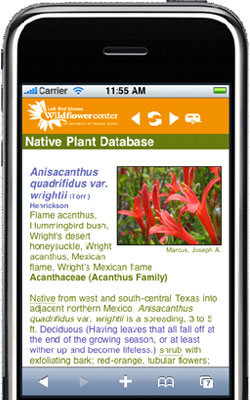
Did you know you can access the Native Plant Information Network with your web-enabled smartphone?
Ask Mr. Smarty Plants
Ask Mr. Smarty Plants is a free service provided by the staff and volunteers at the Lady Bird Johnson Wildflower Center.

rate this answer

Tuesday - October 24, 2006
From: Austin, TX
Region: Southwest
Topic: Container Gardens, Wildlife Gardens
Title: Native plants for a lizard terrarium
Answered by: Nan Hampton
QUESTION:
My brother is setting up a terrarium for his lizard and wants advice on some species to put in the tank. He wants plants that generally fit the below description. Can you think of anything fairly common and easily obtainable that would fit his descriptions? 1. Foreground plants: one species <5" tall and grasslike (mostly shady area) 2. Midground plants between 5 and 18" either attached to rocks or wood (partly shady area) 3. Rear plant (a single species) fewer than 18" tall (mostly sunny area) 4. Rear glass : attach plants on bark hanging against glass (mosses? adiantum?) I don't know the moisture level of the tank yet so I can't help you with that but maybe fairly moist for at least the foreground plants since he suggested Hydrocotyle for that area.ANSWER:
1. Foreground plants:
Texas Frogfruit ( Phyla nodiflora) is a possibility for one of the foreground plants. It grows only 3-6 inches high and does well in dry or moist soils.
Meadow Violet (Viola sororia) or Missouri Violet (V. missouriensis), considered the same species by some experts, are also possibilities.
If the terrarium is going to be really moist, he could consider one of the Water Clovers, such as Marsilea macropoda or M. vestita, as well as one of the Pennyworts such as Hydrocotyle umbellata or H. verticillata var. verticillata
Sedges might also work for the foreground although they are likely to grow >5 inches tall.
2. Midground plants:
Sedges would be a good choice for the midground plants. Cedar Sedge (Carex planostachys) grows less than a foot tall and is generally happy in dry soils.
Another sedge possibility is Meadow Sedge (C. perdentata) that does well in both dry or moist soils and grows 12-18 inches high.
Maidenhair Fern (Adiantum capillus-veneris) grow 6-12" high and could also be a good plant for the midground area. It will grow in soil-filled depression in rocks.
3. Rear plants:
Ferns such as Southern Shield Fern (Thelypteris kunthii) that can grow as high as 2-3 feet could be a choice for the rear plant, but it does prefer the shade.
A grass such as Little Bluestem ( Schizachyrium scoparium ) is a possibility for the sunny area.
4. Rear glass:
For plants attached to bark hanging against the glass at the back, he might consider one of the epiphytes such as Ballmoss (Tillandsia recurvata) or Spanish moss (Tillandsia usneoides).
More Wildlife Gardens Questions
Wildlife Habitat Restoration in Quebec, Canada
December 30, 2009 - Hi there.
What are the best trees and shrubs for wildlife restoration in Quebec? thanks!
view the full question and answer
A list of bloom times for wildflowers in Michigan
July 03, 2013 - Hello, I am new to bee keeping and live in central Michigan. Can you tell me or do you know where I could find a list of the Michigan wild flower bloom times? This would be very helpful to me.
Than...
view the full question and answer
Colony of bees nesting in sycamore
July 06, 2010 - I have a very large, old sycamore tree that has recently become home to a colony of honey bees. They have taken up dwelling in a hollow limb of the tree about 25 feet off the ground. While this is gre...
view the full question and answer
Xeriscape demonstration garden
October 30, 2007 - I am working with the city of Schertz to rejuvenate a xeriscape demonstration garden. We want to plant a hummingbird/butterfly garden using native plants. The current bed is currently overrun with ber...
view the full question and answer
Native trees that host moths and butterflies for birds in Houston Texas
April 05, 2010 - I have learned that non-native or alien plants do not attract the insects that the birds need to live on. I would like to know which native trees for central Texas have the greatest hosting capacity ...
view the full question and answer
| Support the Wildflower Center by Donating Online or Becoming a Member today. |