Native Plants

Q. Who is Mr. Smarty Plants?
A: There are those who suspect Wildflower Center volunteers are the culpable and capable culprits. Yet, others think staff members play some, albeit small, role. You can torture us with your plant questions, but we will never reveal the Green Guru's secret identity.
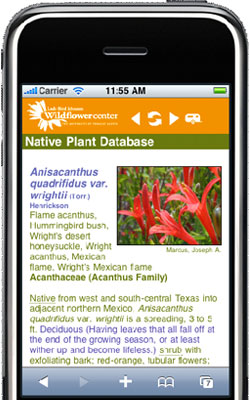
Did you know you can access the Native Plant Information Network with your web-enabled smartphone?

Ask Mr. Smarty Plants
Ask Mr. Smarty Plants is a free service provided by the staff and volunteers at the Lady Bird Johnson Wildflower Center.

rate this answer

Thursday - August 16, 2012
From: Brownsville, TX
Region: Southwest
Topic: Non-Natives, Problem Plants, Shrubs
Title: Male or female Jatropha curcas from Brownsville TX
Answered by: Barbara Medford
QUESTION:
How do know the sex of a young Jatropha C. plant? how many weeks before you can tell a boy/girl plant ?ANSWER:
Somewhat to our surprise there were several species of the genus Jatropha, a member of the Euphorbiaceae (spurge) family, native to North America. One that comes closest to your identification of Jatropha C. is Jatropha cathartica (Berlandier's nettlespurge). According to our Native Plant Database, it is endemic to Texas in North America, but also grows in Mexico. This USDA Plant Profile Map shows that it does grow in several counties in South Texas, including Cameron.
Our first question (never actually having heard of this plant before) was "What is Jatropha?" From the African Development Bank - Renewable Energy we found an article with that very title: What is Jatropha? It appears that the plant you are most likely asking about is Jatropha curcas, which is native to Central and South America, but has spread all over the world in tropical and sub-tropical climates. This USDA Plant Profile Map shows this plant has been introduced into Hawaii, Puerto Rico and Florida.
Since this is a non-native and out of our realm of plants native to North America, we are going to give you links to some websites to help you answer your own question. We are curious as to why you would want to propagate this plant? It can be invasive, it has serious toxicity, and isn't particularly attractive. Perhaps you're planning home production of biodiesel for the family car?
From General Biodiesel Jatropha curcas: Poison shrub or environmental savior?
Wikipedia Jatropha curcas
Tropilab Inc. Jatropha Curcas - Physic Nut
More Problem Plants Questions
Desert Willow Roots from Lubbock, TX
September 18, 2014 - I have a very, very happy Desert Willow that has grown larger than we expected and is probably too close to the house. Do I need to worry about a cracked foundation or pipe problems? Thanks!
view the full question and answer
Skin Reaction form Cochineal on Prickly Pear
February 16, 2015 - I have severe burning and peeling skin on pads of fingers after touching "white stuff" on a prickly pear. White stuff tuned purple then burned skin even after washing hands. Skin has been cracking a...
view the full question and answer
Killing oak sprouts from El Paso TX
August 16, 2011 - I want to know how to kill oak root sprouts and seedlings. Very dense and out-of-control in huge area of front lawn. I had tree cut down and I still cannot get rid of them. They're only getting wors...
view the full question and answer
Killing regrowing shoots of a downed hackberry tree
June 28, 2013 - Hackberry plants won't die. You and others have suggested to cut the suckers or saplings to get rid of them. Over the years I have continued to cut the same saplings and the only thing I have now ar...
view the full question and answer
Eliminating weeds from seeded wildflower stands
June 25, 2007 - We live in Eastern Central Texas in a small community on Texas Highway 7.
Last fall, we went to the Wildseed Flower Farm near Fredricksburg and purchased
a bag of mixed wildflower seeds and planted...
view the full question and answer
| Support the Wildflower Center by Donating Online or Becoming a Member today. |