Native Plants

Q. Who is Mr. Smarty Plants?
A: There are those who suspect Wildflower Center volunteers are the culpable and capable culprits. Yet, others think staff members play some, albeit small, role. You can torture us with your plant questions, but we will never reveal the Green Guru's secret identity.

Did you know you can access the Native Plant Information Network with your web-enabled smartphone?

Ask Mr. Smarty Plants
Ask Mr. Smarty Plants is a free service provided by the staff and volunteers at the Lady Bird Johnson Wildflower Center.

rate this answer

Wednesday - July 11, 2012
From: Logansport, IN
Region: Midwest
Topic: Pollinators, Propagation, Herbs/Forbs
Title: Petunias pollinated by clematis from Logansport IN
Answered by: Barbara Medford
QUESTION:
Can petunias be pollinated by clematis? I have 2 petunias that have split blooms and look like a small clematis flower. They are growing close to a jackamani clematis.ANSWER:
Clematis x jackmanii is a result of many hybridizations since the mid 1800's, and therefore will not appear in our Native Plant Database. We will look at a clematis native to Indiana to learn some of its traits. There are 3 members of the Ranunculaceae (Buttercup) family that grow natively in Indiana. These are:
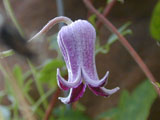
Clematis pitcheri (Purple clematis)
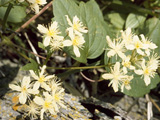
Clematis virginiana (Devil's darning needles)
Then we searched our database for petunias. Actually, we already know that the petunia native to North America is not likely to be the one you have in your garden. If you bought bedding plants in a large nursery, the petunias are hybridized many times over for shape and color, and originated in South America. In botanical classification, tobacco, tomato, potato, and petunia are all in the family Solanaceae. There are about 35 species in the genus
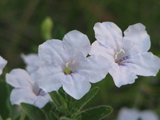
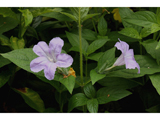
There are 3 species of the native petunia native to Indiana, all members of the genus Ruellia and family Acanthaceae (Acanthus):
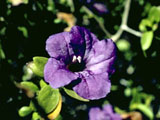
Ruellia caroliniensis (Carolina wild petunia)
Ruellia humilis (Fringeleaf wild petunia)
Ruellia strepens (Limestone ruellia)
So, to summarize, you are asking if members of the genus Petunia (non-native, family Solanaceae or the genus Ruellia (native petunia, family Acanthaceae) could cross breed with members of the native Clematis genus (family Ranunculaceae.)
The female flowers of each crop can be fertilized only by pollen from male flowers of the same species. So, we are looking at three different genera, families and species. Won't work.
If you study some of the information on the petunias and clematis, you will note they have many different forms, especially those that have been hybridized. It would seem that the similarities in your petunias and clematis are completely coincidental.
From the Image Gallery
More Pollinators Questions
Plants for pollinators & honey bees in PA
March 12, 2012 - In the database section entitled "Value to Beneficial Insects" on the page for "Tilia americana L" (also known as the Bee Tree, or Linden Tree, American Basswood); the tree is identified as being ...
view the full question and answer
Butterfly egg kit from Spring Hill FL
October 27, 2011 - Could you please tell me all native plant(s) I can buy for my Sons Painted Lady Butterfly kit (eggs are going to hatch soon)and I don't know what to buy for the baby caterpillars to eat. I contacted ...
view the full question and answer
Pollinator friendly lawn for Longmont CO
July 06, 2015 - I have a sunny, treeless, South-facing yard, with a slight South-facing slope in Boulder County, CO. It has one patch of buffalo grass, but is more then half some other type of grass. I would like t...
view the full question and answer
Artist's project on protecting pollinators in Austin
February 26, 2011 - I am designing a citywide artist's project to protect and preserve local, natural pollinators (with an emphasis on honeybees). What nectar-rich plants would you recommend for this type of project?
...
view the full question and answer
Pollinator plants for Ilex verticillata (winterberry)
June 09, 2008 - How close do a male and female common winterberry need to be to produce berries. We bought a male and female last year and attracted cedar wax wings. Amazing show. We just bought two more females a...
view the full question and answer
| Support the Wildflower Center by Donating Online or Becoming a Member today. |