Native Plants

Q. Who is Mr. Smarty Plants?
A: There are those who suspect Wildflower Center volunteers are the culpable and capable culprits. Yet, others think staff members play some, albeit small, role. You can torture us with your plant questions, but we will never reveal the Green Guru's secret identity.

Did you know you can access the Native Plant Information Network with your web-enabled smartphone?

Ask Mr. Smarty Plants
Ask Mr. Smarty Plants is a free service provided by the staff and volunteers at the Lady Bird Johnson Wildflower Center.

rate this answer

Saturday - June 23, 2012
From: Marietta, GA
Region: Southeast
Topic: Herbs/Forbs
Title: Hybrid Impatiens leaves yellowing from Marietta GA
Answered by: Barbara Medford
QUESTION:
My impatiens looked great when I went out of town, I had recently fertilized. The person left to water them fertilized them. Now they are yellow and dwarfed. Anything I can do?ANSWER:
We were willing to bet that impatiens were non-native to North America, because we see them marketed vigorously and in heavily hybridized forms. However, it turns out that the family Balsaminaceae (Touch-Me-Not) includes three species native to North America, and all three are native to Georgia.
Impatiens capensis (Jewelweed)
Impatiens noli-tangere (Western touch-me-not)
Impatiens pallida (Pale touch-me-not)
The information we got from the webpages above was that they needed shade (2 hours or less of sun a day) and wet soil.
Now these are probably not what you have in your garden, but rather the hybridized plants, but we will use the information we have in our database to try to help you figure out what happened. Of course, if you saw these natives in your garden, you would probably pull them out as weeds, and we can't know what effects the hybridizing of the plants had on their water and sun needs. Try reading this article from Gardening Know-How Caring for Impatiens, and figure out what you were doing or not doing that caused the yellowing leaves. Our first top-of-the head thought is too much fertilizer and not enough water, but again, maybe the hybrids have different needs.
From the Image Gallery
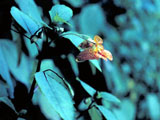
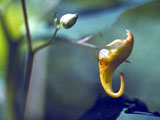
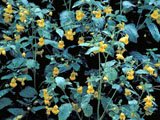
More Herbs/Forbs Questions
Plants for oak shade from Whitney TX
December 24, 2012 - I live in Whitney, Texas and have a number of beautiful Live Oak trees in a portion of my yard providing deep shade. Asian Jasmine grows in about 5 ft circle around them and then nothing! I have walk ...
view the full question and answer
Availability of Texas Frogfruit
June 22, 2012 - Are there any nursery suppliers that supply Texas frogfruit?
view the full question and answer
Source for chile pequin plants in Austin
June 11, 2013 - Where can I buy chile pequin plants in Austin?
Thank you,
view the full question and answer
Plants for Liberty Hill TX in full sun
April 15, 2008 - We recently bought an acre of land in Liberty Hill, TX. We have a large planting area in the front that is devoid of any plant life. I would like to turn this into a semi shaded area with some annua...
view the full question and answer
Is Asclepias purpurascens a Texas native?
April 23, 2013 - Is the Asclepias purpurascens a Texas native plant? If so where does it grow?
view the full question and answer
| Support the Wildflower Center by Donating Online or Becoming a Member today. |