Native Plants
Q. Who is Mr. Smarty Plants?
A: There are those who suspect Wildflower Center volunteers are the culpable and capable culprits. Yet, others think staff members play some, albeit small, role. You can torture us with your plant questions, but we will never reveal the Green Guru's secret identity.
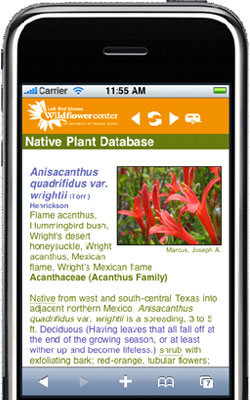
Did you know you can access the Native Plant Information Network with your web-enabled smartphone?
Ask Mr. Smarty Plants
Ask Mr. Smarty Plants is a free service provided by the staff and volunteers at the Lady Bird Johnson Wildflower Center.
rate this answer

Thursday - June 21, 2012
From: Baltimore, MD
Region: Mid-Atlantic
Topic: Plant Identification
Title: Identification of small plant with white flowers in Baltimore, MD
Answered by: Nan Hampton
QUESTION:
It's a small plant, has flowers in June, four white petals with large, tall conical center, about no more than an inch in diameter. The leaves are alternating with branched veins. It stays at about 6" high, grows in deep shade, comes in variegated as well. It is spreading through the lawn by its roots. One of my tenants planted it. It puts up with a lot of abuse. Baltimore is famous for its acidic clay soil.ANSWER:
Since you said that one of your tenants planted it, Mr. Smarty Plants is very suspicious that this isn't a native plant. However, I did do a COMBINATION SEARCH in our Native Plant Database choosing "Maryland" from the Select State or Province option, "Herb" from Habit (general appearance) and "White" from Bloom color. You could do the same search on your own and look through the photos and read the descriptions. I found the following four plants that partially fit your description:
Cornus canadensis (Bunchberry dogwood). Here are more photos and information from Plants of Wisconsin.
Cardamine concatenata (Cutleaf toothwort). Here are more photos and information from Connecticut Botanical Society.
Cakile edentula (American searocket). Here are more photos and information from Connecticut Botanical Society.
Mitchella repens (Partridgeberry). Here are more photos and information from Duke University.
Diodia virginiana (Buttonweed). Here are more photos and information from Missouri Plants.
I suspect that none of these is the plant that is growing in your lawn. However, if you have—or can take—photos, you will find links to several plant identification forums on our Plant Identification page that would accept your photos of the plant to be identified.
From the Image Gallery


More Plant Identification Questions
Identification of Verbesina occidentalis (Yellow crownbeard) in Burnet County TX
November 23, 2015 - Looked up (small) yellow crownbeard..yellow, no description or pic. Csn you tell me if this is what is in this pic? THX!
Can't insert a pic to say y/n. 😟it's in Burnet, Co..SE of Marble Fal...
view the full question and answer
Identification of flower in book
August 12, 2015 - Hi, I make paper flowers and I came across this flower in my book under the name camellia. But I am sure it is not. I tried finding out similar flowers but i am lost as I don't know if such a flower ...
view the full question and answer
Plant identification
November 15, 2013 - I need help identifying a flower/plant. It has a long stem with a Flower at the top and small 2" green things that look like small bananas at the bottom.( But not Bananas) I open one up and it had s...
view the full question and answer
Tree with blue berries in Los Angeles, CA
March 22, 2016 - There's a tree outside my house with somewhat thin and short spiky leaves with blue berries. The berries
Some of the berries have a frost look and some are dark blue.
view the full question and answer
Differences between Ratibida columnifera and Ratibida peduncularis
June 03, 2010 - How do you tell the difference between Ratibida columnifera and Ratibida peduncularis. On NPIN columnifera has red and penduncularis is solid yellow, but I have seen pictures listed as columnifera tha...
view the full question and answer
| Support the Wildflower Center by Donating Online or Becoming a Member today. |