Native Plants

Q. Who is Mr. Smarty Plants?
A: There are those who suspect Wildflower Center volunteers are the culpable and capable culprits. Yet, others think staff members play some, albeit small, role. You can torture us with your plant questions, but we will never reveal the Green Guru's secret identity.

Did you know you can access the Native Plant Information Network with your web-enabled smartphone?

Ask Mr. Smarty Plants
Ask Mr. Smarty Plants is a free service provided by the staff and volunteers at the Lady Bird Johnson Wildflower Center.

rate this answer

Monday - March 05, 2012
From: Austin, TX
Region: Southwest
Topic: Planting, Drought Tolerant, Shrubs
Title: low-growing evergreen shrubs for thin soil
Answered by: Guy Thompson
QUESTION:
Thanks to the winter freeze, we'll be starting fresh with the plants in the bed along the front of our house. The bed is about 13' long and faces the west, so it gets afternoon/ evening sun but no morning sun. We live in the Loop 360/Bee Cave Road area, with thin topsoil and no automatic sprinkler system. We'd like low-growing (1 - 3') evergreen plants that will look somewhat "bushy" and not spindly. Would violet silverleaf or myrtle boxwood be our best bets? What about flame acanthus, nandina, or purple heart?ANSWER:
The plants you suggest, violet silverleaf, also called Leucophyllum frutescens (Cenizo) (dwarf varieties are available), and myrtle boxwood, also called Paxistima myrsinites (Mountain lover), would be good choices for your location. Other possibilities are Ilex vomitoria (Yaupon), for which you also can obtain dwarf varieties, Mahonia trifoliolata (Agarita), a prickly shrub that can be kept compact by pruning, Salvia greggii (Autumn sage), a colorful bloomer that needs a small amount of pruning, and Lonicera sempervirens (Coral honeysuckle), which is actually a climbing vine but can be trained to remain low on a trellis. I should point out that Yaupon plants are dioecious, that is, each plant has either male or female flowers but not both. Nurseries usually sell female plants, which bear the colorful red berries, but if there are no yaupon plants growing wild in your neighborhood you might buy a male plant to pollinate the others.
A non-native that does well in Austin is rosemary.
All of these species should thrive in your location. They need good drainage, so if your "thin topsoil" has hard caliche below it, you should loosen that up and add compost before planting. Whichever species you choose will need to be kept moist for some time while they become established.
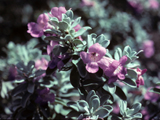
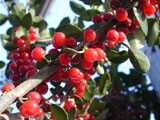
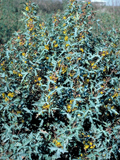
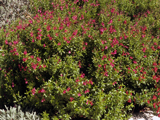
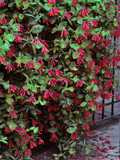
Below are some sample images from the Lady Bird Johnson Wildflower Center image gallery:
From the Image Gallery
More Shrubs Questions
Recommendations for native plants for Dallas Co., TX
May 12, 2007 - Looking for a Recommendation: Can you suggest a plant that meets the following requirements?
ENVIRONMENT --
- I live in Garland, in Dallas County, TX.
- The soil is primarily clay.
- Full sun...
view the full question and answer
Specimen evergreen for sun in Central Texas
August 28, 2010 - I'm soliciting suggestions for a specimen plant for a new garden we're building. It will be planted in a 3' square raised (18") Limestone bed. It will be full sun, Western exposure, and relative...
view the full question and answer
Dog Friendly Privacy Hedge for Long Island
April 14, 2013 - Can you please advise me of some plants for a privacy hedge that are non-toxic to dogs and that would thrive on Long Island, NY? I am looking for a hedge to grow to about 6-8 ft.
view the full question and answer
Aromatic sumac in Travis County
August 14, 2010 -
This is an answer to article in today's, August 14, newspaper. I assume that aromatic sumac is native to Travis county because I have it all over my property. It turns bright red in the fall adding...
view the full question and answer
Replacement for boxwoods in Ohio
February 26, 2014 - I want to replace my boxwood plants but I don't know what would be a good replacement. I have a hydrangea plant that is in the middle and I would like something to go on each side of the hydrangea. I...
view the full question and answer
| Support the Wildflower Center by Donating Online or Becoming a Member today. |