Native Plants

Q. Who is Mr. Smarty Plants?
A: There are those who suspect Wildflower Center volunteers are the culpable and capable culprits. Yet, others think staff members play some, albeit small, role. You can torture us with your plant questions, but we will never reveal the Green Guru's secret identity.

Did you know you can access the Native Plant Information Network with your web-enabled smartphone?

Ask Mr. Smarty Plants
Ask Mr. Smarty Plants is a free service provided by the staff and volunteers at the Lady Bird Johnson Wildflower Center.

rate this answer

Thursday - July 07, 2011
From: Hillsboro, TX
Region: Southwest
Topic: Rare or Endangered Plants, Herbs/Forbs
Title: Wide appearance of Texas Bluebells in Hillsboro TX
Answered by: Barbara Medford
QUESTION:
I thought Texas Bluebells were rare, endangered and liked wet places. So why, after at least a dozen years of not seeing any and during this horrible drought am I seeing them where I have never seen them before. I see lots for miles around me. Maybe that is what the last query was about.ANSWER:
We are not sure which recent answer on bluebells you are referring to, but the most recent Mr. Smarty Plants question had to do with propagation of bluebells.
This USDA Plant Profile map shows that Eustoma exaltatum ssp. russellianum (Texas bluebells) is native around Hill County. It also appears to grow in a few counties in the Texas Panhandle, which could hardly qualify as wet places. One reason that you don't see so many around ordinarily is from our webpage on this plant in our Native Plant Database:
"One reason Texas Bluebells are not as common now as they once were is due to their beauty. People have literally picked them from the wild in such numbers that the wild populations have been unable to reseed in their native habitat."
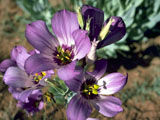
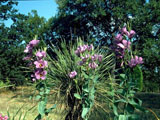
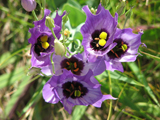
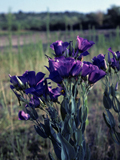
From The Austin Wildflower, read this article on The Texas Bluebell, which explores some of the different names of this plant, and agrees that it is "near extinction." This was, however, the only time we found any reference to this plant being rare or endangered. We have two thoughts on your seeing so many of them in your area. The first is that a plant called "Lisianthus" which is the old scientific name for Eustoma has been grown extensively in Japan for 70 years and is often sold in nurseries. Some of these may have been sowed or accidentally escaped from gardens, and now have a new career as weeds. The other thought is that we wonder if you are seeing some other blue flower perhaps, again, a non-native that has escaped. Pictures below of our "real" Texas Bluebell.
From the Image Gallery
More Herbs/Forbs Questions
Plants to grow in shady sand in Florida
March 31, 2013 - We live in central Florida (directly between Orlando and Tampa). Our yard is mostly sand for soil and difficult parts in shade almost all day from large trees. What ground cover (grass) and hedges can...
view the full question and answer
Transplanting bluebonnets in late Fall from Georgetown TX
November 08, 2013 - Transplanting bluebonnets in October? Neighbor wants to share abundance of rosettes and good size plants- any suggestions or warnings? Will freeze/frost protection be needed if we get December freeze...
view the full question and answer
Low cost, low maintenance, water tolerants native plants for New Jersey
February 25, 2006 - I am planning a bed around my deck which will include shrubs and flowers. I am looking for plants that require a lot of water due to the wet soil conditions and poor drainage in my yard. Do you have...
view the full question and answer
Smoky Mountains Shaded Slope Plant Suggestions
April 29, 2013 - We live in a very shady spot in Great Smoky Mountains in Western North Carolina. We would like to plant vegetation on a sloped area behind our cottage to stop erosion after building an addition. Our h...
view the full question and answer
Need suggestions for plants to put between stones on a path in Austin, TX
April 12, 2013 - I am looking for plants to put between stones on a path, which are low-an inch or two, green, low water and tolerate full sun in Austin, Texas
view the full question and answer
| Support the Wildflower Center by Donating Online or Becoming a Member today. |