Native Plants
Q. Who is Mr. Smarty Plants?
A: There are those who suspect Wildflower Center volunteers are the culpable and capable culprits. Yet, others think staff members play some, albeit small, role. You can torture us with your plant questions, but we will never reveal the Green Guru's secret identity.
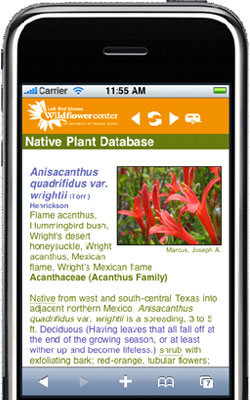
Did you know you can access the Native Plant Information Network with your web-enabled smartphone?
Ask Mr. Smarty Plants
Ask Mr. Smarty Plants is a free service provided by the staff and volunteers at the Lady Bird Johnson Wildflower Center.

rate this answer

Wednesday - June 29, 2011
From: Brewster, MA
Region: Northeast
Topic: Groundcovers
Title: Low groundcovers for MA
Answered by: Anne Bossart
QUESTION:
We are developing ground mounted solar installations in southeastern MA. We are seeking advice for native groundcover species for our various regions (coastal meadows, etc). Species like bearberry and low-bush blueberry are typical. Are there others (and perhaps some annuals) that you can recommend? We must keep to less than 24" to avoid shading the panels.ANSWER:
You will ultimately be limited in your choices by what plants are available in the nurseries in your area, but can begin the process by visiting our Native Plant Database. If you do a Combination Search selecting All Habits, Sun, Moist or Dry Conditions (depending on your site) and a height of 1-3 feet, it will generate a list of plants that you can consider for your project. It will give you perennials, annuals, grasses and small shrubs. You will find Vaccinium angustifolium (Late lowbush blueberry) and Arctostaphylos uva-ursi (Kinnikinnick) on that list.
Here are some other tough plants native to your area to consider (you will have to verify moisture requirements as we have not selected for that):
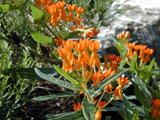
Asclepias tuberosa (Butterflyweed)
Coreopsis verticillata (Threadleaf coreopsis)
Gaylussacia baccata (Black huckleberry)
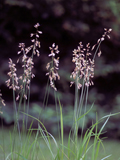
Hierochloe odorata (Sweetgrass)
Iris versicolor (Harlequin blueflag)
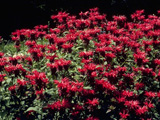
Monarda didyma (Scarlet beebalm)
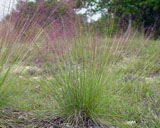
Muhlenbergia capillaris (Gulf muhly)
Potentilla arguta (Tall cinquefoil)
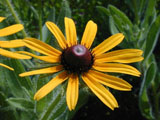
Rudbeckia hirta (Black-eyed susan)
Symphyotrichum laeve var. laeve (Smooth blue aster)
Vaccinium vitis-idaea (Lingonberry)
Planting a mixed meadow of plants like these will not interfere with your solar installation but will be attractive and provide wildlife habitat benefits. That's a win/win!
From the Image Gallery




More Groundcovers Questions
Compatibility of mixed ground covers with St. Agustine grass
March 04, 2015 - My husband and I live in Northwest Austin. We have removed lawn from our front yard and replaced it with mulch and some trees and other plantings.
We would like to replace the lawn in our backyard ...
view the full question and answer
What will grow in red clay in Conroe TX?
April 10, 2011 - We just built a new home and the foundation was poured on red clay which is what my flowerbed area is in. Could you please tell me what can be planted that will grow. I am looking for ground cover, fl...
view the full question and answer
Native ground cover for bare ground
April 24, 2015 - I have a 20 x 40 foot partly sunny area that has only leaves covering the bare ground. I want to replace the leaves with ground cover. Can I mix ground covers like clover, asian jasmine, etc? I would ...
view the full question and answer
Is Phyla lanceolata (frogfruit) poisonous to dogs fromTitusville FL?
June 01, 2014 - Is Phyla lanceolata, also called Fogfruit, Lanceleaf Fogfruit, or Northern Fogfruit, toxic to dogs? We have it growing amongst our grass. I can't find it on any toxic plant list.
view the full question and answer
Shade tolerant groundcover plants for Tarrant County, Texas
November 01, 2011 - I live in far NE Tarrant County (Ft Worth), TX and need a groundcover that can tolerate complete shade and poor, rocky, clay soil. I need mostly for erosion control, and needs to be relatively low
view the full question and answer
| Support the Wildflower Center by Donating Online or Becoming a Member today. |