Native Plants

Q. Who is Mr. Smarty Plants?
A: There are those who suspect Wildflower Center volunteers are the culpable and capable culprits. Yet, others think staff members play some, albeit small, role. You can torture us with your plant questions, but we will never reveal the Green Guru's secret identity.

Did you know you can access the Native Plant Information Network with your web-enabled smartphone?

Ask Mr. Smarty Plants
Ask Mr. Smarty Plants is a free service provided by the staff and volunteers at the Lady Bird Johnson Wildflower Center.

rate this answer

Sunday - May 29, 2011
From: Muskego, WI
Region: Midwest
Topic: Privacy Screening
Title: Evergreens for privacy screen in WI
Answered by: Anne Bossart
QUESTION:
We'd like to add privacy to our backyard with evergreen trees. The problem with this area is it very wet and the ground is soft and mushy until the dry summer conditions. We've rocklined the the area where water runs like a brook when it rains a lot, which has helped direct the rain, but it still is damp and moist.ANSWER:
You may be disappointed with our recommendations as the suitable evergreen trees are the one that can seem to dominate the natural world around you, such as:
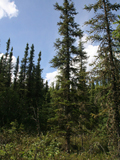
Abies balsamea (Balsam fir) (Images)
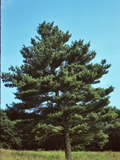
Pinus strobus (Eastern white pine)
Thuja occidentalis (Arborvitae)
Tsuga canadensis (Eastern hemlock) (check with your local agricultural extension service before you plant this tree, as it is highly susceptible to attack by woolly adelgid in warmer parts of its native range)
However, they are adapted to the conditions you describe as they are native to your area.
We recommend you use these "everyday" conifers for the backbone of your screen and then add smaller deciduous flowering trees to make the planting more interesting such as:
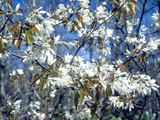
Amelanchier laevis (Allegheny service-berry)
(which flowers early in the spring, produces berries the birds love and then has interesting orange to red fall colour)
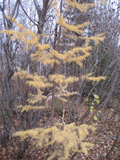
(which is a decidous conifer that turns yellow or orange in the fall before it loses its needles)
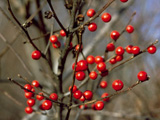
Ilex verticillata (Common winterberry)
(which will provide an amazing display of red berries as long as you plant a male and a female)
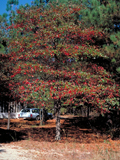
(which has very intense red fall colour)
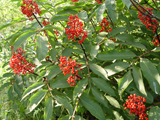
Sambucus racemosa (Red elderberry)
(which also flowers early and produces very red berries)
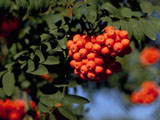
Sorbus americana (American mountain ash)
(which produces red/orange berries that persist after the golden/orange leaves are shed in the fall)
If you create your screen using a mixed planting, you will not only have the privacy you need but it will be attractive to look at throughout the year, and will provide much needed wildlife habitat!
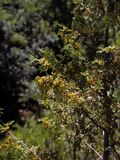
Here are some photos from our Image Library

More Privacy Screening Questions
Spacing for wax myrtles as screen in Texas
December 21, 2008 - I have bought 30 wax myrtles, 15 gallon sized, and would like to plant them along my fence line, as a screen. How far apart is the recommended distance when planting plants of this size?
Thank you!
view the full question and answer
Screening Planter Recommendations for Lakeway TX
May 16, 2012 - I live in Lakeway in a townhome. The parking lot is directly in front of my unit so I always see headlights and cars. The HOA has agreed to build a planter about 4 feet high to help hide the cars. W...
view the full question and answer
Deer-resistant screening tree/shrub
April 17, 2008 - Can you recommend a deer resistant screening tree/shrub? We would like to use privet but are not sure which variety or if the deer will really stay off it, we've had conflicting views!
We live on th...
view the full question and answer
Native evergreen vine for St. Paul MN
June 17, 2010 - I am looking for a native vine that will stay green, or at least keep its leaves, throughout the winter. The vine will be grown on a trellis between our house and our neighbor's, and we want to keep...
view the full question and answer
Privacy hedge for Burleson, TX.
April 09, 2013 - I moved out to the country away from the hustle and bustle only to find that I have less privacy out there because of open land. I hear children screaming and dogs barking from 1/4 mile away. I want t...
view the full question and answer
| Support the Wildflower Center by Donating Online or Becoming a Member today. |