Native Plants

Q. Who is Mr. Smarty Plants?
A: There are those who suspect Wildflower Center volunteers are the culpable and capable culprits. Yet, others think staff members play some, albeit small, role. You can torture us with your plant questions, but we will never reveal the Green Guru's secret identity.

Did you know you can access the Native Plant Information Network with your web-enabled smartphone?

Ask Mr. Smarty Plants
Ask Mr. Smarty Plants is a free service provided by the staff and volunteers at the Lady Bird Johnson Wildflower Center.

rate this answer

Thursday - April 21, 2011
From: St. Augustine, FL
Region: Southeast
Topic: Non-Natives, Seasonal Tasks
Title: Late blooming Esperanza in St. Augustine FL
Answered by: Barbara Medford
QUESTION:
I bought an Esperanza at a plant expo- I was told it was a Florida native Allamanda. It took me two years to figure out what I had. Mine grows 8 ft. tall and is huge! But it doesn't bloom until almost August, and then not many blooms. It comes back each year after the freeze. But is there anyway to get him to bloom sooner and more often? I only paid $3 bucks for him 3 years ago.. so if it's hopeless -it's ok.. I got my money of of this plant. He's indestructible. But his flowers are so pretty- I want to see more. Thank you!ANSWER:
Okay, let us get this straight. You bought a plant called "Allamanda" but figured out it was Esperanza. The only plant in our Native Plant Database with "esperanza" as one of its common names is Tecoma stans (Yellow bells). From our webpage on this plant:
"Conditions Comments: North American native varieties of this species can survive winters within their natural range but may die to the ground during especially harsh winters even there. Varieties sold in nurseries may be from tropical stock and not do so well in US cold."
Another comment in Conditions is: "Soil Description: Well drained, rocky, limestone, sand, and loam soils." That doesn't sound much like the acidic, moist soils in Florida, does it?
You will notice the part saying that nurseries may be selling varieties from tropical stock. You need to understand that just because something is sold locally does not mean it will do well locally.
In spite of this being a native plant, in spite of it being native to Florida, the plant you purchased may have been native to a tropical climate. According to this USDA Plant Profile map St. John's County in northeastern Florida does not have esperanza growing natively. If it is, indeed, Tecoma stans (Yellow bells), it blooms in its native habitat from April to November. You can't force a plant to bloom any time it is not ready, so we feel the environment may be shortening the blooming period.
So, let's explore one more possibility. Maybe the plant you purchased is Allamanda cathartica, Golden Trumpet, which is native to Brazil. See this article on this plant in Floridata. which explains why it freezes so readily. Pictures from Google.
The Lady Bird Johnson Wildflower Center is dedicated to the growth, propagation and protection of plants native not only to North America but to the areas in which those plants are being grown. They will require less (or none) fertilizer, supplementary watering or chemicals for them to prosper. Your chances of having a plant live go up as it planted in an area where it belongs.
From the Image Gallery
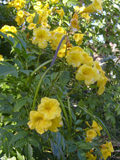
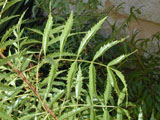
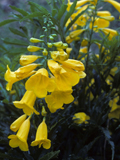
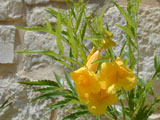
More Seasonal Tasks Questions
Time to cut back Turk's Cap in Austin
January 27, 2011 - I did not find my question answered in the database. My question is: When is the best time to cut back Red Turks Cap? I live in Central Austin.
view the full question and answer
Moving a red oak away from the house foundation
January 24, 2008 - About a 3 weeks ago I noticed a 5 ft. red oak growing in my flower bed. I hadn't noticed it growing up through my shrubs until the leaves turned bright red. The problem is that its coming up about tw...
view the full question and answer
Overwintering Texas bluebonnets
November 17, 2011 - I planted Texas Bluebonnet and I want to know how to save them through the winter months. I think they are so beautiful. Can I cover them with something?
view the full question and answer
Survivability of plants after freeze
December 08, 2003 - I have many beautiful plants that froze. Some were Lantana, Hummingbird Bush, Candlestick Trees, Esperanza, Some flowers, and Marigolds. I love all of my plants and flowers and I want them to grow bac...
view the full question and answer
Spring care for Garrya ovata from Pflugerville, TX
February 24, 2014 - Hello again, Mr. S-P,
I planted a Mexican silktassel in April 2012 (purchased at the WFC). It has done well, but the leaves are bronzed and splotchy from this winter's freezes. All the stems are...
view the full question and answer
| Support the Wildflower Center by Donating Online or Becoming a Member today. |