Native Plants

Q. Who is Mr. Smarty Plants?
A: There are those who suspect Wildflower Center volunteers are the culpable and capable culprits. Yet, others think staff members play some, albeit small, role. You can torture us with your plant questions, but we will never reveal the Green Guru's secret identity.
Did you know you can access the Native Plant Information Network with your web-enabled smartphone?

Ask Mr. Smarty Plants
Ask Mr. Smarty Plants is a free service provided by the staff and volunteers at the Lady Bird Johnson Wildflower Center.

rate this answer

Sunday - May 01, 2011
From: Savannah, GA
Region: Southeast
Topic: Erosion Control
Title: Grasses for erosion control in sand on coastal Georgia
Answered by: Nan Hampton
QUESTION:
I've been tasked with identifying native grass varieties or mixes (Coastal Georgia) that can be used for erosion control on sandy slopes created from dredged river sediment and that receive lots of sun. Ideally, it could be planted any time of the year. Any thoughts?ANSWER:
The following grasses and grass-like plants are found on the Georgia coast and are adapted to growing in sand. You didn't mention how far from the ocean and ocean spray the area is and whether the grasses need to be salt tolerant. The Native Plant Society of Florida has a list of Natives to Grow in Nassau County (the coastal county adjacent to Georgia) with indications of salt tolerance so I have added this information for the grasses that occur on their list. Some of these grasses require more water than the others. You should check the GROWING CONDITIONS on each of the species page to determine if they are compatible with your site.
Spartina patens (Marsh-hay cord grass) highly salt tolerant. Here are photos and more information about both S. patens and S. alterniflora.
Spartina alterniflora (Saltmarsh cordgrass)
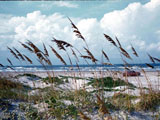
Uniola paniculata (Sea oats) highly salt and drought tolerant.
Sorghastrum secundum (lopsided Indiangrass). The Florida NPSOT lists this grass as highly salt and drought tolerant; however, the Institute for Regional Conservation says it is not highly salt tolerant.
Tripsacum dactyloides (Eastern gamagrass) highly salt tolerant.
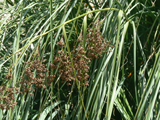
Cladium mariscus ssp. jamaicense (Jamaica swamp sawgrass) highly salt tolerant.
Triplasis purpurea (Purple sandgrass). Here are photos and more information.
Eleocharis montevidensis (Sand spikerush)
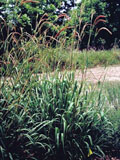
Panicum virgatum (Switchgrass)
Here are photos from our Image Gallery of some of the grasses listed above:

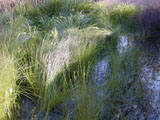
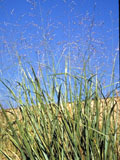
More Erosion Control Questions
Erosion Control in a Mid-Atlantic Shoreline
April 09, 2012 - My family owns a riverfront property off of Machodoc Creek which runs into the Potomac on the Virginia side. The water is roughly 3 feet deep at the shoreline and concrete cylinders are used to contro...
view the full question and answer
Native grass for erosion control on Shoal Creek in Austin, TX
June 22, 2011 - What is the best grass seed for erosion control in Austin, TX - Shoal Creek goes through my back yard and I need to seed some areas and it gets lots of sun.
view the full question and answer
Holding soil on a bank in Goldsboro, NC
July 25, 2010 - I live in Goldsboro, NC on a small ridge with a very steep bank on one side of our property. What native plants can we plant on the bank to help hold the soil. Also, what would be best to plant on t...
view the full question and answer
Plants for curb appeal from Birmingham AL
June 16, 2011 - My front yard is on a down hill slope. Can you recommend some plants that would be good for creating curb appeal that will be planted up against the house? We need some that are short around 2 feet ...
view the full question and answer
Plantings for a slope from New Carrollton MD
June 27, 2012 - My house (Maryland, near DC) sits at the bottom of a south facing slope. The soil is very heavy clay. The grade is about 1:20 for about 100 feet (with a steeper part at the top). Part of the hill is i...
view the full question and answer
| Support the Wildflower Center by Donating Online or Becoming a Member today. |