Native Plants

Q. Who is Mr. Smarty Plants?
A: There are those who suspect Wildflower Center volunteers are the culpable and capable culprits. Yet, others think staff members play some, albeit small, role. You can torture us with your plant questions, but we will never reveal the Green Guru's secret identity.

Did you know you can access the Native Plant Information Network with your web-enabled smartphone?

Ask Mr. Smarty Plants
Ask Mr. Smarty Plants is a free service provided by the staff and volunteers at the Lady Bird Johnson Wildflower Center.

rate this answer

Friday - January 07, 2011
From: Ashford, CT
Region: Northeast
Topic: Trees
Title: Windthrow Resistant Trees for Northeast Connecticut
Answered by: Mike Tomme
QUESTION:
We live in northeast CT, and prefer to plant native trees. Many people here do not want trees around their homes, despite the benefits of shade and shelter they provide, because they are afraid of windthrow damaging their homes. Which native trees are least likely to be vulnerable to being blown over? We have several high water table soils, but most are dry glacial till.ANSWER:
Mr. Smarty Plants worked a crossword puzzle recently where one of the clues read, "Strong as an _ _ _." Let's see, "ox?" Nope, not enough letters. "Acre of garlic?" Nope, too many letters. Wait, I've got it - Quercus.
No type of tree is going to be completely immune to windthrow, but the oaks did not come by their reputation for strength by accident. If any tree is going to stand up to a high wind, my money is on an oak.
Here are nine species of oak pulled from the native plant database which the USDA identifies as native to Windham county in northeast Connecticut:
Quercus bicolor (Swamp white oak)
Quercus coccinea (Scarlet oak)
Quercus rubra (Northern red oak)
Quercus rubra var. ambigua (Northern red oak)
From this list, you can go into the database (click on Plant Database in the upper right hand corner of this page) and look up each plant. You can then make your selection(s) based on your taste and the specific conditions of your site.
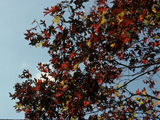
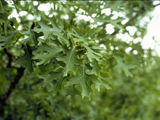
Here are a couple of pictures from the species listed above. These pictures are not intended to recommend these species, they're just pretty.
More Trees Questions
Transplanting a bald cypress from Houston
December 10, 2012 - We would like to transplant a bald cypress from front yard to back. It is about 10 ft tall, 3" trunk diameter, 2-1/2 years old and in good health. Any idea how large the root ball might need to be du...
view the full question and answer
Need help selecting maple cultivars in Houston.
November 25, 2009 - I live in Houston, TX and would like to plant 2 red maples in my front yard. I know there are multiple varieties planted down here, but I can't tell which one would do best. The ones that I've come ...
view the full question and answer
Roots in foundation of home in Audubon NJ
February 17, 2012 - I live in an old house (almost 90 years old), and within the past year I have noticed in one area the concrete basement floor breaking. Today I finally made time to investigate. In these old houses ...
view the full question and answer
Identification of pines on I35 between Dallas and Denton
May 03, 2011 - I frequently drive I-35E from Dallas up to Denton and I've often wondered if the pine trees that I see near the road and in the surrounding areas, especially between Lewisville and Denton, have been ...
view the full question and answer
Identity of wild plum in Childress County, Texas
March 16, 2015 - I have a Wild Plum follow up question. My wife grew up around the Childress TX area. She remembers going around the creeks and gathering Wild Plums for her mother as a child. Would you have any ide...
view the full question and answer
| Support the Wildflower Center by Donating Online or Becoming a Member today. |