Native Plants

Q. Who is Mr. Smarty Plants?
A: There are those who suspect Wildflower Center volunteers are the culpable and capable culprits. Yet, others think staff members play some, albeit small, role. You can torture us with your plant questions, but we will never reveal the Green Guru's secret identity.

Did you know you can access the Native Plant Information Network with your web-enabled smartphone?

Ask Mr. Smarty Plants
Ask Mr. Smarty Plants is a free service provided by the staff and volunteers at the Lady Bird Johnson Wildflower Center.

rate this answer

Thursday - November 11, 2010
From: Homewood, AL
Region: Southeast
Topic: Planting, Pruning
Title: Will suckering of coralberry be a problem in Homewood AL?
Answered by: Barbara Medford
QUESTION:
I am considering planting Symphoricarpos orbiculatus in the yard of the home I just purchased. I am interested in attracting wildlife to my yard and covering over a stump with a 3' diameter. My only concern is its suckering habits. Will surrounding the plants with landscape edging be sufficient to contain them? Thanks!ANSWER:
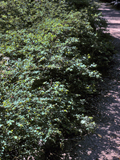
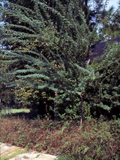
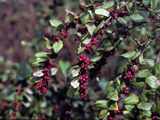
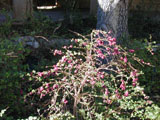
Symphoricarpos orbiculatus (Coralberry) is a native to Alabama. From our Native Plant Database, here is a comment on its suckering properties: "Coralberry forms extensive colonies and spreads by rooting at the nodes where it touches the ground." A landscape barrier of stone, etc. would not communicate anything to the plant, only marking, for you, the spot beyond which you did not want the plant to sucker. As the long, supple branches arch over, they will ignore whatever barrier you have put in and droop to the ground outside it, where they will root.
We would suggest that you use tip pruning to keep those branches from crossing your barrier. We think a barrier would still be a good idea, as it will help you remember where you DON'T want the plant to go. This is not something you can go off and forget about, just pruning once a year or something like that. Once those suckers have rooted in the ground, you have another shrub growing, probably where you don't want it, and you will be fighting with the suckers from the new bush as well as the old.
For the purposes you have stated, attracting wildlife and covering an old stump, we believe this is an ideal plant, but you will have to stay after it, year round. Just about any plant is going to try to reproduce itself, once it has found a good place to grow. The birds that eat the berries and drop the seeds somewhere else, the wind that blows seeds to a different location are other ways you can get more bushes. Our database page says Coralberry makes a good woodland understory plant. If that is not the yard you had in mind, we suggest you select something else.
From the Image Gallery
More Pruning Questions
Pruning non-native peach in Austin, TX.
June 18, 2015 - I planted two five gallon Texas Star peach trees last February but didn't have the nerve to prune them back to knee height. After having been convinced that this is a good thing to do, I'd like to k...
view the full question and answer
Can Monterrey Oak be topped into a bush from Austin TX
June 16, 2013 - I received a suggestion to use Monterey oak as privacy hedge by topping the small tree and letting it bush. I can't find any pictures or info on this being done though.
view the full question and answer
Pruning Pigeonberry
February 06, 2013 - Should pigeonberry be pruned back to the ground this time of year or should a few inches of stem be left? This is my first spring with them in the garden and I've not found any reference material tha...
view the full question and answer
Mimosa shape
November 27, 2007 - I planted a summer chocolate mimosa, and although it has bloomed lovely foliage, it has two main branches growing in a vee shape. Is this normal? Do I need to do anything to spur the growth in a more ...
view the full question and answer
Trimming Texas mountain laurel in Austin
August 27, 2009 - Is there a specific time to trim established mountain laurels? Should I cut off the dried seed pods since they are weighing down the branches?
view the full question and answer
| Support the Wildflower Center by Donating Online or Becoming a Member today. |