Native Plants

Q. Who is Mr. Smarty Plants?
A: There are those who suspect Wildflower Center volunteers are the culpable and capable culprits. Yet, others think staff members play some, albeit small, role. You can torture us with your plant questions, but we will never reveal the Green Guru's secret identity.

Did you know you can access the Native Plant Information Network with your web-enabled smartphone?

Ask Mr. Smarty Plants
Ask Mr. Smarty Plants is a free service provided by the staff and volunteers at the Lady Bird Johnson Wildflower Center.

rate this answer

Thursday - November 04, 2010
From: Lago Vista, TX
Region: Southwest
Topic: Trees
Title: Thuja arborvitae not thriving in Austin
Answered by: Barbara Medford
QUESTION:
I planted 5 giant thuja arborvitae two years ago. They have grown six inches and aren't doing that well. I live in Austin Texas and it was a hot summer. I water them 2x a week, now 1x a week. They are looking brown(dead) on a few limbs or leaves. What is the best fertilizer for them and when and how ofter to apply?ANSWER:
This USDA Plant Profile map for Thuja occidentalis (Arborvitae) shows it growing no nearer to Austin than Tennessee. An article on Thuja occidentalis, also known as White Cedar, by Earl J. S. Rook, described its range as: "Manitoba to the Gaspé, south to Minnesota, Wisconsin, Michigan, upstate New York, and northern New England. Isolated populations farther to the south, especially in the Appalachians."
From our own database page on this tree: "Native Habitat: Swampy areas; lake margins; open, rocky hillsides." Doesn't sound much like Austin, does it?
We realize you probably bought your trees locally, thinking that if they were sold here, they would thrive here; unfortunately, that is not always the case. We urge gardeners to check on any plant's viability in the area where they wish to plant it, before they buy the plant. If the plant is native to North America (which this one is, just not our part of North America) you can find it on our Native Plant Database. You can search for it either on a common name or scientific name. Sometimes plants are sold under trade names which are intended to sell the plant, not give you information about it. However, you can search on the Internet on the trade name and probably find the information you need.
As far as fertilizer is concerned, fertilizing stressed plants, which yours obviously are, can cause more harm than good. The fertilizer will push the plant to put on more foliage when that plant is already exhausted just trying to stay alive in a hostile environment. You will have to decide if you want to continue to expend resources-water, time, fertilizer, etc.-on what may well be a lost cause. Sorry.
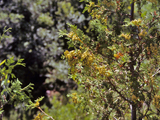
From our Native Plant Image Gallery:
This picture was taken in Cudahy, Wisconsin.
More Trees Questions
Food Allergy to Beautyberry or Persimmon?
October 22, 2015 - I think I might have a food allergy to Beautyberry or American Persimmon, eaten Saturday at the North Carolina Great Dismal park. These were the only strange foods recently, though I've had persimmo...
view the full question and answer
Bignoniaceae Family Members Fix Nitrogen?
January 23, 2016 - Do plants in the Bignoniaceae family, such as Tecoma stans and Chilopsis linearis, fix nitrogen into the soil? I ask because they have a bean-type pod. Just curious.
view the full question and answer
Wild plum tree failing to bloom from Simonton TX
May 04, 2013 - I have a wild plum tree that has been in the ground for 3 or 4 years and it has not ever flowered. Why? I don't know what kind it is. I dug it up from a friends yard. Her wild plum trees have flowere...
view the full question and answer
Tahitian gardenias (Gardenia taitensis) salt and wind resistance in Hawaii
February 03, 2006 - Are Tahitian Gardenias salt tolerant? We live on a rocky coastline in Hawaii and we get a lot of salt spray.
view the full question and answer
Need plants to replace cedars on a 40 degree slope in Boerne, TX.
August 28, 2012 - My backyard is a roughly 40 degree slope that is covered with cedars. The slope is basically all rock, what can I grow here to replace the cedar which drink too much water. I would still like the area...
view the full question and answer
| Support the Wildflower Center by Donating Online or Becoming a Member today. |