Native Plants

Q. Who is Mr. Smarty Plants?
A: There are those who suspect Wildflower Center volunteers are the culpable and capable culprits. Yet, others think staff members play some, albeit small, role. You can torture us with your plant questions, but we will never reveal the Green Guru's secret identity.

Did you know you can access the Native Plant Information Network with your web-enabled smartphone?

Ask Mr. Smarty Plants
Ask Mr. Smarty Plants is a free service provided by the staff and volunteers at the Lady Bird Johnson Wildflower Center.

rate this answer

Monday - August 16, 2010
From: Carrboro, NC
Region: Southeast
Topic: Plant Identification
Title: Plant ID from North Carolina
Answered by: Barbara Medford
QUESTION:
Hi Mr. Smartyplants, I know that you can identify blue cohash in a neat way: 3 stems which easy branch to 3 more stems which each branch into 3 more and then 3 leaves attached to each. Well, do you know of any plants that do something just as simply in a 4-4-4-4 structure?ANSWER:
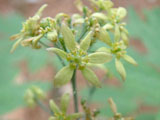
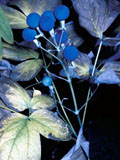
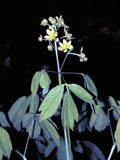
Is this just an academic question, or do you have a plant you are trying to identify? Caulophyllum thalictroides (blue cohosh) is native to North America as well as to North Carolina. If you have seen a plant with the 4-4-4-4 configuration, that would be very exciting. However, we know of no such plant, native or not. So, if you have seen one:
We love identifying native plants for folks! Do you have a picture of a plant found growing in the wild somewhere in North America and you would like to know its name? Send us an email following the instructions below. Please do not send pictures of house plants, office plants, garden plants, plants seen on your vacation to Costa Rica or other clearly non-native species. For identification of non-native plants you might consider visiting the UBC Botanical Gardens Forums website.
- Tell us where and when you found the plant and describe the site where it occurred.
- If possible, take several high-resolution images including details of leaves, stems, flowers, fruit, and the overall plant.
- Save images in JPEG format. Do not reduce the resolution of your images. High-resolution images are much easier for us to work with.
Send email with images attached to [email protected]. Please enter Plant ID Request on the subject line of your email.
From our Native Plant Database:

More Plant Identification Questions
Plant ID at the Wildflower Center from Austin
June 18, 2012 - I was at the Wildflower Center today and loved the green plants with delicate white flowers that were in both clay pots in front of the auditorium. Please let me know the name of the plants.
view the full question and answer
Identity of night-glowing object in tree in New Hampshire
August 02, 2013 - I know this sounds crazy but last night when my husband stepped outside he noticed a purplish glow in one of the trees. At first he thought some kind of animal but when throwing a rock at it it did no...
view the full question and answer
Identification of seedlings
December 20, 2014 - So..last spring I spread out a bag of random Texas wildflower seed I bought at Home Depot. Bautiful things happened. Since that time I've collected seeds while out camping etc and just been chunking ...
view the full question and answer
Seed pod of Proboscidea louisianica (Deveil's claw) in New Mexico
August 30, 2014 - I found the most amazing seed pods of the devil's claw right here in Albuquerque. I thought it was a wood skeleton of a pterodactyl (flying dinosaur, I believe), but heard it's a devil's claw. Ok...
view the full question and answer
Smarty Plants on milkweed
August 20, 2005 - I am looking for a photo of the local milkweed in the state of North Carolina. The name would be a help also. I am raising butterflies and I am in dire need of plants.
view the full question and answer
| Support the Wildflower Center by Donating Online or Becoming a Member today. |