Native Plants

Q. Who is Mr. Smarty Plants?
A: There are those who suspect Wildflower Center volunteers are the culpable and capable culprits. Yet, others think staff members play some, albeit small, role. You can torture us with your plant questions, but we will never reveal the Green Guru's secret identity.

Did you know you can access the Native Plant Information Network with your web-enabled smartphone?

Ask Mr. Smarty Plants
Ask Mr. Smarty Plants is a free service provided by the staff and volunteers at the Lady Bird Johnson Wildflower Center.

rate this answer

Friday - July 30, 2010
From: Allison Park, PA
Region: Mid-Atlantic
Topic: Deer Resistant
Title: Deer-resistant plants for a steep hillside in Allison Park PA
Answered by: Barbara Medford
QUESTION:
What do you recommend for a steep hillside, mostly shade and acidic? The deer have eaten everything except the weeds.ANSWER:
One word: grasses. In the first place, that is probably what you are calling "weeds." In the second place, deer rarely touch grasses. You really answered your own question without knowing it. You might like to look at our list of Deer-Resistant Plants for help with plants besides grasses. All of the 8 grasses and grass-like plants we have selected are tolerant of acidic soils and shade to part shade conditions. We would suggest you also contact the Penn State Cooperative Extension Office for Allegheny County. They may have a list of grasses for your purpose better than ours because they are working from experience.
We recommend grasses for controlling erosion because of their extensive fibrous root systems that serve to hold the soil in place. However, seeding grass is not the whole process. The seeds need moisture to germinate. If the moisture comes in the form of rain, it is likely to wash the seeds down the bank before they have a chance to germinate and take root. An erosion control blanket in which the erosion-control fabric works by slowing the runoff water allows sediments to fall out rather than be washed away. Seeds are sown under the erosion-control material and grow up through the matting when they germinate. You can also insert plants into the soil by cutting through the matting. The roots of the plants that are growing through the erosion-control material anchor the soil to stop the erosion. If you use erosion-control blankets made of biodegrable material, they will eventually disappear leaving the plants to control the problem. Many nurseries carry this erosion control fabric, and can give you help in how to install it.
We will go to our Native Plant Database and search for grasses native to your area in and around Allegheny County, PA, USDA Hardiness Zone 6a. We will stipulate in our search "part shade" (2 to 6 hours of sun a day) and "shade" (less than 2 hours of sun). Follow each link to the page on that plant in our Native Plant Database to learn its expected size, sun needs, propagation, growing conditions and soil types.
Grasses for hillside in Allegheny County PA:
Andropogon gerardii (big bluestem)
Carex blanda (eastern woodland sedge)
Calamagrostis canadensis (bluejoint)
Chasmanthium latifolium (Inland sea oats)
Elymus canadensis (Canada wildrye)
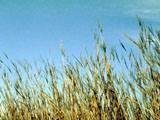
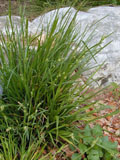
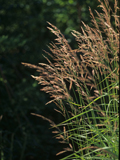
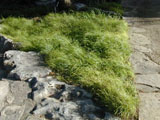
From the Image Gallery
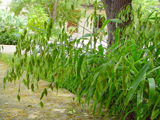
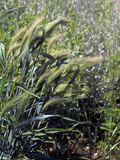
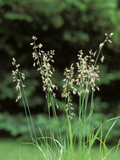
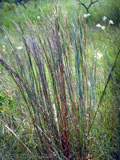
More Deer Resistant Questions
Deer-resistant groundcover for sunny hillside in California
November 17, 2009 - we are looking for a deer resistant, drought resistant ground cover that we can grow from seed. we have a large,partial sunny hillside, well drained,that is cover with oak leaves and pine needles..and...
view the full question and answer
Overwintering possumhaw seedlings indoors in Pflugerville, TX.
September 30, 2009 - Can possumhaw (Ilex decidua) seedlings be kept indoors over the winter? The goal is to protect them from deer and there is no other good option (i.e., no protected outdoor porch, etc.), unless you ca...
view the full question and answer
Height of plastic tree guards to protect against deer
August 27, 2008 - How high do the plastic tree guards used to prevent deer rubbing need to be? I live in northeastern Pa.
view the full question and answer
Deer-resistant trees for privacy in Texas
January 09, 2015 - I need to find a deer resistant tall shrub or tree to plant and hide the deer fence my neighbor just put up on our property line. My property has full sun in parts and mostly shady in other parts and ...
view the full question and answer
Determining best time to harvest deer grass seeds in California
September 06, 2006 - When is the best time to harvest deer grass seeds at about 4,000 feet in southern Riverside County California??
view the full question and answer
| Support the Wildflower Center by Donating Online or Becoming a Member today. |